
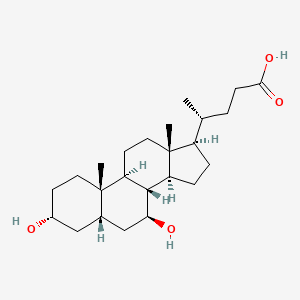
Ursodeoxycholic Acid
Ursodeoxycholic acid is a bile acid found in the bile of bears (Ursidae) as a conjugate with taurine. Used therapeutically, it prevents the synthesis and absorption of cholesterol and can lead to the dissolution of gallstones. It has a role as a mouse metabolite and a human metabolite. It is a C24-steroid, a dihydroxy-5beta-cholanic acid and a bile acid. It is a conjugate acid of an ursodeoxycholate. — ChEBI
- IUPAC name
- (4R)-4-[(3R,5S,7S,8R,9S,10S,13R,14S,17R)-3,7-dihydroxy-10,13-dimethyl-2,3,4,5,6,7,8,9,11,12,14,15,16,17-tetradecahydro-1H-cyclopenta[a]phenanthren-17-yl]pentanoic acid
- Molecular formula
- C24H40O4
- Molecular weight
- 392.6 g/mol
- Exact mass
- 392.29265975 Da
- XLogP3
- 4.9
- Topological polar surface area
- 77.8 Ų
- Hydrogen-bond donors
- 3
- Hydrogen-bond acceptors
- 4
- Covalent units
- 1
- Defined stereocentres
- 10
Also known as
16 more reported names
External database identifiers
- ChEBI:CHEBI:9907
- ChEMBL:CHEMBL1551
- EPA DTXSID:DTXSID6023731
- PubMed:38244730
- PubMed:38104874
- PubMed:37968239
- PubMed:36473578
- PubMed:36470304
- PubMed:34461081
- PubMed:34155936
- PubMed:34079822
- PubMed:33568795
- PubMed:32679164
- PubMed:32198087
- PubMed:31299240
Evidence from additional scientific databases
NIH PubChem PUG-View
Attributed physical-property, hazard, environmental and use annotations.
- LogP: 3 Source: DrugBank
- LogP: 3.00 Source: Human Metabolome Database (HMDB)
- Melting Point: 200-205 Source: DrugBank
- Melting Point: 203 °C Source: Human Metabolome Database (HMDB)
- Physical Description: Solid Source: Human Metabolome Database (HMDB)
- Solubility: 0.02 mg/mL Source: Human Metabolome Database (HMDB)
- Note: This chemical does not meet GHS hazard criteria for 4.5% (2 of 44) of reports. Source: European Chemicals Agency (ECHA)
- Signal: Warning Source: European Chemicals Agency (ECHA)
- GHS Hazard Statements: H315 (95.5%): Causes skin irritation [Warning Skin corrosion/irritation]; H319 (95.5%): Causes serious eye irritation [Warning Serious eye damage/eye irritation] Source: European Chemicals Agency (ECHA)
- Precautionary Statement Codes: P264, P264+P265, P280, P302+P352, P305+P351+P338, P321, P332+P317, P337+P317, and P362+P364 (click each P-code to see the statement) Source: European Chemicals Agency (ECHA)
- ECHA C&L Notifications Summary: Aggregated GHS information provided per 44 reports by companies from 4 notifications to the ECHA C&L Inventory. Each notification may be associated with multiple companies.; Reported as not meeting GHS hazard criteria per 2 of 44 reports by companies.; There are 3 notifications provided by 42 of 44 reports by companies with hazard statement code(s).; Information may vary between notifications depending on impurities, additives, and other factors. The percentage value in parenthesis indicates the notified classification ratio from companies that provide hazard codes. Only hazard codes with percentage values above 10% are shown. For more detailed information, please visit ECHA C&L website. Source: European Chemicals Agency (ECHA)
- Toxicity Summary: UDCA has been shown to have potentially toxic molecular properties. UDCA breaks down into toxic lithocholic acid. After being absorbed in the small intestine, UDCA undergoes hepatic conjugation. Beyond conjugation, UDCA does not experience further breakdown by the liver or intestinal mucosa. It becomes oxidized or reduced, yielding either 7-keto-lithocholic acid or lithocholic acid. Litcholic acid can be toxic to liver cells and even cause liver failure in those with compromised sulfation. It also leads to segmental bile duct injury, hepatocyte failure, and death. Source: StatPearls
- Uses: Use (kg; approx.) in Germany (2009): >10000; Use (kg) in USA (2002): 6870; Consumption (g per capita; approx.) in Germany (2009): 0.122; Consumption (g per capita) in the USA (2002): 0.0244; Excretion rate: 1; Calculated removal (%): 73.4 Source: NORMAN Suspect List Exchange
Mapped by: Existing checksum-valid CAS to unique PubChem CID match. Retrieved: 2026-08-31. Open source record
Scientific classifications and hazard annotations provide context and do not replace the market-specific regulatory decision shown above.
Additional source coverage and match status
| Source | Result | Checked |
|---|---|---|
| NIH PubChem PUG-View | Exact match | 2026-08-31 |
A recorded no-match is useful evidence that the source was checked; it is not a claim that the substance does not exist elsewhere.
Retrieved from NIH PubChem on 2026-08-31 by checksum-valid CAS matching. Chemical properties do not replace the regulatory decision on this page.