
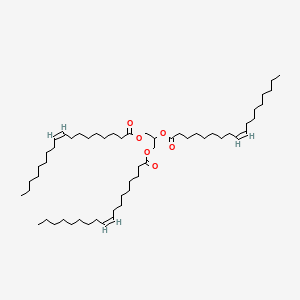
Triolein
Triolein is a triglyceride formed by esterification of the three hydroxy groups of glycerol with oleic acid. Triolein is one of the two components of Lorenzo's oil. It has a role as a plant metabolite and a Caenorhabditis elegans metabolite. It is functionally related to an oleic acid. — ChEBI
- IUPAC name
- 2,3-bis[[(Z)-octadec-9-enoyl]oxy]propyl (Z)-octadec-9-enoate
- Molecular formula
- C57H104O6
- Molecular weight
- 885.4 g/mol
- Exact mass
- 884.78329103 Da
- XLogP3
- 22.4
- Topological polar surface area
- 78.9 Ų
- Hydrogen-bond donors
- 0
- Hydrogen-bond acceptors
- 6
- Covalent units
- 1
- Defined stereocentres
- 0
Also known as
16 more reported names
External database identifiers
- ChEBI:CHEBI:53753
- ChEMBL:CHEMBL4297656
- EPA DTXSID:DTXSID3026988
- PubMed:29968805
- PubMed:15550674
Evidence from additional scientific databases
NIH PubChem PUG-View
Attributed physical-property, hazard, environmental and use annotations.
- Boiling Point: 237 °C at 18 atm Source: Hazardous Substances Data Bank (HSDB)
- Boiling Point: Boiling Point at 760 mm Hg = 554 °C /Estimated via extrapolation/ Source: Hazardous Substances Data Bank (HSDB)
- Color/Form: Colorless to yellowish, oily liquid Source: Hazardous Substances Data Bank (HSDB)
- Color/Form: POLYMORPHIC Source: Hazardous Substances Data Bank (HSDB)
- Density: 0.915 at 15 °C/4 °C Source: Hazardous Substances Data Bank (HSDB)
- Melting Point: -4 °C Source: Hazardous Substances Data Bank (HSDB)
- Melting Point: -32 °C Source: Human Metabolome Database (HMDB)
- Odor: Odorless Source: Hazardous Substances Data Bank (HSDB)
- Physical Description: Liquid Source: EPA Chemical Data Reporting (CDR)
- Physical Description: Colorless to yellowish odorless liquid; [Merck Index] Clear colorless liquid; [MSDSonline] Source: Haz-Map, Information on Hazardous Chemicals and Occupational Diseases
- Physical Description: Liquid Source: Human Metabolome Database (HMDB)
- Refractive Index: Index of refraction: 1.4676 at 20 °C/D; 1.4561 at 60 °C/D Source: Hazardous Substances Data Bank (HSDB)
- Solubility: Insoluble in water Source: Hazardous Substances Data Bank (HSDB)
- Solubility: Soluble in chloroform, ether, carbon tetrachloride and slightly soluble in alcohol. Source: Hazardous Substances Data Bank (HSDB)
- Vapor Pressure: VP: 18 mm Hg at 237 °C Source: Hazardous Substances Data Bank (HSDB)
- Note: This chemical does not meet GHS hazard criteria for 100% (291 of 291) of all reports. Source: European Chemicals Agency (ECHA)
- GHS Hazard Statements: Not Classified; Reported as not meeting GHS hazard criteria by 291 of 291 companies. For more detailed information, please visit ECHA C&L website. Source: European Chemicals Agency (ECHA)
- ECHA C&L Notifications Summary: Aggregated GHS information provided per 291 reports by companies from 1 notifications to the ECHA C&L Inventory.; Reported as not meeting GHS hazard criteria per 291 of 291 reports by companies.; There are 0 notifications provided by 0 of 291 reports by companies with hazard statement code(s).; Information may vary between notifications depending on impurities, additives, and other factors. The percentage value in parenthesis indicates the notified classification ratio from companies that provide hazard codes. Only hazard codes with percentage values above 10% are shown. For more detailed information, please visit ECHA C&L website. Source: European Chemicals Agency (ECHA)
- Cosmetic Ingredient Review Finding(s): Safe in the present practices of use and concentration. Ingredient, concentration, and use information are available in documents discoverable at https://cir-reports.cir-safety.org Source: Cosmetic Ingredient Review (CIR)
- Environmental Bioconcentration: An estimated BCF of 3 was calculated in fish for triolein(SRC), using an estimated log Kow of 23.3(1) and a regression-derived equation(1). According to a classification scheme(2), this BCF suggests the potential for bioconcentration in aquatic organisms is low(SRC). Source: Hazardous Substances Data Bank (HSDB)
- Environmental Fate: TERRESTRIAL FATE: Based on a classification scheme(1), an estimated Koc value of 1X10+10(SRC), determined from a structure estimation method(2), indicates that triolein is expected to be immobile in soil(SRC). Volatilization of triolein from moist soil surfaces may be an important fate process(SRC) given an estimated Henry's Law constant of 9.6X10⁻⁴ atm-cu m/mole(SRC), using a fragment constant estimation method(2). However, volatilization from soil is expected to be attenuated by adsorption. Triolein is not expected to volatilize from dry soil surfaces(SRC) based upon an estimated vapor pressure range of 5X10⁻⁵ mm Hg(3) to 1.1X10⁻⁹ mm Hg(SRC), determined from a fragment constant method(2). 14C-Labeled triolein biodegraded to CO2 at a rate of 63.5% to 84% over 140 days in a sewage sludge amended soil(4), suggesting that biodegradation may occur in the soil environment(SRC). Source: Hazardous Substances Data Bank (HSDB)
- Environmental Fate: AQUATIC FATE: Based on a classification scheme(1), an estimated Koc value of 1X10+10(SRC), determined from a structure estimation method(2), indicates that triolein is expected to adsorb to suspended solids and sediment(SRC). Volatilization from water surfaces is expected(3) based upon an estimated Henry's Law constant of 9.6X10⁻⁴ atm-cu m/mole(SRC), developed using a fragment constant estimation method(4). Using this Henry's Law constant and an estimation method(3), volatilization half-lives for a model river and model lake are 11 hours and 13 days, respectively(SRC). However, volatilization from water surfaces is expected to be attenuated by adsorption to suspended solids and sediment in the water column. The estimated volatilization half-life from a model pond is 5.1X10+5 years(SRC) if adsorption is considered(4). A base-catalyzed second-order hydrolysis rate constant of 0.15 L/mole-sec(SRC) was estimated using a structure estimation method(5); this corresponds to half-lives of 1.5 years and 55 days at pH values of 7 and 8, respectively(5). According to a classification scheme(6),an estimated BCF of 3.2(SRC), from an estimated log Kow of 23(2) and a regression-derived equation(2 Source: Hazardous Substances Data Bank (HSDB)
- Environmental Fate: ATMOSPHERIC FATE: Triolein, which is liquid at room temperatures, has vapor pressure estimates that vary by several orders of magnitude at 25 °C(SRC); a vapor pressure of 1.1X10⁻⁹ mm Hg can be estimated(SRC) from a fragment constant method(1) while a vapor pressure of 5X10⁻⁵ mm Hg at 25 °C(2) can be determined from limited measured data and estimates at much higher temperatures and extrapolation(SRC). According to a model of gas/particle partitioning of semivolatile organic compounds in the atmosphere(3), triolein may exist in both the vapor and particulate phases in the ambient atmosphere. Vapor-phase triolein is degraded in the atmosphere by reaction with photochemically-produced hydroxyl radicals(SRC); the half-life for this reaction in air is estimated to be 1.7 hours(SRC), calculated from its rate constant of 2.32X10⁻¹⁰ cu cm/molecule-sec at 25 °C(SRC) that was derived using a structure estimation method(1). Vapor-phase triolein is also degraded in the atmosphere by reaction with ozone(SRC); the half-life for this reaction in air is estimated to be 0.7 hours(SRC), calculated from its rate constant of 3.9X10⁻¹⁶ cu cm/molecule-sec at 25 °C(SRC) that was derived using a structure Source: Hazardous Substances Data Bank (HSDB)
- Consumer Uses: Lubricating agent Source: EPA Chemical Data Reporting (CDR)
- Industry Uses: Lubricating agent Source: EPA Chemical Data Reporting (CDR)
- Cosmetic Ingredient Review Link: CIR ingredient: Triolein Source: Cosmetic Ingredient Review (CIR)
- Sources/Uses: A major component of oils and fats, e.g., olive oil; [Merck Index] Used as lubricant (e.g. for cosmetics, drugs, and textiles), emulsifier (e.g. for water/oil mixtures), intermediate for radioactive iodine derivatives, and plasticizer; Used in sweet almond oil for medicines and cosmetics; [HSDB] Source: Haz-Map, Information on Hazardous Chemicals and Occupational Diseases
- Industrial Processes with risk of exposure: Textiles (Fiber & Fabric Manufacturing) [Category: Industry] Source: Haz-Map, Information on Hazardous Chemicals and Occupational Diseases
- Uses: Textile lubricants Source: Hazardous Substances Data Bank (HSDB)
- Uses: Lubricant, eg, for cosmetics, drugs Source: Hazardous Substances Data Bank (HSDB)
- Uses: Emulsifier, eg, for water/oil mixtures Source: Hazardous Substances Data Bank (HSDB)
- Uses: Chemical intermediate for radioactive iodine derivatives Source: Hazardous Substances Data Bank (HSDB)
- Uses: For more Uses (Complete) data for TRIOLEIN (10 total), please visit the HSDB record page. Source: Hazardous Substances Data Bank (HSDB)
Mapped by: Existing checksum-valid CAS to unique PubChem CID match. Retrieved: 2026-08-31. Open source record
Scientific classifications and hazard annotations provide context and do not replace the market-specific regulatory decision shown above.
Additional source coverage and match status
| Source | Result | Checked |
|---|---|---|
| NIH PubChem PUG-View | Exact match | 2026-08-31 |
A recorded no-match is useful evidence that the source was checked; it is not a claim that the substance does not exist elsewhere.
Retrieved from NIH PubChem on 2026-08-31 by checksum-valid CAS matching. Chemical properties do not replace the regulatory decision on this page.