
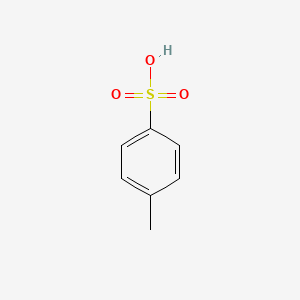
p-Toluenesulfonic acid
Toluene-4-sulfonic acid is an arenesulfonic acid that is benzenesulfonic acid in which the hydrogen at position 4 is replaced by a methyl group. It is a member of toluenes and an arenesulfonic acid. It is a conjugate acid of a toluene-4-sulfonate. — ChEBI
- IUPAC name
- 4-methylbenzenesulfonic acid
- Molecular formula
- C7H8O3S
- Molecular weight
- 172.20 g/mol
- Exact mass
- 172.01941529 Da
- XLogP3
- 1.7
- Topological polar surface area
- 62.8 Ų
- Hydrogen-bond donors
- 1
- Hydrogen-bond acceptors
- 3
- Covalent units
- 1
- Defined stereocentres
- 0
Also known as
16 more reported names
External database identifiers
- ChEBI:CHEBI:27849
- ChEMBL:CHEMBL541253
- EPA DTXSID:DTXSID0026701
- PubMed:23125819
- PubMed:23007546
- PubMed:22966690
- PubMed:22961309
- PubMed:22926535
- PubMed:22925760
- PubMed:22878001
- PubMed:22840030
- PubMed:22822714
- PubMed:22818945
- PubMed:22808747
- PubMed:22798860
Evidence from additional scientific databases
EMBL-EBI ChEBI
toluene-4-sulfonic acid
An arenesulfonic acid that is benzenesulfonic acid in which the hydrogen at position 4 is replaced by a methyl group.
- Formula
- C7H8O3S
- Average mass
- 172.205 g/mol
- Monoisotopic mass
- 172.01942 Da
- Formal charge
- 0
- toluenes — is a (CHEBI:27024)
- arenesulfonic acid — is a (CHEBI:33555)
- toluenes — is a (CHEBI:27024)
- arenesulfonic acid — is a (CHEBI:33555)
- toluene-4-sulfonate — is conjugate acid of (CHEBI:27023)
Additional curated names
Cross-references from this source
Mapped by: Exact CAS cross-reference in the ChEBI compound record. Source updated: 2015-02-12. Retrieved: 2026-08-31. Open source record
NIH PubChem PUG-View
Attributed physical-property, hazard, environmental and use annotations.
- Boiling Point: 140 °C @ 20 MM HG Source: Hazardous Substances Data Bank (HSDB)
- Boiling Point: Boiling point = 38 °C Source: Hazardous Substances Data Bank (HSDB)
- Color/Form: MONOCLINIC LEAFLETS OR PRISMS Source: Hazardous Substances Data Bank (HSDB)
- Density: 1.45 at 77 °F (USCG, 1999) - Denser than water; will sink Source: CAMEO Chemicals
- Density: Relative density (water = 1): 1.24 Source: ILO-WHO International Chemical Safety Cards (ICSCs)
- Dissociation Constants: -1.34 Source: Hazardous Substances Data Bank (HSDB)
- Flash Point: 363 °F (184 °C) (CLOSED CUP) Source: Hazardous Substances Data Bank (HSDB)
- Flash Point: 184 °C c.c. Source: ILO-WHO International Chemical Safety Cards (ICSCs)
- LogP: 0.9 (calculated) Source: ILO-WHO International Chemical Safety Cards (ICSCs)
- Melting Point: 221 °F (USCG, 1999) Source: CAMEO Chemicals
- Melting Point: 106-107 °C Source: Haz-Map, Information on Hazardous Chemicals and Occupational Diseases
- Melting Point: 106-107 °C /ANHYDROUS/ Source: Hazardous Substances Data Bank (HSDB)
- Melting Point: MELTING POINT: 38 °C /METASTABLE FORM/ Source: Hazardous Substances Data Bank (HSDB)
- Melting Point: Melting point = 106 °C /monohydrate/; 93 °C /trihydrate/ Source: Hazardous Substances Data Bank (HSDB)
- Melting Point: 104.50 °C. @ 760.00 mm Hg Source: Human Metabolome Database (HMDB)
- Melting Point: 106-107 °C Source: ILO-WHO International Chemical Safety Cards (ICSCs)
- Physical Description: Toluene sulfonic acid, liquid, with more than 5% free sulfuric acid appears as colorless to black solid. Odorless or nearly odorless. (USCG, 1999) Source: CAMEO Chemicals
- Physical Description: Liquid; Dry Powder; Liquid; Dry Powder; CBI; Large Crystals Source: EPA Chemical Data Reporting (CDR)
- Physical Description: Colorless hygroscopic solid; [ICSC] Colorless to black solid with no or little odor; [CHRIS] Off-white crystals; [Integra MSDS] Source: Haz-Map, Information on Hazardous Chemicals and Occupational Diseases
- Physical Description: COLOURLESS HYGROSCOPIC FLAKES. Source: ILO-WHO International Chemical Safety Cards (ICSCs)
- Solubility: ABOUT 67 G/100 ML WATER; SOL IN ALCOHOL, ETHER Source: Hazardous Substances Data Bank (HSDB)
- Solubility: VERY SOL IN WATER /SODIUM SALT/ Source: Hazardous Substances Data Bank (HSDB)
- Solubility: Solubility in water, g/100ml at 25 °C: 67 (freely soluble) Source: ILO-WHO International Chemical Safety Cards (ICSCs)
- Vapor Pressure: 0.0000027 [mmHg] Source: Haz-Map, Information on Hazardous Chemicals and Occupational Diseases
- Exposure Routes: Serious local effects by all routes of exposure. Source: ILO-WHO International Chemical Safety Cards (ICSCs)
- First Aid: EYES: wash thoroughly with copious amounts of water for at least 15 min.; call physician if irritation persists.; SKIN: wash thoroughly with large amounts of water for at least 15 min.; INGESTION: give large amount of water. (USCG, 1999) Source: CAMEO Chemicals
- Signal: Warning Source: Regulation (EC) No 1272/2008 of the European Parliament and of the Council
- GHS Hazard Statements: H315: Causes skin irritation [Warning Skin corrosion/irritation]; H319: Causes serious eye irritation [Warning Serious eye damage/eye irritation]; H335: May cause respiratory irritation [Warning Specific target organ toxicity, single exposure; Respiratory tract irritation] Source: Regulation (EC) No 1272/2008 of the European Parliament and of the Council
- Precautionary Statement Codes: P261, P264, P264+P265, P271, P280, P302+P352, P304+P340, P305+P351+P338, P319, P321, P332+P317, P337+P317, P362+P364, P403+P233, P405, and P501 (click each P-code to see the statement) Source: Regulation (EC) No 1272/2008 of the European Parliament and of the Council
- Signal: Danger Source: European Chemicals Agency (ECHA)
- GHS Hazard Statements: H314 (42.3%): Causes severe skin burns and eye damage [Danger Skin corrosion/irritation]; H315 (62.1%): Causes skin irritation [Warning Skin corrosion/irritation]; H318 (37%): Causes serious eye damage [Danger Serious eye damage/eye irritation]; H319 (62.1%): Causes serious eye irritation [Warning Serious eye damage/eye irritation]; H335 (87%): May cause respiratory irritation [Warning Specific target organ toxicity, single exposure; Respiratory tract irritation] Source: European Chemicals Agency (ECHA)
- Precautionary Statement Codes: P260, P261, P264, P264+P265, P271, P280, P301+P330+P331, P302+P352, P302+P361+P354, P304+P340, P305+P351+P338, P305+P354+P338, P316, P317, P319, P321, P332+P317, P337+P317, P362+P364, P363, P403+P233, P405, and P501 (click each P-code to see the statement) Source: European Chemicals Agency (ECHA)
- ECHA C&L Notifications Summary: Aggregated GHS information provided per 1895 reports by companies from 57 notifications to the ECHA C&L Inventory. Each notification may be associated with multiple companies.; Information may vary between notifications depending on impurities, additives, and other factors. The percentage value in parenthesis indicates the notified classification ratio from companies that provide hazard codes. Only hazard codes with percentage values above 10% are shown. For more detailed information, please visit ECHA C&L website. Source: European Chemicals Agency (ECHA)
- Signal: Danger Source: NITE-CMC
- GHS Hazard Statements: H302: Harmful if swallowed [Warning Acute toxicity, oral]; H314: Causes severe skin burns and eye damage [Danger Skin corrosion/irritation]; H318: Causes serious eye damage [Danger Serious eye damage/eye irritation]; H371: May cause damage to organs [Warning Specific target organ toxicity, single exposure] Source: NITE-CMC
- Precautionary Statement Codes: P260, P264, P264+P265, P270, P280, P301+P317, P301+P330+P331, P302+P361+P354, P304+P340, P305+P354+P338, P308+P316, P316, P317, P321, P330, P363, P405, and P501 (click each P-code to see the statement) Source: NITE-CMC
- Signal: Warning Source: Hazardous Chemical Information System (HCIS), Safe Work Australia
- GHS Hazard Statements: H315: Causes skin irritation [Warning Skin corrosion/irritation]; H319: Causes serious eye irritation [Warning Serious eye damage/eye irritation]; H335: May cause respiratory irritation [Warning Specific target organ toxicity, single exposure; Respiratory tract irritation] Source: Hazardous Chemical Information System (HCIS), Safe Work Australia
- NFPA Health Rating: 3 - Materials that, under emergency conditions, can cause serious or permanent injury. Source: Hazardous Substances Data Bank (HSDB)
- NFPA Fire Rating: 1 - Materials that must be preheated before ignition can occur. Materials require considerable preheating, under all ambient temperature conditions, before ignition and combustion can occur. Source: Hazardous Substances Data Bank (HSDB)
- NFPA Instability Rating: 1 - Materials that in themselves are normally stable but that can become unstable at elevated temperatures and pressures. Source: Hazardous Substances Data Bank (HSDB)
- Cosmetic Ingredient Review Conclusion: Toluene Sulfonic Acid...safe as cosmetic ingredient in the present practice of use and concentration as described in this safety assessment, when formulated to be nonirritating Source: Cosmetic Ingredient Review (CIR)
- Cosmetic Ingredient Review Finding(s): Safe for use in cosmetics, with qualifications Source: Cosmetic Ingredient Review (CIR)
- Environmental Bioconcentration: Using an estimated log Kow of -0.62(1), one would estimate a BCF of 0.2 for p- toluenesulfonic acid using a recommended regression equation(2). This would indicate that p-toluenesulfonic acid would not bioconcentrate in aquatic organisms(SRC). Source: Hazardous Substances Data Bank (HSDB)
- Environmental Fate: TERRESTRIAL FATE: p-Toluenesulfonic acid is a strong acid (pKa = -1.34(1)) and is completely dissociated and highly soluble (about 620 g/L(2)) in water. It would be expected to leach fairly rapidly. Its biodegradation in soil is unknown(SRC). Source: Hazardous Substances Data Bank (HSDB)
- Environmental Fate: AQUATIC FATE: Once released into the aquatic compartment, p- toluenesulfonic acid will not be transported into the sediment or volatilize to the atmosphere. Based on the results of biodegradation screening studies(1-8), it may slowly biodegrade if acclimated microbial populations are present. p- Toluenesulfonic acid would not be expected to bioconcentrate in aquatic organisms(SRC). Source: Hazardous Substances Data Bank (HSDB)
- Environmental Fate: ATMOSPHERIC FATE: Based on its estimated vapor pressure, 2.7X10⁻⁶ mm Hg at 25 °C(2), p-toluenesulfonic acid should exist in the atmosphere both as an aerosol and as a vapor(4). Vapor-phase p- toluenesulfonic acid will react with photochemically-produced hydroxyl radicals resulting in an estimated half-life of 11.8 days (3,SRC). p-Toluenesulfonic acid is highly soluble in water, 620,000 mg/L(1), and therefore should be scavenged by rain(SRC). Source: Hazardous Substances Data Bank (HSDB)
- Consumer Uses: Surfactant (surface active agent); Solvent; Catalyst Source: EPA Chemical Data Reporting (CDR)
- Industry Uses: Catalyst; Intermediate; Solvent; Other; Monomers; Surfactant (surface active agent) Source: EPA Chemical Data Reporting (CDR)
- Cosmetic Ingredient Review Link: CIR ingredient: Toluene Sulfonic Acid Source: Cosmetic Ingredient Review (CIR)
- Sources/Uses: Used in the chemical industry as a catalyst; also used in the manufacturing of textile dyes, drugs, cleaning agents, polymers, and paints; [HSDB] Used in photography (color bleaching); [www.ci.tucson.az.us/arthazards/medium.html] Used as a catalyst (with applications including resins in foundry cores), as a curing agent for resins, as a descaling agent (industrial metal cleaners), in electroplating bathes, plastics, dyes, pharmaceutical intermediates, food packaging adhesives, and as a coupling and wetting agent; [EPA ChAMP] Source: Haz-Map, Information on Hazardous Chemicals and Occupational Diseases
- Industrial Processes with risk of exposure: Acid and Alkali Cleaning of Metals [Category: Clean]; Molding and Core Making [Category: Foundry]; Electroplating [Category: Plate]; Working with Glues and Adhesives [Category: Other]; Plastic Composites Manufacturing [Category: Industry]; Photographic Processing [Category: Other] Source: Haz-Map, Information on Hazardous Chemicals and Occupational Diseases
- Uses: /USED AS REAGENT IN/ KIRSTEN MODIFICATION OF KLEBER METHOD (FOR LEMON OIL). Source: Hazardous Substances Data Bank (HSDB)
- Uses: Manufacture of 4-formylbenzenesulfonic acid, p-sulfobenzoic acid, 2-chlorotoluene-4-sulfonic acid, and 4-(chloromethyl)phenylmethanesulfonic acid Source: Hazardous Substances Data Bank (HSDB)
- Uses: Effect solubility of disperse dyes, initiator for catalytic polymerization of caprolactam, catalyst for dimerization of alpha- methylstyrene. Source: Hazardous Substances Data Bank (HSDB)
- Uses: Manufacture of dyes and oral antidiabetic drugs; conversion to sodium and ammonium salts for manufacture of hydrotropes. Source: Hazardous Substances Data Bank (HSDB)
- Uses: Catalyst in coatings, paint, polymer, and textile industries. Stabilizer for monomers and polymers, pharmaceutical intermediate, cleaning agents, plating additive. Source: Hazardous Substances Data Bank (HSDB)
Mapped by: Existing checksum-valid CAS to unique PubChem CID match. Retrieved: 2026-08-31. Open source record
Scientific classifications and hazard annotations provide context and do not replace the market-specific regulatory decision shown above.
Additional source coverage and match status
| Source | Result | Checked |
|---|---|---|
| EMBL-EBI ChEBI | Exact match | 2026-08-31 |
| NIH PubChem PUG-View | Exact match | 2026-08-31 |
A recorded no-match is useful evidence that the source was checked; it is not a claim that the substance does not exist elsewhere.
Retrieved from NIH PubChem on 2026-08-31 by checksum-valid CAS matching. Chemical properties do not replace the regulatory decision on this page.