
Official EU label nameGlossary entry 28748
THIMEROSAL
This record confirms an official common ingredient name for EU cosmetic product labelling. It does not by itself confirm that the substance is permitted, unrestricted or safe.
Global evidence snapshot
The resolved identity has matching regulatory evidence in 4 of 13 indexed market datasets: 4 country records and 1 EU Annex records. Every result and evidence gap is listed below.
Markets checked
13
Markets with evidence
4
Evidence gaps
9
Resolved identifiers
8
Resolved substance identity
CAS:54-64-87439-97-621908-53-262-38-494-43-9102-98-76273-99-0
EC:200-210-4
Ingredient index records:
THIMEROSAL
Cosmetic functions: PRESERVATIVE
Mercurate(1-), ethyl[2-mercaptobenzoato(2-)-O, S]-, sodium
Inventory restriction note: V/16
5 matched or reported names
THIMEROSALthiomersalThiomersalThimerosalMercury and its compounds
Regulatory evidence in all 13 markets
Open each matched record for its scope, concentration, conditions, warnings and official source version.
Swipe or scroll horizontally to see dataset coverage and next actions.
| Market | Result | Records | Dataset | Meaning / next action |
|---|---|---|---|---|
| European Union EU | Conditional positive-list match | 1Open record 1 | Complete annex dataset Regulation (EC) 1223/2009 consolidated to 1 May 2026 | Review every linked record and exact conditions. |
| Great Britain GB | Permitted list with conditions | 1Open record 1 | Complete consolidated annex dataset GB retained Regulation 1223/2009 schedules, effective 15 August 2026 | Review every linked record and exact conditions. |
| Canada CA | Prohibited | 2Open record 1Open record 2 | Complete Hotlist snapshot Health Canada Cosmetic Ingredient Hotlist, 13 August 2025 | Review every linked record and exact conditions. |
| New Zealand NZ | Permitted list with conditions | 1Open record 1 | Complete schedules dataset Cosmetic Products Group Standard schedules effective 1 January 2026 | Review every linked record and exact conditions. |
| ASEAN ASEAN | No local match | 0 | Complete regional annex dataset ASEAN Cosmetic Directive annexes 2026-1, 22 June 2026 | Regional annex coverage does not replace member-state implementation dates, notifications or national deviations. |
| China CN | No local match | 0 | Complete prohibited catalogues plus official-source workflow NMPA 2021 banned catalogues plus dynamic IECIC List I/List II system current since 2025 | IECIC listing is not blanket approval; absence may require the new cosmetic ingredient route, and restrictions are checked separately. |
| Japan JP | No local match | 0 | Complete Standards appendices dataset MHLW Standards for Cosmetics official English source and Japanese amendments checked for the imported snapshot | The Japanese text and subsequent notices are canonical; no local match is not a product-compliance conclusion. |
| South Korea KR | No local match | 0 | Complete current appendix dataset MFDS Notice 2026-19, effective 18 March 2026 | Korean source wording is canonical and other positive lists/notices may still apply to the formulation. |
| United States US | No local match | 0 | Complete enumerated federal ingredient rules eCFR Title 21 issue date 27 August 2026 | FDA has no general approved-cosmetic-ingredient catalogue; absence from these sections is not approval or proof of safety. |
| Australia AU | No local match | 0 | Complete cosmetic-relevant Poisons Standard subset plus official workflow Therapeutic Goods (Poisons Standard—June 2026) Instrument 2026 | An AICIS Inventory match is not cosmetic approval; no Inventory match can indicate a new, exempted, reported or confidential introduction. |
| Brazil BR | No local match | 0 | Complete prohibited dataset plus current restricted-list workflow ANVISA RDC 1.029/2026 and RDC 1.030/2026, published 15 June 2026 | RDC 1.030/2026 amends rather than replaces the prohibited baseline, and the second restricted-list revision was still under consultation in July 2026. |
| India IN | No local match | 0 | Complete current Part 2 dataset plus official workflow for Parts 1, 3 and 4 Cosmetics Rules 2020 plus current BIS IS 4707 parts (1:2020, 2:2025, 3:2025, 4:2022) | The standards are separate controlled publications; absence from a locally indexed excerpt is not permission. |
| Saudi Arabia SA | No local match | 0 | Complete official list index SFDA live prohibited/restricted lists, snapshot 30 August 2026 | No list match is not permission; Gulf/SFDA product, claim, notification and technical requirements still apply. |
No market rows match this filter.
Matching market records and conditions
Great Britain
GB retained Regulation 1223/2009 schedules, effective 15 August 2026Canada
Health Canada Cosmetic Ingredient Hotlist, 13 August 2025Mercury and its compoundsProhibited
Synonyms or related compounds: Mercuric oxide; Phenyl mercuric acetate; Phenyl mercuric benzoate; Phenyl mercuric borate; Thimerosal
Hotlist prohibited entry 303 · Health Canada Hotlist 2025-08-13
ThimerosalProhibited
Synonyms or related compounds: See " Mercury and its compounds "
Hotlist prohibited entry 449 · Health Canada Hotlist 2025-08-13
New Zealand
Cosmetic Products Group Standard schedules effective 1 January 2026Exact Annex II–VI evidence
Annex Ventry 16
Open full regulatory recordTHIMEROSAL
Product scope: Eye products
Maximum concentration: 0.007% (of Hg) If mixed with other mercurial compounds authorized by this Regulation, the maximum concentration of Hg remains fixed at 0.007%
Warnings: Contains Thiomersal
Chemical identity and properties
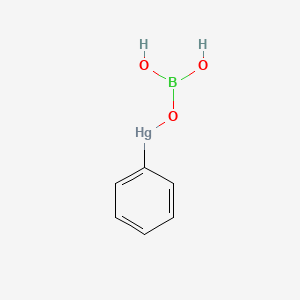
CAS 102-98-7PubChem CID 16683761
Phenylmercury borate
Phenylmercuric borate is an organomercuric compound. It is used as a topical antiseptic and disinfectant. Mercury is a heavy, silvery d-block metal and one of six elements that are liquid at or near room temperature and pressure. It is a naturally occuring substance, and combines with other elements such as chlorine, sulfur, or oxygen to form inorganic mercury compounds (salts). Mercury also combines with carbon to make organic mercury compounds. (L1, L262) — Toxin and Toxin Target Database (T3DB)
- IUPAC name
- boronooxy(phenyl)mercury
- Molecular formula
- C6H7BHgO3
- Molecular weight
- 338.52 g/mol
- Exact mass
- 340.019468 Da
- Topological polar surface area
- 49.7 Ų
- Hydrogen-bond donors
- 2
- Hydrogen-bond acceptors
- 3
- Covalent units
- 1
- Defined stereocentres
- 0
Also known as
FamoseptFenoseptSpidoxolSpidoxRyfenPhenylmercuriboratePhenyl mercuric borateNSC-163948
11 more reported names
phenylhydrargyri borasRefChem:173090203-068-1(dihydrogen borato)phenylmercuryZT1TTY3NGJPhenylmercuriboratMercurate(2-), dihydrogendihydrogen borate;phenylmercury(1+)DB-040400Mercurate(2-), [orthoborato(3-)-.kappa.O]phenyl-, dihydrogenMercurate(2-), [orthoborato(3-)-kappaO]phenyl-, hydrogen (1:2)
Evidence from additional scientific databases
NIH PubChem PUG-View
Exact identifier match16683761
Attributed physical-property, hazard, environmental and use annotations.
- Carcinogen Classification: No indication of carcinogenicity (not listed by IARC). (L135) Source: Toxin and Toxin Target Database (T3DB)
- Exposure Routes: Oral (L7) ; inhalation (L7) ; dermal (L7) Source: Toxin and Toxin Target Database (T3DB)
- Note: This chemical does not meet GHS hazard criteria for 7% (3 of 43) of reports. Source: European Chemicals Agency (ECHA)
- Signal: Danger Source: European Chemicals Agency (ECHA)
- GHS Hazard Statements: H300 (93%): Fatal if swallowed [Danger Acute toxicity, oral]; H310 (93%): Fatal in contact with skin [Danger Acute toxicity, dermal]; H330 (93%): Fatal if inhaled [Danger Acute toxicity, inhalation]; H373 (93%): May causes damage to organs through prolonged or repeated exposure [Warning Specific target organ toxicity, repeated exposure]; H400 (90.7%): Very toxic to aquatic life [Warning Hazardous to the aquatic environment, acute hazard]; H410 (90.7%): Very toxic to aquatic life with long lasting effects [Warning Hazardous to the aquatic environment, long-term hazard] Source: European Chemicals Agency (ECHA)
- Precautionary Statement Codes: P260, P262, P264, P270, P271, P273, P280, P284, P301+P316, P302+P352, P304+P340, P316, P319, P320, P321, P330, P361+P364, P391, P403+P233, P405, and P501 (click each P-code to see the statement) Source: European Chemicals Agency (ECHA)
- ECHA C&L Notifications Summary: Aggregated GHS information provided per 43 reports by companies from 4 notifications to the ECHA C&L Inventory. Each notification may be associated with multiple companies.; Reported as not meeting GHS hazard criteria per 3 of 43 reports by companies.; There are 3 notifications provided by 40 of 43 reports by companies with hazard statement code(s).; Information may vary between notifications depending on impurities, additives, and other factors. The percentage value in parenthesis indicates the notified classification ratio from companies that provide hazard codes. Only hazard codes with percentage values above 10% are shown. For more detailed information, please visit ECHA C&L website. Source: European Chemicals Agency (ECHA)
- Health Effects: Mercury mainly affects the nervous system. Exposure to high levels of metallic, inorganic, or organic mercury can permanently damage the brain, kidneys, and developing fetus. Effects on brain functioning may result in irritability, shyness, tremors, changes in vision or hearing, and memory problems. Acrodynia, a type of mercury poisoning in children, is characterized by pain and pink discoloration of the hands and feet. Mercury poisoning can also cause Hunter-Russell syndrome and Minamata disease. (L7) Source: Toxin and Toxin Target Database (T3DB)
- Toxicity Summary: High-affinity binding of the divalent mercuric ion to thiol or sulfhydryl groups of proteins is believed to be the major mechanism for the activity of mercury. Through alterations in intracellular thiol status, mercury can promote oxidative stress, lipid peroxidation, mitochondrial dysfunction, and changes in heme metabolism. Mercury is known to bind to microsomal and mitochondrial enzymes, resulting in cell injury and death. For example, mercury is known to inhibit aquaporins, halting water flow across the cell membrane. It also inhibits the protein LCK, which causes decreased T-cell signalling and immune system depression. Mercury is also believed to inhibit neuronal excitability by acting on the postsynaptic neuronal membrane. It also affects the nervous system by inhibiting protein kinase C and alkaline phosphatase, which impairs brain microvascular formation and function, as well as alters the blood-brain barrier. Organic mercury exerts developmental effects by binding to tubulin, preventing microtubule assembly and causing mitotic inhibition. Mercury also produces an autoimmune response, likely by modification of major histocompatibility complex (MHC) class II molecules, self Source: Toxin and Toxin Target Database (T3DB)
- Uses: Phenylmercuric borate is used as a topical antiseptic and disinfectant. (L262) Source: Toxin and Toxin Target Database (T3DB)
Mapped by: Existing checksum-valid CAS to unique PubChem CID match. Retrieved: 2026-08-31. Open source record
Scientific classifications and hazard annotations provide context and do not replace the market-specific regulatory decision shown above.
Additional source coverage and match status
| Source | Result | Checked |
|---|---|---|
| EMBL-EBI ChEBI | No exact record | 2026-08-31 |
| NIH PubChem PUG-View | Exact match | 2026-08-31 |
A recorded no-match is useful evidence that the source was checked; it is not a claim that the substance does not exist elsewhere.
Retrieved from NIH PubChem on 2026-09-02 by checksum-valid CAS matching. Chemical properties do not replace the regulatory decision on this page.
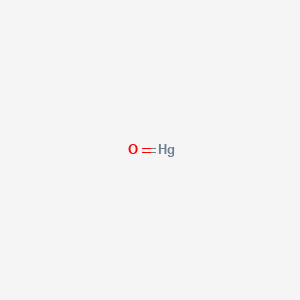
CAS 21908-53-2PubChem CID 30856
Mercuric oxide
Mercuric oxide, [solid] appears as red or orange-red odorless, dense crystalline powder or scales, yellow when finely powdered. Used as a chemical intermediate for mercury salts, organic mercury compounds, and chlorine monoxide; antiseptic in pharmaceuticals; component of dry cell batteries; pigment and glass modifier; fungicide; preservative in cosmetics; analytical reagent; formerly used in antifouling paints. (EPA, 1998) — CAMEO Chemicals
- IUPAC name
- oxomercury
- Molecular formula
- HgO
- Molecular weight
- 216.59 g/mol
- Exact mass
- 217.965558 Da
- Topological polar surface area
- 17.1 Ų
- Hydrogen-bond donors
- 0
- Hydrogen-bond acceptors
- 1
- Covalent units
- 1
- Defined stereocentres
- 0
Also known as
Mercury(II) oxideMercuric oxide, redSantarRed PrecipitateRed mercuric oxideMercury oxide (HgO)Mercuric oxide, yellowSantar M
16 more reported names
Yellow precipitateMercuric oxide redNatural montroyditeMercury(2+) oxideRed oxide of mercuryGelbes quecksilberoxydHydrargyrum oxid flavYellow mercuric oxideMercuric oxide (red)Oxide mercurique jauneMercuric oxide (HgO)Caswell No. 544AYellow oxide of mercuryOxido amarillo de mercurioOxyde de mercureEPA Pesticide Chemical Code 052102
External database identifiers
Retrieved from NIH PubChem on 2026-09-02 by checksum-valid CAS matching. Chemical properties do not replace the regulatory decision on this page.
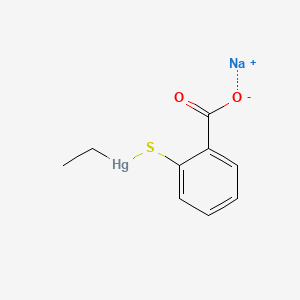
CAS 54-64-8PubChem CID 16684434
Thimerosal
Thimerosal is an alkylmercury compound (approximately 49% mercury by weight) used as an antiseptic and antifungal agent. It has a role as an antiseptic drug, a disinfectant, an antifungal drug and a drug allergen. It contains an ethylmercurithiosalicylate. — ChEBI
- IUPAC name
- sodium (2-carboxylatophenyl)sulfanyl-ethylmercury
- Molecular formula
- C9H9HgNaO2S
- Molecular weight
- 404.82 g/mol
- Exact mass
- 405.992739 Da
- Topological polar surface area
- 65.4 Ų
- Hydrogen-bond donors
- 0
- Hydrogen-bond acceptors
- 3
- Covalent units
- 2
- Defined stereocentres
- 0
Also known as
ThiomersalThiomersalateMercurothiolateMERTHIOLATESodium merthiolateThimerosalateThimerosalumThimerosol
16 more reported names
ThimersalateThiomersalatSodium ethylmercurithiosalicylateThiomersalumMerfaminMertorganMerzoninTiomersalTiomersaleEstivinMerpholMercurothiolatumAeroaid sprayMerzonin sodiumMerthiolate saltEthylmercurithiosalicylate sodium
External database identifiers
Retrieved from NIH PubChem on 2026-08-31 by checksum-valid CAS matching. Chemical properties do not replace the regulatory decision on this page.
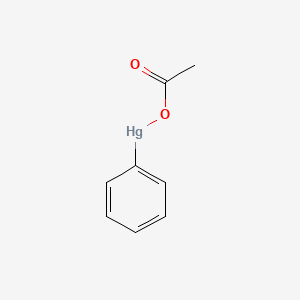
CAS 62-38-4PubChem CID 16682730
Phenylmercuric Acetate
Small lustrous prisms. Toxic by ingestion, inhalation and skin absorption. May severely irritate skin and eyes. Used as an herbicide and fungicide. as such, is mixed with organic solvent for the purpose of application. — CAMEO Chemicals
- IUPAC name
- acetyloxy(phenyl)mercury
- Molecular formula
- C8H8HgO2
- Molecular weight
- 336.74 g/mol
- Exact mass
- 338.023073 Da
- Topological polar surface area
- 26.3 Ų
- Hydrogen-bond donors
- 0
- Hydrogen-bond acceptors
- 2
- Covalent units
- 1
- Defined stereocentres
- 0
Also known as
phenylmercury acetateacetoxyphenylmercuryDyanacideGallotoxHostaquikLiquipheneMercuronMersolite
16 more reported names
NeantinaNorformsNylmeratePrograminQuicksanTrigosanVerdasanAnticonKwiksanMeracenPhenmadZiarnikBufenFemmaScutlPhix
External database identifiers
Retrieved from NIH PubChem on 2026-09-02 by checksum-valid CAS matching. Chemical properties do not replace the regulatory decision on this page.
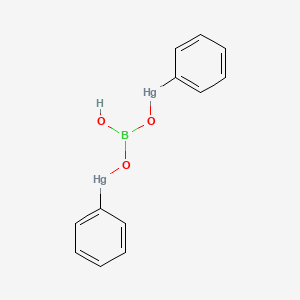
CAS 6273-99-0PubChem CID 16683655
Mercury, [mu-[orthoborato(2-)-O:O']]diphenyldi-
- IUPAC name
- [hydroxy(phenylmercuriooxy)boranyl]oxy-phenylmercury
- Molecular formula
- C12H11BHg2O3
- Molecular weight
- 615.21 g/mol
- Exact mass
- 616.019095 Da
- Topological polar surface area
- 38.7 Ų
- Hydrogen-bond donors
- 1
- Hydrogen-bond acceptors
- 3
- Covalent units
- 1
- Defined stereocentres
- 0
Also known as
Mercury, [.mu.-[orthoborato(2-)-O:O']]diphenyldi-Mercury, (mu-(orthoborato(2-)-O:O'))diphenyldi-MercurylMersolite 90EINECS 228-465-7AI3-60045(mu-(Orthoborato(2-)-O:O'))diphenyldimercuryMercury, [.mu.-(hydrogen orthoborato)]diphenyldi-
4 more reported names
NSC 35683NSC-35683Mercury, (u-(orthoborato(2-)-O:O'))diphenyldi-(mu-Hydrogen-kappaO:kappaO' borato)diphenyldimercury
External database identifiers
- EPA DTXSID:DTXSID80897334
Retrieved from NIH PubChem on 2026-09-02 by checksum-valid CAS matching. Chemical properties do not replace the regulatory decision on this page.

CAS 7439-97-6PubChem CID 23931
Mercury
Mercurycombines with other elements, such as chlorine, sulfur, or oxygen, to form inorganic mercury compounds or "salts", which are usually white powders or crystals. Mercury also combines with carbon to make organic mercury compounds. The most common one, methylmercury, is produced mainly by microscopic organisms in the water and soil. More mercury in the environment can increase the amounts of methylmercury that these small organisms make.Metallic Mercuryis a dense liquid that vaporizes easily at room temperature. Metallic mercury is not easily absorbed into unbroken skin. However, it vaporizes, even at room temperature. The higher the temperature, the more vapors are released. Mercury vapors are colorless and odorless, though they can be seen with the aid of an ultraviolet light.Metallic mercury is used to produce chlorine gas and caustic soda, and is also used in thermometers, dental fillings, and batteries. Mercury salts are sometimes used in skin lightening creams and as antiseptic creams and ointments. — Agency for Toxic Substances and Disease Registry (ATSDR)
- IUPAC name
- mercury
- Molecular formula
- Hg
- Molecular weight
- 200.59 g/mol
- Exact mass
- 201.970644 Da
- Topological polar surface area
- 0.0 Ų
- Hydrogen-bond donors
- 0
- Hydrogen-bond acceptors
- 0
- Covalent units
- 1
- Defined stereocentres
- 0
Also known as
QuicksilverHydrargyrumLiquid silverMetallic mercuryQuecksilberMercureMercurioColloidal mercury
16 more reported names
KwikMercurius vivusMercury, elementalMercury metalHgNCI-C60399MERCURY ELEMENTFXS1BY2PGLCHEBI:16170CHEBI:25195Dietary MercuryMercury metal: Colloidal mercuryMercurius 12XMercurius 21XMercurius vivus 8Mercurius vivus 6X
External database identifiers
- ChEBI:CHEBI:16170
- ChEBI:CHEBI:25195
- EPA DTXSID:DTXSID001029625
- EPA DTXSID:DTXSID1024172
- PubMed:40393628
- PubMed:39947444
- PubMed:39357351
- PubMed:39294077
- PubMed:39164771
- PubMed:38945390
- PubMed:38797200
- PubMed:38653421
- PubMed:37914285
- PubMed:37676925
- PubMed:37415728
- PubMed:37137463
Retrieved from NIH PubChem on 2026-09-02 by checksum-valid CAS matching. Chemical properties do not replace the regulatory decision on this page.
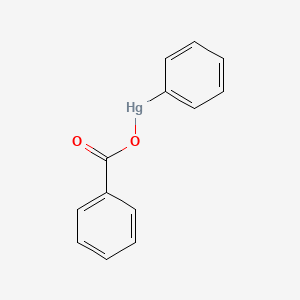
CAS 94-43-9PubChem CID 16682929
Phenylmercury benzoate
- IUPAC name
- benzoyloxy(phenyl)mercury
- Molecular formula
- C13H10HgO2
- Molecular weight
- 398.81 g/mol
- Exact mass
- 400.038723 Da
- Topological polar surface area
- 26.3 Ų
- Hydrogen-bond donors
- 0
- Hydrogen-bond acceptors
- 2
- Covalent units
- 1
- Defined stereocentres
- 0
Also known as
PHENYLMERCURIC BENZOATE(Benzoato-O)phenylmercuryUNII-CHY7T9AM0WCHY7T9AM0WMercury, (benzoato)phenyl-EINECS 202-331-8NSC 84248NSC-84248
6 more reported names
RefChem:173089MERCURY, (BENZOYLOXY)PHENYL-Phenyl mercuric benzoateMercury, (benzoato-O)phenyl-Phenyl Mercury Benzoate(Benzoato-kappaO)phenylmercury
External database identifiers
- EPA DTXSID:DTXSID70896891
Retrieved from NIH PubChem on 2026-09-02 by checksum-valid CAS matching. Chemical properties do not replace the regulatory decision on this page.
Additional authoritative substance research
Each link searches that source for this identity. A link is a research route, not a claim that the source holds an exact record. What each source is, and its legal weight
Take this record further
Official source and scope
Imported from Commission Implementing Decision (EU) 2025/1175 (dataset version EU 2025/1175). The glossary supplies common ingredient names for the ingredient list required by Article 19(1)(g); it is not an approval or safety list.
Open official Decision