
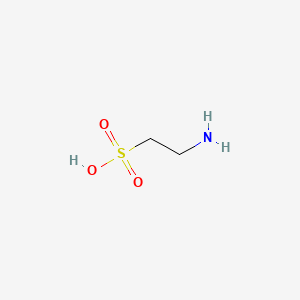
Taurine
Taurine is an amino sulfonic acid that is the 2-amino derivative of ethanesulfonic acid. It is a naturally occurring amino acid derived from methionine and cysteine metabolism. An abundant component of fish- and meat-based foods, it has been used as an oral supplement in the treatment of disorders such as cystic fibrosis and hypertension. It has a role as an antioxidant, a nutrient, a radical scavenger, a glycine receptor agonist, a mouse metabolite, a Saccharomyces cerevisiae metabolite, an Escherichia coli metabolite and a human metabolite. It is a conjugate acid of a 2-aminoethanesulfonate. It is a tautomer of a taurine zwitterion. — ChEBI
- IUPAC name
- 2-aminoethanesulfonic acid
- Molecular formula
- C2H7NO3S
- Molecular weight
- 125.15 g/mol
- Exact mass
- 125.01466426 Da
- XLogP3
- -4.1
- Topological polar surface area
- 88.8 Ų
- Hydrogen-bond donors
- 2
- Hydrogen-bond acceptors
- 4
- Covalent units
- 1
- Defined stereocentres
- 0
Also known as
16 more reported names
External database identifiers
- ChEBI:CHEBI:15891
- ChEMBL:CHEMBL239243
- EPA DTXSID:DTXSID3021304
- PubMed:29968805
- PubMed:29038364
- PubMed:25545282
- PubMed:23170060
- PubMed:23115615
- PubMed:23107717
- PubMed:23067349
- PubMed:23041169
- PubMed:23037169
- PubMed:23035530
- PubMed:23029679
- PubMed:23028699
Evidence from additional scientific databases
EMBL-EBI ChEBI
taurine
An amino sulfonic acid that is the 2-amino derivative of ethanesulfonic acid. It is a naturally occurring amino acid derived from methionine and cysteine metabolism. An abundant component of fish- and meat-based foods, it has been used as an oral supplement in the treatment of disorders such as cystic fibrosis and hypertension.
- Formula
- C2H7NO3S
- Average mass
- 125.149 g/mol
- Monoisotopic mass
- 125.01466 Da
- Formal charge
- 0
- amino sulfonic acid — is a (CHEBI:37793)
- antineoplastic agent — has role (CHEBI:35610)
- human metabolite — has role (CHEBI:77746)
- glycine receptor agonist — has role (CHEBI:64589)
- nutrient — has role (CHEBI:33284)
- radical scavenger — has role (CHEBI:48578)
- Escherichia coli metabolite — has role (CHEBI:76971)
- Saccharomyces cerevisiae metabolite — has role (CHEBI:75772)
- hypoglycemic agent — has role (CHEBI:35526)
- antihypertensive agent — has role (CHEBI:35674)
- immunosuppressive agent — has role (CHEBI:35705)
- antioxidant — has role (CHEBI:22586)
- mouse metabolite — has role (CHEBI:75771)
- antipsychotic agent — has role (CHEBI:35476)
- antineoplastic agent — has role (CHEBI:35610)
- human metabolite — has role (CHEBI:77746)
- glycine receptor agonist — has role (CHEBI:64589)
- nutrient — has role (CHEBI:33284)
- radical scavenger — has role (CHEBI:48578)
- Escherichia coli metabolite — has role (CHEBI:76971)
- Saccharomyces cerevisiae metabolite — has role (CHEBI:75772)
- hypoglycemic agent — has role (CHEBI:35526)
- antihypertensive agent — has role (CHEBI:35674)
- immunosuppressive agent — has role (CHEBI:35705)
- antioxidant — has role (CHEBI:22586)
- mouse metabolite — has role (CHEBI:75771)
- antipsychotic agent — has role (CHEBI:35476)
- amino sulfonic acid — is a (CHEBI:37793)
- 2-aminoethanesulfonate — is conjugate acid of (CHEBI:32970)
- taurine zwitterion — is tautomer of (CHEBI:507393)
- 10098958 Source: PubMed
- 10325611 Source: PubMed
- 10349454 Source: PubMed
- 10827156 Source: PubMed
- 11162030 Source: PubMed
- 11842876 Source: PubMed
- 11918831 Source: PubMed
- 11931837 Source: PubMed
- 12297216 Source: PubMed
- 12499349 Source: PubMed
- 12834252 Source: PubMed
- 14992292 Source: PubMed
- 15503229 Source: PubMed
- 15780050 Source: PubMed
- 15911239 Source: PubMed
- 16038534 Source: PubMed
- 16169526 Source: PubMed
- 16444816 Source: PubMed
- 16923232 Source: PubMed
- 17053427 Source: PubMed
- 17081118 Source: PubMed
- 17417631 Source: PubMed
- 17765547 Source: PubMed
- 17875433 Source: PubMed
Additional curated names
Cross-references from this source
- CAS: 107-35-7 — KEGG COMPOUND
- CAS: 107-35-7 — ChemIDplus
- CAS: 107-35-7 — NIST Chemistry WebBook
- REGISTRY_NUMBER: 1751215 — Reaxys
- REGISTRY_NUMBER: 82121 — Gmelin
- MANUAL_X_REF: 4486 — DrugCentral
- MANUAL_X_REF: C00048188 — KNApSAcK
- MANUAL_X_REF: C00245 — KEGG COMPOUND
- MANUAL_X_REF: D00047 — KEGG DRUG
- MANUAL_X_REF: DB01956 — DrugBank
- MANUAL_X_REF: HMDB0000251 — HMDB
- MANUAL_X_REF: TAU — PDBeChem
- MANUAL_X_REF: Taurine — Wikipedia
- MANUAL_X_REF: TAURINE — MetaCyc
Mapped by: Exact CAS cross-reference in the ChEBI compound record. Source updated: 2025-07-08. Retrieved: 2026-08-31. Open source record
NIH PubChem PUG-View
Attributed physical-property, hazard, environmental and use annotations.
- Boiling Point: It decomposes before reaching boiling point (325ºC) Source: DrugBank
- Color/Form: Colorless crystals Source: Hazardous Substances Data Bank (HSDB)
- Color/Form: Monoclinic prisms from water Source: Hazardous Substances Data Bank (HSDB)
- Density: Density = 1.7 g/cu cm Source: Hazardous Substances Data Bank (HSDB)
- Density: Bulk density = 0.65-0.75 g/cu cm Source: Hazardous Substances Data Bank (HSDB)
- pKa: 1.5 Source: DrugBank
- Melting Point: 572 °F (decomposes) (NTP, 1992) Source: CAMEO Chemicals
- Melting Point: 300 °C Source: DrugBank
- Melting Point: 325 °C (decomposes) Source: Hazardous Substances Data Bank (HSDB)
- Melting Point: 300 °C Source: Human Metabolome Database (HMDB)
- Odor: Odorless Source: Hazardous Substances Data Bank (HSDB)
- Odor: Almost odorless Source: Hazardous Substances Data Bank (HSDB)
- Physical Description: Large white crystals or white powder. Source: CAMEO Chemicals
- Physical Description: Dry Powder Source: EPA Chemical Data Reporting (CDR)
- Physical Description: Colorless solid; [Merck Index] White solid; [CAMEO] Colorless crystals with lumps; [Sigma-Aldrich MSDS] Source: Haz-Map, Information on Hazardous Chemicals and Occupational Diseases
- Physical Description: Solid Source: Human Metabolome Database (HMDB)
- Physical Description: White to cream coloured crystaline solid; Source: Joint FAO/WHO Expert Committee on Food Additives (JECFA)
- Solubility: 50 to 100 mg/mL at 74.3 °F (NTP, 1992) Source: CAMEO Chemicals
- Solubility: 65 g/L in cold water Source: DrugBank
- Solubility: In water, 94.9 g/L at 25 °C Source: Hazardous Substances Data Bank (HSDB)
- Solubility: Soluble in 15.5 parts of water at 12 °C; 100 parts of 95% alcohol dissolves 0.004 parts at 17 °C; insoluble in absolute alcohol Source: Hazardous Substances Data Bank (HSDB)
- Solubility: 80.7 mg/mL Source: Human Metabolome Database (HMDB)
- Solubility: Soluble in water Source: Joint FAO/WHO Expert Committee on Food Additives (JECFA)
- Solubility: Soluble (in ethanol) Source: Joint FAO/WHO Expert Committee on Food Additives (JECFA)
- Solubility: 1.2 [ug/mL] (The mean of the results at pH 7.4) Source: Sanford-Burnham Center for Chemical Genomics
- Vapor Pressure: 0.000172 [mmHg] Source: Haz-Map, Information on Hazardous Chemicals and Occupational Diseases
- pH: pH = 4.1-5.6 (5% aqueous solution) Source: Hazardous Substances Data Bank (HSDB)
- First Aid: EYES: First check the victim for contact lenses and remove if present. Flush victim's eyes with water or normal saline solution for 20 to 30 minutes while simultaneously calling a hospital or poison control center. Do not put any ointments, oils, or medication in the victim's eyes without specific instructions from a physician. IMMEDIATELY transport the victim after flushing eyes to a hospital even if no symptoms (such as redness or irritation) develop.; SKIN: IMMEDIATELY flood affected skin with water while removing and isolating all contaminated clothing. Gently wash all affected skin areas thoroughly with soap and water. If symptoms such as redness or irritation develop, IMMEDIATELY call a physician and be prepared to transport the victim to a hospital for treatment.; INHALATION: IMMEDIATELY leave the contaminated area; take deep breaths of fresh air. If symptoms (such as wheezing, coughing, shortness of breath, or burning in the mouth, throat, or chest) develop, call a physician and be prepared to transport the victim to a hospital. Provide proper respiratory protection to rescuers entering an unknown atmosphere. Whenever possible, Self-Contained Breathing Apparatus (SCBA) shou Source: CAMEO Chemicals
- Note: This chemical does not meet GHS hazard criteria for 18.5% (307 of 1656) of reports. Source: European Chemicals Agency (ECHA)
- Signal: Warning Source: European Chemicals Agency (ECHA)
- GHS Hazard Statements: H315 (81.5%): Causes skin irritation [Warning Skin corrosion/irritation]; H319 (81.5%): Causes serious eye irritation [Warning Serious eye damage/eye irritation]; H335 (81.4%): May cause respiratory irritation [Warning Specific target organ toxicity, single exposure; Respiratory tract irritation] Source: European Chemicals Agency (ECHA)
- Precautionary Statement Codes: P261, P264, P264+P265, P271, P280, P302+P352, P304+P340, P305+P351+P338, P319, P321, P332+P317, P337+P317, P362+P364, P403+P233, P405, and P501 (click each P-code to see the statement) Source: European Chemicals Agency (ECHA)
- ECHA C&L Notifications Summary: Aggregated GHS information provided per 1656 reports by companies from 15 notifications to the ECHA C&L Inventory. Each notification may be associated with multiple companies.; Reported as not meeting GHS hazard criteria per 307 of 1656 reports by companies.; There are 14 notifications provided by 1349 of 1656 reports by companies with hazard statement code(s).; Information may vary between notifications depending on impurities, additives, and other factors. The percentage value in parenthesis indicates the notified classification ratio from companies that provide hazard codes. Only hazard codes with percentage values above 10% are shown. For more detailed information, please visit ECHA C&L website. Source: European Chemicals Agency (ECHA)
- Environmental Bioconcentration: An estimated BCF of 3 was calculated in fish for taurine(SRC), using an estimated log Kow of -3.36(1) and a regression-derived equation(1). According to a classification scheme(2), this BCF suggests the potential for bioconcentration in aquatic organisms is low(SRC). Source: Hazardous Substances Data Bank (HSDB)
- Environmental Fate: TERRESTRIAL FATE: Based on a classification scheme(1), an estimated Koc value of 1(SRC), determined from a structure estimation method(2), indicates that taurine is expected to have very high mobility in soil(SRC). Taurine has pKa values of 1.05 (the acid) and 9.06 (the amine)(3) indicating that this compound will exist as a zwitterion having both a cation and anion form in the environment and cations generally adsorb more strongly to soils containing organic carbon and clay than their neutral counterparts(4). Volatilization of taurine from moist soil surfaces is not expected to be an important fate process(SRC) given an estimated Henry's Law constant of 1.7X10⁻¹² atm-cu m/mole(SRC), using a fragment constant estimation method(2). Taurine is not expected to volatilize from dry soil surfaces(SRC) based upon an estimated vapor pressure of 1.7X10⁻⁷ mm Hg at 25 °C(SRC), determined from a fragment constant method(2). Various species of bacteria and fungi are capable of degrading taurine and using taurine as a sole source of sulfur, carbon and energy(5,6), therefore, biodegradation may be an important fate process(SRC). Source: Hazardous Substances Data Bank (HSDB)
- Environmental Fate: AQUATIC FATE: Based on a classification scheme(1), an estimated Koc value of 1(SRC), determined from a structure estimation method(2), indicates that taurine is not expected to adsorb to suspended solids and sediment(SRC). Volatilization from water surfaces is not expected(3) based upon an estimated Henry's Law constant of 1.7X10⁻¹² atm-cu m/mole(SRC), developed using a fragment constant estimation method(2). Taurine has pKa values of 1.05 (the acid) and 9.06 (the amine)(4) indicating that this compound will exist as a zwitterion having both a cation and anion form in the environment that also suggests volatilization from water will not be an important fate process(SRC). According to a classification scheme(5), an estimated BCF of 3(SRC), from an estimated log Kow of -3.36(2) and a regression-derived equation(2), suggests the potential for bioconcentration in aquatic organisms is low(SRC). Taurine is not expected to undergo hydrolysis in the environment due to the lack of functional groups that hydrolyze under environmental conditions(3). Various species of bacteria and fungi are capable of degrading taurine and using taurine as a sole source of sulfur, carbon and energy(5,6), ther Source: Hazardous Substances Data Bank (HSDB)
- Environmental Fate: ATMOSPHERIC FATE: According to a model of gas/particle partitioning of semivolatile organic compounds in the atmosphere(1), taurine, which has an estimated vapor pressure of 1.7X10⁻⁷ mm Hg at 25 °C(SRC), determined from a fragment constant method(2), will exist in both the vapor and particulate phases in the ambient atmosphere. Vapor-phase taurine is degraded in the atmosphere by reaction with photochemically-produced hydroxyl radicals(SRC); the half-life for this reaction in air is estimated to be 12 hrs(SRC), calculated from its rate constant of 3.3X10⁻¹¹ cu cm/molecule-sec at 25 °C(SRC) that was derived using a structure estimation method(2). Particulate-phase taurine may be removed from the air by wet and dry deposition(SRC). Source: Hazardous Substances Data Bank (HSDB)
- Industry Uses: Not Known or Reasonably Ascertainable Source: EPA Chemical Data Reporting (CDR)
- Sources/Uses: A conditionally essential amino acid; Used as a nutritional supplement; [Merck Index] Used in biochemical research, pharmaceuticals, and as a wetting agent; [NTP] Source: Haz-Map, Information on Hazardous Chemicals and Occupational Diseases
- Uses: Derivatives of taurine, especially fatty acid derivatives, are important wetting, washing, and dispersion agents in body and household cleaning agents, and also in textile processing. Source: Hazardous Substances Data Bank (HSDB)
- Uses: Biochemical research, pharmaceuticals, wetting agents Source: Hazardous Substances Data Bank (HSDB)
- Uses: Nutritional supplement Source: Hazardous Substances Data Bank (HSDB)
- Uses: Cosmetic compositions Source: Hazardous Substances Data Bank (HSDB)
- Uses: For more Uses (Complete) data for Taurine (10 total), please visit the HSDB record page. Source: Hazardous Substances Data Bank (HSDB)
- Uses: Use (kg; approx.) in Germany (2009): >750; Consumption (g per capita; approx.) in Germany (2009): 0.00916; Calculated removal (%): 75.1 Source: NORMAN Suspect List Exchange
Mapped by: Existing checksum-valid CAS to unique PubChem CID match. Retrieved: 2026-08-31. Open source record
Scientific classifications and hazard annotations provide context and do not replace the market-specific regulatory decision shown above.
Additional source coverage and match status
| Source | Result | Checked |
|---|---|---|
| EMBL-EBI ChEBI | Exact match | 2026-08-31 |
| NIH PubChem PUG-View | Exact match | 2026-08-31 |
A recorded no-match is useful evidence that the source was checked; it is not a claim that the substance does not exist elsewhere.
Retrieved from NIH PubChem on 2026-08-31 by checksum-valid CAS matching. Chemical properties do not replace the regulatory decision on this page.