
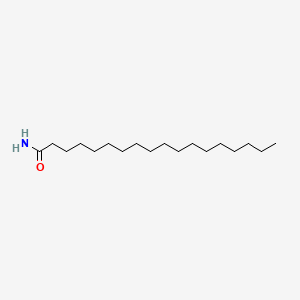
Stearic acid amide
Octadecanamide is a fatty amide of stearic acid. It has a role as a metabolite. It is functionally related to an octadecanoic acid. — ChEBI
- IUPAC name
- octadecanamide
- Molecular formula
- C18H37NO
- Molecular weight
- 283.5 g/mol
- Exact mass
- 283.287514804 Da
- XLogP3
- 6.8
- Topological polar surface area
- 43.1 Ų
- Hydrogen-bond donors
- 1
- Hydrogen-bond acceptors
- 1
- Covalent units
- 1
- Defined stereocentres
- 0
Also known as
16 more reported names
External database identifiers
- ChEBI:CHEBI:34900
- ChEMBL:CHEMBL88311
- EPA DTXSID:DTXSID9027025
- PubMed:22840040
- PubMed:21740750
- PubMed:21627300
- PubMed:21043449
- PubMed:20079680
- PubMed:19857868
- PubMed:18855435
- PubMed:18652423
- PubMed:17197513
- PubMed:17085322
- PubMed:17051769
- PubMed:16125660
Evidence from additional scientific databases
NIH PubChem PUG-View
Attributed physical-property, hazard, environmental and use annotations.
- Boiling Point: BP: 250 °C at 12 mm Hg Source: Hazardous Substances Data Bank (HSDB)
- Color/Form: Leaflets from alcohol Source: Hazardous Substances Data Bank (HSDB)
- Color/Form: Colorless Source: Hazardous Substances Data Bank (HSDB)
- LogP: log Kow = 6.70 Source: Hazardous Substances Data Bank (HSDB)
- Melting Point: 107 °C Source: Hazardous Substances Data Bank (HSDB)
- Melting Point: 109 °C Source: Human Metabolome Database (HMDB)
- Physical Description: Dry Powder; Dry Powder; Large Crystals; Large Crystals Source: EPA Chemical Data Reporting (CDR)
- Physical Description: Colorless solid; [Hawley] Beige powder; [MSDSonline] Source: Haz-Map, Information on Hazardous Chemicals and Occupational Diseases
- Physical Description: Solid Source: Human Metabolome Database (HMDB)
- Solubility: Insoluble in water Source: Hazardous Substances Data Bank (HSDB)
- Solubility: Very soluble in ethyl ether, chloroform Source: Hazardous Substances Data Bank (HSDB)
- Solubility: Slightly soluble in alcohol and ether Source: Hazardous Substances Data Bank (HSDB)
- Vapor Pressure: 0.004 [mmHg] Source: Haz-Map, Information on Hazardous Chemicals and Occupational Diseases
- Note: This chemical does not meet GHS hazard criteria for 99.1% (220 of 222) of all reports. Source: European Chemicals Agency (ECHA)
- GHS Hazard Statements: Not Classified; Reported as not meeting GHS hazard criteria by 220 of 222 companies (only 0.9% companies provided GHS information). For more detailed information, please visit ECHA C&L website. Source: European Chemicals Agency (ECHA)
- ECHA C&L Notifications Summary: Aggregated GHS information provided per 222 reports by companies from 4 notifications to the ECHA C&L Inventory.; Reported as not meeting GHS hazard criteria per 220 of 222 reports by companies.; There are 2 notifications provided by 2 of 222 reports by companies with hazard statement code(s).; Information may vary between notifications depending on impurities, additives, and other factors. The percentage value in parenthesis indicates the notified classification ratio from companies that provide hazard codes. Only hazard codes with percentage values above 10% are shown. For more detailed information, please visit ECHA C&L website. Source: European Chemicals Agency (ECHA)
- Toxicity Summary: IDENTIFICATION AND USE: Stearic acid amide (Stearamide) is a solid. It is used as a corrosion inhibitor in oil wells. It is also used in food packaging, plastic and rubber products. HUMAN STUDIES: There are no data available. ANIMAL STUDIES: Rats (5/sex/dose) were administered stearamide in corn oil via gavage at a dose of 10,000 mg/kg and then observed for 14 days. No mortality was observed. Salmonella typhimurium strains TA98, TA100, TA1535, TA1537 and TA1538 were exposed to stearamide at concentrations of 50, 150, 500, 1500 or 5000 ug/plate in the presence and absence of metabolic activation. Stearamide was not mutagenic in this assay. Source: Hazardous Substances Data Bank (HSDB)
- Environmental Bioconcentration: An estimated BCF of 510 was calculated in fish for stearic acid amide(SRC), using an estimated log Kow of 6.70(1) and a regression-derived equation(1). According to a classification scheme(2), this BCF suggests the potential for bioconcentration in aquatic organisms is high(SRC), provided the compound is not metabolized by the organism(SRC). Source: Hazardous Substances Data Bank (HSDB)
- Environmental Fate: TERRESTRIAL FATE: Based on a classification scheme(1), an estimated Koc value of 4.6X10+4(SRC), determined from a structure estimation method(2), indicates that stearic acid amide is expected to be immobile in soil(SRC). Volatilization of stearic acid amide from moist soil surfaces is not an important fate process(SRC) given an estimated Henry's Law constant of 1.0X10⁻⁶ atm-cu m/mole(SRC), using a fragment constant estimation method(3). Additionally, adsorption to soil is expected to attenuate volatilization(SRC). Stearic acid amide is not expected to volatilize from dry soil surfaces(SRC) based upon an estimated vapor pressure of 6.7X10⁻⁷ mm Hg at 25 °C(SRC), determined from a fragment constant method(2). Stearic acid amide reached 62% degradation after 28 days in the CO2 Evolution test(4) indicating that biodegradation in an important environmental fate process in soil(SRC). Source: Hazardous Substances Data Bank (HSDB)
- Environmental Fate: AQUATIC FATE: Based on a classification scheme(1), an estimated Koc value of 4.6X10+4(SRC), determined from a structure estimation method(2), indicates that stearic acid amide is expected to adsorb to suspended solids and sediment(SRC). Volatilization from water surfaces is not expected(3) based upon an estimated Henry's Law constant of 1.0X10⁻⁶ atm-cu m/mole(SRC), developed using a fragment constant estimation method(4). According to a classification scheme(5), an estimated BCF of 510(SRC), from an estimated log Kow of 6.70(2) and a regression-derived equation(2), suggests the potential for bioconcentration in aquatic organisms is high(SRC). Stearic acid amide reached 62% degradation after 28 days in the CO2 Evolution test(6) indicating that biodegradation is an important environmental fate process in water(SRC). Source: Hazardous Substances Data Bank (HSDB)
- Environmental Fate: ATMOSPHERIC FATE: According to a model of gas/particle partitioning of semivolatile organic compounds in the atmosphere(1), stearic acid amide, which has an estimated vapor pressure of 6.7X10⁻⁷ mm Hg at 25 °C(SRC), determined from a fragment constant method(2), will exist in both the vapor and particulate phases in the ambient atmosphere. Vapor-phase stearic acid amide is degraded in the atmosphere by reaction with photochemically-produced hydroxyl radicals(SRC); the half-life for this reaction in air is estimated to be 14 hours(SRC), calculated from its rate constant of 2.7X10⁻¹¹ cu cm/molecule-sec at 25 °C(SRC) that was derived using a structure estimation method(3). Particulate-phase stearic acid amide may be removed from the air by wet and dry deposition(SRC). Stearic acid amide does not contain chromophores that absorb at wavelengths >290 nm(4) and, therefore, is not expected to be susceptible to direct photolysis by sunlight(SRC). Source: Hazardous Substances Data Bank (HSDB)
- Consumer Uses: Stabilizing agent; Lubricating agent; Anti-adhesive/cohesive Source: EPA Chemical Data Reporting (CDR)
- Industry Uses: Lubricating agent; Anti-adhesive/cohesive; Anti-slip agent Source: EPA Chemical Data Reporting (CDR)
- Sources/Uses: Used as a release agent in plastic and film manufacturing, as an intermediate for textile waterproofing agents, and as a corrosion inhibitor in oil wells; [HSDB] Source: Haz-Map, Information on Hazardous Chemicals and Occupational Diseases
- Industrial Processes with risk of exposure: Petroleum Production and Refining [Category: Industry] Source: Haz-Map, Information on Hazardous Chemicals and Occupational Diseases
- Uses: Corrosion inhibitor in oil wells. Source: Hazardous Substances Data Bank (HSDB)
- Uses: Industrial uses: Anti-adhesive agents; Lubricants and lubricant additives; Plating agents and surface treating agents; Processing aids; Viscosity adjustors Consumer uses: Building/Construction Materials; Food Packaging; Fuels and Related Products; Plastic and Rubber Products Source: Hazardous Substances Data Bank (HSDB)
- Uses: CHEM INT FOR TEXTILE WATERPROOFING AGENTS Source: Hazardous Substances Data Bank (HSDB)
- Uses: Plastics -> Typical concentration range in plastic materials -> 0.2 - 3.0% Source: NORMAN Suspect List Exchange
Mapped by: Existing checksum-valid CAS to unique PubChem CID match. Retrieved: 2026-08-31. Open source record
Scientific classifications and hazard annotations provide context and do not replace the market-specific regulatory decision shown above.
Additional source coverage and match status
| Source | Result | Checked |
|---|---|---|
| NIH PubChem PUG-View | Exact match | 2026-08-31 |
A recorded no-match is useful evidence that the source was checked; it is not a claim that the substance does not exist elsewhere.
Retrieved from NIH PubChem on 2026-08-31 by checksum-valid CAS matching. Chemical properties do not replace the regulatory decision on this page.