
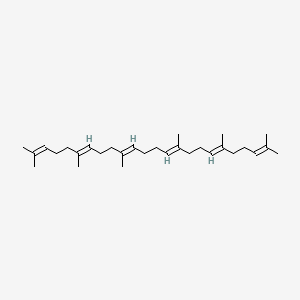
Squalene
Squalene is a triterpene consisting of 2,6,10,15,19,23-hexamethyltetracosane having six double bonds at the 2-, 6-, 10-, 14-, 18- and 22-positions with (all-E)-configuration. It has a role as a mouse metabolite, a Saccharomyces cerevisiae metabolite, a plant metabolite and a human metabolite. — ChEBI
- IUPAC name
- (6E,10E,14E,18E)-2,6,10,15,19,23-hexamethyltetracosa-2,6,10,14,18,22-hexaene
- Molecular formula
- C30H50
- Molecular weight
- 410.7 g/mol
- Exact mass
- 410.391251595 Da
- XLogP3
- 11.6
- Topological polar surface area
- 0.0 Ų
- Hydrogen-bond donors
- 0
- Hydrogen-bond acceptors
- 0
- Covalent units
- 1
- Defined stereocentres
- 0
Also known as
16 more reported names
External database identifiers
- ChEBI:CHEBI:15440
- ChEMBL:CHEMBL458402
- EPA DTXSID:DTXSID0026044
- PubMed:33219891
- PubMed:29968805
- PubMed:28096968
- PubMed:24362891
- PubMed:23833782
- PubMed:18390722
- PubMed:17732574
- PubMed:16557464
- PubMed:16341241
- PubMed:16140017
- PubMed:15225664
- PubMed:14844354
Evidence from additional scientific databases
NIH PubChem PUG-View
Attributed physical-property, hazard, environmental and use annotations.
- Boiling Point: 545 °F at 25 mmHg (NTP, 1992) Source: CAMEO Chemicals
- Boiling Point: 421.3 °C Source: Hazardous Substances Data Bank (HSDB)
- Color/Form: Oil; crystals from ether/methanol (-5 °C) Source: Hazardous Substances Data Bank (HSDB)
- Density: 0.8584 at 68 °F (NTP, 1992) - Less dense than water; will float Source: CAMEO Chemicals
- Density: 0.8584 g/cu cm at 20 °C Source: Hazardous Substances Data Bank (HSDB)
- Density: 0.858 @25 °C Source: PAC Chemical Database, U.S. Department of Energy
- Flash Point: greater than 235 °F (NTP, 1992) Source: CAMEO Chemicals
- Flash Point: 110 °C - closed cup Source: Hazardous Substances Data Bank (HSDB)
- Melting Point: -103 °F (NTP, 1992) Source: CAMEO Chemicals
- Melting Point: -4.8 °C Source: Hazardous Substances Data Bank (HSDB)
- Melting Point: -75 °C Source: Human Metabolome Database (HMDB)
- Odor: Faint agreeable odor Source: Hazardous Substances Data Bank (HSDB)
- Physical Description: Trans-squalene is a clear, slightly yellow liquid with a faint odor. Density 0.858 g / cm3. Source: CAMEO Chemicals
- Physical Description: Liquid with a mild agreeable odor; Absorbs oxygen and becomes viscous like linseed oil; [Merck Index] Clear, colorless to slightly yellow viscous liquid; [Acros Organics MSDS] Source: Haz-Map, Information on Hazardous Chemicals and Occupational Diseases
- Physical Description: Liquid Source: Human Metabolome Database (HMDB)
- Refractive Index: Index of Refraction: 1.4990 at 20 °C Source: Hazardous Substances Data Bank (HSDB)
- Solubility: less than 1 mg/mL at 66 °F (NTP, 1992) Source: CAMEO Chemicals
- Solubility: Practically insoluble in water. Source: Hazardous Substances Data Bank (HSDB)
- Solubility: Freely soluble in ether, petroleum ether, carbon tetrachloride, acetone, other fat solvents; sparingly soluble in alcohol, glacial acetic acid Source: Hazardous Substances Data Bank (HSDB)
- Solubility: Slightly soluble in alcohol; soluble in lipids and organic solvents Source: Hazardous Substances Data Bank (HSDB)
- Vapor Pressure: 2 [mm Hg] @240 °C Source: PAC Chemical Database, U.S. Department of Energy
- Viscosity: 12 cP at 25 °C Source: Hazardous Substances Data Bank (HSDB)
- First Aid: EYES: First check the victim for contact lenses and remove if present. Flush victim's eyes with water or normal saline solution for 20 to 30 minutes while simultaneously calling a hospital or poison control center. Do not put any ointments, oils, or medication in the victim's eyes without specific instructions from a physician. IMMEDIATELY transport the victim after flushing eyes to a hospital even if no symptoms (such as redness or irritation) develop.; SKIN: IMMEDIATELY flood affected skin with water while removing and isolating all contaminated clothing. Gently wash all affected skin areas thoroughly with soap and water. If symptoms such as redness or irritation develop, IMMEDIATELY call a physician and be prepared to transport the victim to a hospital for treatment.; INHALATION: IMMEDIATELY leave the contaminated area; take deep breaths of fresh air. If symptoms (such as wheezing, coughing, shortness of breath, or burning in the mouth, throat, or chest) develop, call a physician and be prepared to transport the victim to a hospital. Provide proper respiratory protection to rescuers entering an unknown atmosphere. Whenever possible, Self-Contained Breathing Apparatus (SCBA) shou Source: CAMEO Chemicals
- Note: This chemical does not meet GHS hazard criteria for 25.5% (80 of 314) of reports. Source: European Chemicals Agency (ECHA)
- Signal: Danger Source: European Chemicals Agency (ECHA)
- GHS Hazard Statements: H304 (73.6%): May be fatal if swallowed and enters airways [Danger Aspiration hazard] Source: European Chemicals Agency (ECHA)
- Precautionary Statement Codes: P301+P316, P331, P405, and P501 (click each P-code to see the statement) Source: European Chemicals Agency (ECHA)
- ECHA C&L Notifications Summary: Aggregated GHS information provided per 314 reports by companies from 3 notifications to the ECHA C&L Inventory.; Reported as not meeting GHS hazard criteria per 80 of 314 reports by companies.; There are 2 notifications provided by 234 of 314 reports by companies with hazard statement code(s).; Information may vary between notifications depending on impurities, additives, and other factors. The percentage value in parenthesis indicates the notified classification ratio from companies that provide hazard codes. Only hazard codes with percentage values above 10% are shown. For more detailed information, please visit ECHA C&L website. Source: European Chemicals Agency (ECHA)
- Signal: Danger Source: Hazardous Substances Data Bank (HSDB)
- GHS Hazard Statements: H304: May be fatal if swallowed and enters airways [Danger Aspiration hazard] Source: Hazardous Substances Data Bank (HSDB)
- Precautionary Statement Codes: P301+P316, P331, P405, and P501 (click each P-code to see the statement) Source: Hazardous Substances Data Bank (HSDB)
- Cosmetic Ingredient Review Finding(s): Safe in the present practices of use and concentration. Ingredient, concentration, and use information are available in documents discoverable at https://cir-reports.cir-safety.org Source: Cosmetic Ingredient Review (CIR)
- Toxicity Summary: IDENTIFICATION AND USE: Squalene is a liquid. The source of squalene is usually from shark liver and sometimes from olive oil. It is used as traditional medicine, experimental medication, and dietary supplement. Squalene is a component of some adjuvants that are added to vaccines to enhance the immune response. MF59, an adjuvant added to the FLUAD flu vaccine, is such an example. Squalene by itself is not an adjuvant, but emulsions of squalene with surfactants do enhance the immune response. Squalene is also found in a variety of foods, cosmetics. HUMAN EXPOSURE AND TOXICITY: Squalene is not a significant human skin irritant or sensitizer. Limited contact sensitization tests indicate squalene is not a significant contact allergen or irritant. Twenty two million doses of the influenza vaccine FLUAD have been administered safely since 1997. This vaccine contains about 10 mg of squalene per dose. No severe adverse events have been associated with the vaccine. Some mild local reactions have been observed. Clinical studies on squalene-containing vaccines have been done in infants and neonates without evidence of safety concerns. One of the many possible exposures suspected of causing ch Source: Hazardous Substances Data Bank (HSDB)
- Environmental Bioconcentration: An estimated BCF of 4 was calculated in fish for squalene(SRC), using an estimated log Kow of 14.1(1) and a regression-derived equation(1). According to a classification scheme(2), this BCF suggests the potential for bioconcentration in aquatic organisms is low(SRC). Source: Hazardous Substances Data Bank (HSDB)
- Environmental Fate: TERRESTRIAL FATE: Based on a classification scheme(1), an estimated Koc value of 1X10+8(SRC), determined from a structure estimation method(2), indicates that squalene is expected to be immobile mobility in soil(SRC). Volatilization of squalene from moist soil surfaces is expected to be an important fate process(SRC) given an estimated Henry's Law constant of 2.0 atm-cu m/mole(SRC), using a fragment constant estimation method(2). However, adsorption to soil is expected to attenuate volatilization(SRC). Squalene is not expected to volatilize from dry soil surfaces(SRC) based upon an estimated vapor pressure of 6.3X10⁻⁶ mm Hg at 25 °C(SRC), determined from a fragment constant method(1). Using OECD Guideline 301F (Ready Biodegradability: Manometric Respirometry Test), squalene achieved 80.1 and 42.6% degradation at 20 and 100 mg/L, respectively, over 28-day incubation periods classifying the compound as inherently biodegradable, but not readily biodegradable(3). Microorganisms isolated from soil have been able to use squalene as a carbon source(4). Source: Hazardous Substances Data Bank (HSDB)
- Environmental Fate: AQUATIC FATE: Based on a classification scheme(1), an estimated Koc value of 1X10+8(SRC), determined from a structure estimation method(2), indicates that squalene is expected to adsorb to suspended solids and sediment(SRC). Volatilization from water surfaces is expected(3) based upon an estimated Henry's Law constant of 2.0 atm-cu m/mole(SRC), developed using a fragment constant estimation method(2). Using this Henry's Law constant and an estimation method(3), volatilization half-lives for a model river and model lake are 6 hours and 8 days, respectively(SRC). However, volatilization from water surfaces is expected to be attenuated by adsorption to suspended solids and sediment in the water column. The estimated volatilization half-life from a model pond is >5 years if adsorption is considered(4). According to a classification scheme(5), an estimated BCF of 4(SRC), from an estimated log Kow of 14.1(2) and a regression-derived equation(2), suggests the potential for bioconcentration in aquatic organisms is low(SRC). Using OECD Guideline 301F (Ready Biodegradability: Manometric Respirometry Test), squalene achieved 80.1 and 42.6% degradation at 20 and 100 mg/L, respectively, over 28 Source: Hazardous Substances Data Bank (HSDB)
- Environmental Fate: ATMOSPHERIC FATE: According to a model of gas/particle partitioning of semivolatile organic compounds in the atmosphere(1), squalene, which has an estimated vapor pressure of 6.3X10⁻⁶ mm Hg at 25 °C(SRC), determined from a fragment constant method(2), will exist in both the vapor and particulate phases in the ambient atmosphere. Vapor-phase squalene is degraded in the atmosphere by reaction with photochemically-produced hydroxyl radicals(SRC); the half-life for this reaction in air is estimated to be about 43 minutes(SRC), calculated from its rate constant of 5.3X10⁻¹⁰ cu cm/molecule-sec at 25 °C(SRC) that was derived using a structure estimation method(2). Vapor-phase squalene is also degraded in the atmosphere by reaction with ozone(SRC); the half-life for this reaction in air is estimated to be about 7 minutes(SRC), calculated from its rate constant of 2.6X10⁻¹⁵ cu cm/molecule-sec at 25 °C(SRC) that was derived using a structure estimation method(2). Several studies have found that squalene reacts readily with ozone in indoor air and yields reaction products that include mono- and bifunctional group compounds such as aldehydes, ketones and carboxylic acids(3). Squalene, which is Source: Hazardous Substances Data Bank (HSDB)
- Cosmetic Ingredient Review Link: CIR ingredient: Squalene Source: Cosmetic Ingredient Review (CIR)
- Sources/Uses: Present in large quantities in shark liver oil, and in minute amounts in olive oil, wheat germ oil, rice bran oil, and yeast; An intermediate in the biosynthesis of cholesterol; Used as a bactericide, and as an intermediate for pharmaceuticals, organic coloring agents, rubber chemicals, aromatics, and surface active agents; [Merck Index] Also used in biochemical and pharmaceutical research; [NTP] Source: Haz-Map, Information on Hazardous Chemicals and Occupational Diseases
- Uses: Bactericide; intermediate in manufacture of pharmaceuticals, organic coloring materials, rubber chemicals, aromatics and surface active agents. Source: Hazardous Substances Data Bank (HSDB)
- Uses: Biochemical and pharmaceutical research, a percursor of cholestrol in biosynthesis, chemical intermediate. Source: Hazardous Substances Data Bank (HSDB)
- Uses: Squalane and Squalene have been identified as natural components of human sebum. Both ingredients are used in a variety of cosmetics at concentrations ranging from < or =0.1 to >50%. Source: Hazardous Substances Data Bank (HSDB)
- Uses: Squalene is a polyunsaturated hydrocarbon with a formula of C30H50. Squalene can be found in certain fish oils, especially shark liver oil, in high amounts and some vegetable oils in relatively smaller amounts. Human sebum also contains 13% squalene as one of its major constituents. Squalane is a saturated derivative of squalene and also found in these sources. Interest in squalene has been raised after its characterization in shark liver oil which is used as a traditional medicine for decades. Several studies exhibited results that prove certain bioactivities for squalene and squalane. Up to date, anticancer, antioxidant, drug carrier, detoxifier, skin hydrating, and emollient activities of these substances have been reported both in animal models and in vitro environments. According to promising results from recent studies, squalene and squalane are considered important substances in practical and clinical uses with a huge potential in nutraceutical and pharmaceutical industries. Source: Hazardous Substances Data Bank (HSDB)
- Uses: For more Uses (Complete) data for Squalene (9 total), please visit the HSDB record page. Source: Hazardous Substances Data Bank (HSDB)
Mapped by: Existing checksum-valid CAS to unique PubChem CID match. Retrieved: 2026-08-31. Open source record
Scientific classifications and hazard annotations provide context and do not replace the market-specific regulatory decision shown above.
Additional source coverage and match status
| Source | Result | Checked |
|---|---|---|
| NIH PubChem PUG-View | Exact match | 2026-08-31 |
A recorded no-match is useful evidence that the source was checked; it is not a claim that the substance does not exist elsewhere.
Retrieved from NIH PubChem on 2026-08-31 by checksum-valid CAS matching. Chemical properties do not replace the regulatory decision on this page.