
Official EU label nameGlossary entry 26915
SODIUM PERBORATE
This record confirms an official common ingredient name for EU cosmetic product labelling. It does not by itself confirm that the substance is permitted, unrestricted or safe.
Global evidence snapshot
The resolved identity has matching regulatory evidence in 9 of 13 indexed market datasets: 12 country records and 0 EU Annex records. Every result and evidence gap is listed below.
Markets checked
13
Markets with evidence
9
Evidence gaps
4
Resolved identifiers
15
Resolved substance identity
CAS:15120-21-57632-04-411138-47-95120-21-510332-33-913517-20-937244-98-710486-00-712267-73-113840-56-712179-04-312040-72-1
EC:239-172-9231-556-4234-390-0
Ingredient index records:
SODIUM PERBORATE
Cosmetic functions: ORAL CARE, OXIDISING
Sodium Perborate is the inorganic salt that conforms to the formula:
Inventory restriction note: II/1397
11 matched or reported names
SODIUM PERBORATESodium perborateSodium perborate [1]Sodium peroxometaborate; sodium peroxoborate [2]Perboric acid, sodium salt [1]Sodium perborate [1]; Sodium peroxometaborate; sodium peroxoborate [2]过硼酸钠 — Sodium perborate (CAS No. 15120-21-5)과붕산나트륨과붕산나트륨일수화물Ácido perbórico e sais de sódio hidratados (PERBORIC ACID AND HYDRATED SODIUM SALTS)[7] Sodium borate, disodium tetraborate anhydrous; boric acid, sodium salt [8] CAS No.CAS No. 12267-73-1 [9] Orthoboric acid, sodium salt [10] CAS No.13840-56-7 [10] Disodium tetraborate decahydrate; borax decahydrate [11] Disodium tetraborate pentahydrate; borax pentahydrate [12] CAS No.12179-04-3 [12] Perboric acid, sodium salt [1] Perboric acid, sodium salt, monohydrate [2] Perboric acid (HBO(O2)), 6) sodium salt, monohydrate [3] (CAS No. 11138-47-9 [1], 12040-72-1 [2], 10332-33-9 [3])Perboric acid, sodium salt [1]; Perboric acid, sodium salt, monohydrate [2]; Perboric acid (HBO(O2)), sodium salt, monohydrate [3]
Regulatory evidence in all 13 markets
Open each matched record for its scope, concentration, conditions, warnings and official source version.
Swipe or scroll horizontally to see dataset coverage and next actions.
| Market | Result | Records | Dataset | Meaning / next action |
|---|---|---|---|---|
| European Union EU | No local match | 0 | Complete annex dataset Regulation (EC) 1223/2009 consolidated to 1 May 2026 | No annex match only means that these five annexes did not return a match; CosIng identity data and other EU obligations still need review. |
| Great Britain GB | No local match | 0 | Complete consolidated annex dataset GB retained Regulation 1223/2009 schedules, effective 15 August 2026 | No annex match is not approval and does not cover Northern Ireland, which follows the applicable EU framework. |
| Canada CA | Restricted | 1Open record 1 | Complete Hotlist snapshot Health Canada Cosmetic Ingredient Hotlist, 13 August 2025 | Review every linked record and exact conditions. |
| New Zealand NZ | Prohibited | 3Open record 1Open record 2 | Complete schedules dataset Cosmetic Products Group Standard schedules effective 1 January 2026 | Review every linked record and exact conditions. |
| ASEAN ASEAN | Prohibited | 1Open record 1 | Complete regional annex dataset ASEAN Cosmetic Directive annexes 2026-1, 22 June 2026 | Review every linked record and exact conditions. |
| China CN | Prohibited | 1Open record 1 | Complete prohibited catalogues plus official-source workflow NMPA 2021 banned catalogues plus dynamic IECIC List I/List II system current since 2025 | Review every linked record and exact conditions. |
| Japan JP | Prohibited | 1Open record 1 | Complete Standards appendices dataset MHLW Standards for Cosmetics official English source and Japanese amendments checked for the imported snapshot | Review every linked record and exact conditions. |
| South Korea KR | Restricted | 1Open record 1 | Complete current appendix dataset MFDS Notice 2026-19, effective 18 March 2026 | Review every linked record and exact conditions. |
| United States US | No local match | 0 | Complete enumerated federal ingredient rules eCFR Title 21 issue date 27 August 2026 | FDA has no general approved-cosmetic-ingredient catalogue; absence from these sections is not approval or proof of safety. |
| Australia AU | No local match | 0 | Complete cosmetic-relevant Poisons Standard subset plus official workflow Therapeutic Goods (Poisons Standard—June 2026) Instrument 2026 | An AICIS Inventory match is not cosmetic approval; no Inventory match can indicate a new, exempted, reported or confidential introduction. |
| Brazil BR | Prohibited | 1Open record 1 | Complete prohibited dataset plus current restricted-list workflow ANVISA RDC 1.029/2026 and RDC 1.030/2026, published 15 June 2026 | Review every linked record and exact conditions. |
| India IN | Prohibited | 1Open record 1 | Complete current Part 2 dataset plus official workflow for Parts 1, 3 and 4 Cosmetics Rules 2020 plus current BIS IS 4707 parts (1:2020, 2:2025, 3:2025, 4:2022) | Review every linked record and exact conditions. |
| Saudi Arabia SA | Prohibited | 2Open record 1Open record 2 | Complete official list index SFDA live prohibited/restricted lists, snapshot 30 August 2026 | Review every linked record and exact conditions. |
No market rows match this filter.
Matching market records and conditions
New Zealand
Cosmetic Products Group Standard schedules effective 1 January 2026Sodium perborate [1]Prohibited
Schedule 4, reference 1397, source row 1497 · effective-2026-01-01
Sodium peroxometaborate; sodium peroxoborate [2]Prohibited
Schedule 4, reference 1397, source row 1498 · effective-2026-01-01
Perboric acid, sodium salt [1]Prohibited
Schedule 4, reference 1399, source row 1504 · effective-2026-01-01
ASEAN
ASEAN Cosmetic Directive annexes 2026-1, 22 June 2026China
NMPA 2021 banned catalogues plus dynamic IECIC List I/List II system current since 2025Japan
MHLW Standards for Cosmetics official English source and Japanese amendments checked for the imported snapshotSouth Korea
MFDS Notice 2026-19, effective 18 March 2026Brazil
ANVISA RDC 1.029/2026 and RDC 1.030/2026, published 15 June 2026India
Cosmetics Rules 2020 plus current BIS IS 4707 parts (1:2020, 2:2025, 3:2025, 4:2022)Saudi Arabia
SFDA live prohibited/restricted lists, snapshot 30 August 2026Sodium perborate [1]; Sodium peroxometaborate; sodium peroxoborate [2]Prohibited
SFDA prohibited list, page 140, row 3 · live-snapshot-2026-08-30
Perboric acid, sodium salt [1]; Perboric acid, sodium salt, monohydrate [2]; Perboric acid (HBO(O2)), sodium salt, monohydrate [3]Prohibited
SFDA prohibited list, page 140, row 5 · live-snapshot-2026-08-30
Chemical identity and properties
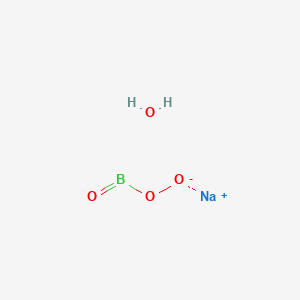
CAS 10332-33-9PubChem CID 23695970
Sodium Perborate Monohydrate
- IUPAC name
- sodium;oxidooxy(oxo)borane;hydrate
- Molecular formula
- BH2NaO4
- Molecular weight
- 99.82 g/mol
- Exact mass
- 99.9943830 Da
- Topological polar surface area
- 50.4 Ų
- Hydrogen-bond donors
- 1
- Hydrogen-bond acceptors
- 4
- Covalent units
- 3
- Defined stereocentres
- 0
Also known as
Caswell No. 784ASodium borate, monohydrateY9UKD0XE6FUNII-Y9UKD0XE6FEPA Pesticide Chemical Code 011105SODIUM BORATE MONOHYDRATESODIUM PERBORATE MONOHYDRATE (MART.)SODIUM PERBORATE MONOHYDRATE [MART.]
11 more reported names
Amosan Wound CleanserRefChem:56246Amosan Oral Wound CleanserAmosan Wound CleanserCherry FlavourPerboric acid, sodium salt, monohydrateSodium perborate monohydrate [USAN]Sodium perborate monohydrate (USAN)Perboric acid sodium salt monohydrateSodium oxoboraneperoxolate--water (1/1/1)SODIUM PERBORATE MONOHYDRATE [WHO-DD]Perboric acid (HBO(O2)), sodium salt, monohydrate
External database identifiers
- EPA DTXSID:DTXSID9035676
Evidence from additional scientific databases
NIH PubChem PUG-View
Exact identifier match23695970
Attributed physical-property, hazard, environmental and use annotations.
- Physical Description: Dry Powder Source: EPA Chemical Data Reporting (CDR)
- ERG2024, Guide 140 (Sodium perborate monohydrate): General First Aid:; · Call 911 or emergency medical service.; · Ensure that medical personnel are aware of the material(s) involved, take precautions to protect themselves and avoid contamination.; · Move victim to fresh air if it can be done safely.; · Administer oxygen if breathing is difficult.; · If victim is not breathing:; -- DO NOT perform mouth-to-mouth resuscitation; the victim may have ingested or inhaled the substance.; -- If equipped and pulse detected, wash face and mouth, then give artificial respiration using a proper respiratory medical device (bag-valve mask, pocket mask equipped with a one-way valve or other device).; -- If no pulse detected or no respiratory medical device available, provide continuous compressions. Conduct a pulse check every two minutes or monitor for any signs of spontaneous respirations.; · Remove and isolate contaminated clothing and shoes.; · For minor skin contact, avoid spreading material on unaffected skin.; · In case of contact with substance, remove immediately by flushing skin or eyes with running water for at least 20 minutes.; · For severe burns, immediate medical attention is required.; · Effects of exposure (inhalation, ingestion, Source: Emergency Response Guidebook (ERG)
- Note: This chemical does not meet GHS hazard criteria for 2.6% (5 of 192) of reports. Source: European Chemicals Agency (ECHA)
- Signal: Danger Source: European Chemicals Agency (ECHA)
- GHS Hazard Statements: H272 (97.4%): May intensify fire; oxidizer [Danger Oxidizing liquids; Oxidizing solids]; H302+H332 (19.3%): Harmful if swallowed or if inhaled [Warning Acute toxicity, oral; acute toxicity, inhalation]; H302 (97.4%): Harmful if swallowed [Warning Acute toxicity, oral]; H318 (97.4%): Causes serious eye damage [Danger Serious eye damage/eye irritation]; H331 (20.3%): Toxic if inhaled [Danger Acute toxicity, inhalation]; H332 (22.9%): Harmful if inhaled [Warning Acute toxicity, inhalation]; H335 (97.4%): May cause respiratory irritation [Warning Specific target organ toxicity, single exposure; Respiratory tract irritation]; H360 (97.4%): May damage fertility or the unborn child [Danger Reproductive toxicity] Source: European Chemicals Agency (ECHA)
- Precautionary Statement Codes: P203, P210, P220, P261, P264, P264+P265, P270, P271, P280, P301+P317, P304+P340, P305+P354+P338, P316, P317, P318, P319, P321, P330, P370+P378, P403+P233, P405, and P501 (click each P-code to see the statement) Source: European Chemicals Agency (ECHA)
- ECHA C&L Notifications Summary: Aggregated GHS information provided per 192 reports by companies from 6 notifications to the ECHA C&L Inventory. Each notification may be associated with multiple companies.; Reported as not meeting GHS hazard criteria per 5 of 192 reports by companies.; There are 5 notifications provided by 187 of 192 reports by companies with hazard statement code(s).; Information may vary between notifications depending on impurities, additives, and other factors. The percentage value in parenthesis indicates the notified classification ratio from companies that provide hazard codes. Only hazard codes with percentage values above 10% are shown. For more detailed information, please visit ECHA C&L website. Source: European Chemicals Agency (ECHA)
- Signal: Danger Source: NITE-CMC
- GHS Hazard Statements: H272: May intensify fire; oxidizer [Danger Oxidizing liquids; Oxidizing solids]; H302: Harmful if swallowed [Warning Acute toxicity, oral]; H318: Causes serious eye damage [Danger Serious eye damage/eye irritation]; H331: Toxic if inhaled [Danger Acute toxicity, inhalation]; H361: Suspected of damaging fertility or the unborn child [Warning Reproductive toxicity] Source: NITE-CMC
- Precautionary Statement Codes: P203, P210, P220, P261, P264, P264+P265, P270, P271, P280, P301+P317, P304+P340, P305+P354+P338, P316, P317, P318, P321, P330, P370+P378, P403+P233, P405, and P501 (click each P-code to see the statement) Source: NITE-CMC
- Signal: Danger Source: Hazardous Chemical Information System (HCIS), Safe Work Australia
- GHS Hazard Statements: H272: May intensify fire; oxidizer [Danger Oxidizing liquids; Oxidizing solids]; H302: Harmful if swallowed [Warning Acute toxicity, oral]; H318: Causes serious eye damage [Danger Serious eye damage/eye irritation]; H335: May cause respiratory irritation [Warning Specific target organ toxicity, single exposure; Respiratory tract irritation]; H360Df: May damage the unborn child; Suspected of damaging fertility [Danger Reproductive toxicity] Source: Hazardous Chemical Information System (HCIS), Safe Work Australia
- Precautionary Statement Codes: P203, P210, P220, P261, P264, P264+P265, P270, P271, P280, P301+P317, P304+P340, P305+P354+P338, P317, P318, P319, P330, P370+P378, P403+P233, P405, and P501 (click each P-code to see the statement) Source: Hazardous Chemical Information System (HCIS), Safe Work Australia
- GHS Hazard Statements: H272: May intensify fire; oxidizer [Danger Oxidizing liquids; Oxidizing solids]; H302: Harmful if swallowed [Warning Acute toxicity, oral]; H318: Causes serious eye damage [Danger Serious eye damage/eye irritation]; H331: Toxic if inhaled [Danger Acute toxicity, inhalation]; H335: May cause respiratory irritation [Warning Specific target organ toxicity, single exposure; Respiratory tract irritation]; H360Df: May damage the unborn child; Suspected of damaging fertility [Danger Reproductive toxicity] Source: Hazardous Chemical Information System (HCIS), Safe Work Australia
- Consumer Uses: Not Known or Reasonably Ascertainable; Oxidizing agent Source: EPA Chemical Data Reporting (CDR)
- Industry Uses: Not Known or Reasonably Ascertainable Source: EPA Chemical Data Reporting (CDR)
Mapped by: Existing checksum-valid CAS to unique PubChem CID match. Retrieved: 2026-08-31. Open source record
Scientific classifications and hazard annotations provide context and do not replace the market-specific regulatory decision shown above.
Additional source coverage and match status
| Source | Result | Checked |
|---|---|---|
| EMBL-EBI ChEBI | No exact record | 2026-08-31 |
| NIH PubChem PUG-View | Exact match | 2026-08-31 |
A recorded no-match is useful evidence that the source was checked; it is not a claim that the substance does not exist elsewhere.
Retrieved from NIH PubChem on 2026-09-02 by checksum-valid CAS matching. Chemical properties do not replace the regulatory decision on this page.
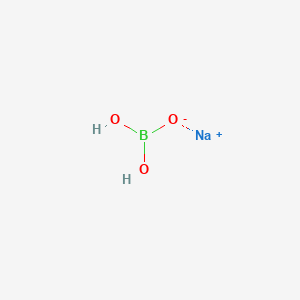
CAS 11138-47-9PubChem CID 23711812
Perboric acid, sodium salt
- IUPAC name
- sodium dihydrogen borate
- Molecular formula
- BH2NaO3
- Molecular weight
- 83.82 g/mol
- Exact mass
- 83.9994684 Da
- Topological polar surface area
- 63.5 Ų
- Hydrogen-bond donors
- 2
- Hydrogen-bond acceptors
- 3
- Covalent units
- 2
- Defined stereocentres
- 0
Also known as
sodium;dihydrogen borateEINECS 234-390-0EC 234-390-0NaH2BO3WBQSJYNAUANADO-UHFFFAOYSA-Nboric acid (H3BO3), sodium salt (1:1)
External database identifiers
- EPA DTXSID:DTXSID401360726
Evidence from additional scientific databases
NIH PubChem PUG-View
Exact identifier match23711812
Attributed physical-property, hazard, environmental and use annotations.
- Signal: Danger Source: Regulation (EC) No 1272/2008 of the European Parliament and of the Council
- GHS Hazard Statements: H272: May intensify fire; oxidizer [Danger Oxidizing liquids; Oxidizing solids]; H302: Harmful if swallowed [Warning Acute toxicity, oral]; H318: Causes serious eye damage [Danger Serious eye damage/eye irritation]; H331: Toxic if inhaled [Danger Acute toxicity, inhalation]; H335: May cause respiratory irritation [Warning Specific target organ toxicity, single exposure; Respiratory tract irritation]; H360FD: May damage fertility; May damage the unborn child [Danger Reproductive toxicity] Source: Regulation (EC) No 1272/2008 of the European Parliament and of the Council
- Precautionary Statement Codes: P203, P210, P220, P261, P264, P264+P265, P270, P271, P280, P301+P317, P304+P340, P305+P354+P338, P316, P317, P318, P319, P321, P330, P370+P378, P403+P233, P405, and P501 (click each P-code to see the statement) Source: Regulation (EC) No 1272/2008 of the European Parliament and of the Council
- Signal: Danger Source: European Chemicals Agency (ECHA)
- GHS Hazard Statements: H272 (62.4%): May intensify fire; oxidizer [Danger Oxidizing liquids; Oxidizing solids]; H302 (62.4%): Harmful if swallowed [Warning Acute toxicity, oral]; H318 (100%): Causes serious eye damage [Danger Serious eye damage/eye irritation]; H332 (62.4%): Harmful if inhaled [Warning Acute toxicity, inhalation]; H335 (100%): May cause respiratory irritation [Warning Specific target organ toxicity, single exposure; Respiratory tract irritation]; H360 (100%): May damage fertility or the unborn child [Danger Reproductive toxicity] Source: European Chemicals Agency (ECHA)
- Precautionary Statement Codes: P203, P210, P220, P261, P264, P264+P265, P270, P271, P280, P301+P317, P304+P340, P305+P354+P338, P317, P318, P319, P330, P370+P378, P403+P233, P405, and P501 (click each P-code to see the statement) Source: European Chemicals Agency (ECHA)
- ECHA C&L Notifications Summary: Aggregated GHS information provided per 165 reports by companies from 12 notifications to the ECHA C&L Inventory. Each notification may be associated with multiple companies.; Information may vary between notifications depending on impurities, additives, and other factors. The percentage value in parenthesis indicates the notified classification ratio from companies that provide hazard codes. Only hazard codes with percentage values above 10% are shown. For more detailed information, please visit ECHA C&L website. Source: European Chemicals Agency (ECHA)
- Signal: Danger Source: NITE-CMC
- GHS Hazard Statements: H302: Harmful if swallowed [Warning Acute toxicity, oral]; H318: Causes serious eye damage [Danger Serious eye damage/eye irritation]; H332: Harmful if inhaled [Warning Acute toxicity, inhalation]; H335: May cause respiratory irritation [Warning Specific target organ toxicity, single exposure; Respiratory tract irritation]; H360: May damage fertility or the unborn child [Danger Reproductive toxicity]; H401: Toxic to aquatic life [Hazardous to the aquatic environment, acute hazard] Source: NITE-CMC
- Precautionary Statement Codes: P203, P261, P264, P264+P265, P270, P271, P273, P280, P301+P317, P304+P340, P305+P354+P338, P317, P318, P319, P330, P403+P233, P405, and P501 (click each P-code to see the statement) Source: NITE-CMC
- Signal: Danger Source: Hazardous Chemical Information System (HCIS), Safe Work Australia
- GHS Hazard Statements: H272: May intensify fire; oxidizer [Danger Oxidizing liquids; Oxidizing solids]; H302: Harmful if swallowed [Warning Acute toxicity, oral]; H318: Causes serious eye damage [Danger Serious eye damage/eye irritation]; H331: Toxic if inhaled [Danger Acute toxicity, inhalation]; H335: May cause respiratory irritation [Warning Specific target organ toxicity, single exposure; Respiratory tract irritation]; H360Df: May damage the unborn child; Suspected of damaging fertility [Danger Reproductive toxicity] Source: Hazardous Chemical Information System (HCIS), Safe Work Australia
Mapped by: Existing checksum-valid CAS to unique PubChem CID match. Retrieved: 2026-08-31. Open source record
Scientific classifications and hazard annotations provide context and do not replace the market-specific regulatory decision shown above.
Additional source coverage and match status
| Source | Result | Checked |
|---|---|---|
| NIH PubChem PUG-View | Exact match | 2026-08-31 |
A recorded no-match is useful evidence that the source was checked; it is not a claim that the substance does not exist elsewhere.
Retrieved from NIH PubChem on 2026-09-02 by checksum-valid CAS matching. Chemical properties do not replace the regulatory decision on this page.
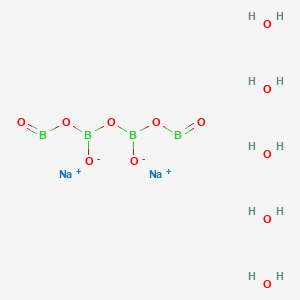
CAS 12179-04-3PubChem CID 86341921
Sodium tetraborate pentahydrate
- IUPAC name
- disodium;[oxido(oxoboranyloxy)boranyl]oxy-oxoboranyloxyborinate;pentahydrate
- Molecular formula
- B4H10Na2O12
- Molecular weight
- 291.3 g/mol
- Exact mass
- 292.0339850 Da
- Topological polar surface area
- 113.0 Ų
- Hydrogen-bond donors
- 5
- Hydrogen-bond acceptors
- 12
- Covalent units
- 8
- Defined stereocentres
- 0
Also known as
Sodium borate, pentahydrateSG2N20S03UBoron sodium oxide(B4Na2O7), pentahydrateBoric acid(H2B4O7), disodium salt, pentahydrateRefChem:887925601-808-1Boron sodium oxide (B4Na2O7), hydrate (1:5)Disodium tetraborate pentahydrate
6 more reported names
UNII-SG2N20S03UBoron sodium oxide (B4Na2O7), pentahydrateEC 215-540-4Boric acid (H2B4O7), disodium salt, pentaborateBoron sodium oxide pentahydrateQZSYXKPOZFXCDM-UHFFFAOYSA-N
External database identifiers
- EPA DTXSID:DTXSID7034389
Evidence from additional scientific databases
NIH PubChem PUG-View
Exact identifier match86341921
Attributed physical-property, hazard, environmental and use annotations.
- Density: 1.82 Source: Occupational Safety and Health Administration (OSHA)
- Density: 1.82 Source: The National Institute for Occupational Safety and Health (NIOSH)
- Melting Point: 392 °F Source: Occupational Safety and Health Administration (OSHA)
- Melting Point: 392 °F Source: The National Institute for Occupational Safety and Health (NIOSH)
- Physical Description: CBI; Dry Powder; Liquid; Other Solid Source: EPA Chemical Data Reporting (CDR)
- Physical Description: Colorless or white, odorless crystals or free-flowing powder; Begins to lose water of hydration at 252 degrees F; [NIOSH] Source: Haz-Map, Information on Hazardous Chemicals and Occupational Diseases
- Physical Description: Colorless or white, odorless crystals or free-flowing powder. Source: Occupational Safety and Health Administration (OSHA)
- Physical Description: Colorless or white, odorless crystals or free-flowing powder. [herbicide] [Note: Begins to lose water of hydration at 252 °F.] Source: The National Institute for Occupational Safety and Health (NIOSH)
- Solubility: 3% Source: The National Institute for Occupational Safety and Health (NIOSH)
- Vapor Pressure: 0 mmHg (approx) Source: Occupational Safety and Health Administration (OSHA)
- Vapor Pressure: 0 mmHg (approx) Source: The National Institute for Occupational Safety and Health (NIOSH)
- Exposure Routes: inhalation, ingestion, skin and/or eye contact Source: The National Institute for Occupational Safety and Health (NIOSH)
- First Aid: (General first aid procedures); Eye: Irrigate immediately - If this chemical contacts the eyes, immediately wash (irrigate) the eyes with large amounts of water, occasionally lifting the lower and upper lids. Get medical attention immediately.; Skin: Soap wash - If this chemical contacts the skin, wash the contaminated skin with soap and water.; Breathing: Respiratory support; Swallow: Medical attention immediately - If this chemical has been swallowed, get medical attention immediately. Source: The National Institute for Occupational Safety and Health (NIOSH)
- Signal: Danger Source: Regulation (EC) No 1272/2008 of the European Parliament and of the Council
- GHS Hazard Statements: H360FD: May damage fertility; May damage the unborn child [Danger Reproductive toxicity] Source: Regulation (EC) No 1272/2008 of the European Parliament and of the Council
- Precautionary Statement Codes: P203, P280, P318, P405, and P501 (click each P-code to see the statement) Source: Regulation (EC) No 1272/2008 of the European Parliament and of the Council
- Signal: Danger Source: European Chemicals Agency (ECHA)
- GHS Hazard Statements: H319 (57.2%): Causes serious eye irritation [Warning Serious eye damage/eye irritation]; H360 (91.2%): May damage fertility or the unborn child [Danger Reproductive toxicity] Source: European Chemicals Agency (ECHA)
- Precautionary Statement Codes: P203, P264+P265, P280, P305+P351+P338, P318, P337+P317, P405, and P501 (click each P-code to see the statement) Source: European Chemicals Agency (ECHA)
- ECHA C&L Notifications Summary: Aggregated GHS information provided per 339 reports by companies from 12 notifications to the ECHA C&L Inventory. Each notification may be associated with multiple companies.; Information may vary between notifications depending on impurities, additives, and other factors. The percentage value in parenthesis indicates the notified classification ratio from companies that provide hazard codes. Only hazard codes with percentage values above 10% are shown. For more detailed information, please visit ECHA C&L website. Source: European Chemicals Agency (ECHA)
- Signal: Danger Source: NITE-CMC
- GHS Hazard Statements: H335: May cause respiratory irritation [Warning Specific target organ toxicity, single exposure; Respiratory tract irritation]; H360: May damage fertility or the unborn child [Danger Reproductive toxicity]; H370: Causes damage to organs [Danger Specific target organ toxicity, single exposure] Source: NITE-CMC
- Precautionary Statement Codes: P203, P260, P261, P264, P270, P271, P280, P304+P340, P308+P316, P318, P319, P321, P403+P233, P405, and P501 (click each P-code to see the statement) Source: NITE-CMC
- Signal: Danger Source: Hazardous Chemical Information System (HCIS), Safe Work Australia
- GHS Hazard Statements: H360FD: May damage fertility; May damage the unborn child [Danger Reproductive toxicity] Source: Hazardous Chemical Information System (HCIS), Safe Work Australia
- Target Organs: Eyes, skin, respiratory system Source: The National Institute for Occupational Safety and Health (NIOSH)
- Consumer Uses: Flame retardant; Anti-adhesive/cohesive Source: EPA Chemical Data Reporting (CDR)
- Industry Uses: Anti-adhesive/cohesive; Plating agent; Flame retardant; Corrosion inhibitor; Not Known or Reasonably Ascertainable; Etching agent; Chelating agent; Defoamer Source: EPA Chemical Data Reporting (CDR)
- Sources/Uses: Used as a preservative, antiseptic and fungicide; also used to manufacture glazes, enamels, soldering fluxes and cleaning compounds and to fireproof textiles and wood; [ACGIH] Boric acid and borates as tablets or powder are used to kill larvae in barns and other insects in houses. Rarely, they are sprayed as herbicides. [EPA: Recognition of Pesticide Poisonings] Source: Haz-Map, Information on Hazardous Chemicals and Occupational Diseases
- Industrial Processes with risk of exposure: Soldering [Category: Heat or Machine]; Using Disinfectants or Biocides [Category: Clean]; Farming (Pesticides) [Category: Industry]; Textiles (Printing, Dyeing, or Finishing) [Category: Industry] Source: Haz-Map, Information on Hazardous Chemicals and Occupational Diseases
Mapped by: Existing checksum-valid CAS to unique PubChem CID match. Retrieved: 2026-08-31. Open source record
Scientific classifications and hazard annotations provide context and do not replace the market-specific regulatory decision shown above.
Additional source coverage and match status
| Source | Result | Checked |
|---|---|---|
| NIH PubChem PUG-View | Exact match | 2026-08-31 |
A recorded no-match is useful evidence that the source was checked; it is not a claim that the substance does not exist elsewhere.
Retrieved from NIH PubChem on 2026-09-02 by checksum-valid CAS matching. Chemical properties do not replace the regulatory decision on this page.
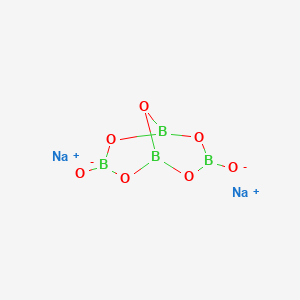
CAS 12267-73-1PubChem CID 10219853
Sodium Tetraborate
- IUPAC name
- disodium;3,7-dioxido-2,4,6,8,9-pentaoxa-1,3,5,7-tetraborabicyclo[3.3.1]nonane
- Molecular formula
- B4Na2O7
- Molecular weight
- 201.2 g/mol
- Exact mass
- 201.9811616 Da
- Topological polar surface area
- 92.3 Ų
- Hydrogen-bond donors
- 0
- Hydrogen-bond acceptors
- 7
- Covalent units
- 3
- Defined stereocentres
- 0
Also known as
1330-43-4Sodium Tetraborate, AnhydrousBorax glassBoron sodium oxide (B4Na2O7)Anhydrous boraxSodium biborateBorax AnhydrousFused borax
16 more reported names
Sodium borate anhydrousBorax, fusedSodium pyroborateDehyborGranuborSprayborSodium borate, anhydrousBorax, dehydratedSodium boron oxideRasorite 658191EN8ZMDBoric acid, disodium saltBoric acid (H2B4O7), disodium saltSodium tetraborate anhydrousINS NO.285Sodium boron oxide (na2b4o7)
External database identifiers
- EPA DTXSID:DTXSID101014358
- PubMed:21774671
- PubMed:19059942
- PubMed:1432568
Evidence from additional scientific databases
NIH PubChem PUG-View
Exact identifier match10219853
Attributed physical-property, hazard, environmental and use annotations.
- Boiling Point: 1,575 °C (decomposes) Source: Hazardous Substances Data Bank (HSDB)
- Boiling Point: 2867 °F (decomposes) Source: Occupational Safety and Health Administration (OSHA)
- Boiling Point: 2867 °F (Decomposes) Source: The National Institute for Occupational Safety and Health (NIOSH)
- Color/Form: Colorless glassy solid; hygroscopic Source: Hazardous Substances Data Bank (HSDB)
- Color/Form: Light grey, vitreous granules Source: Hazardous Substances Data Bank (HSDB)
- Color/Form: White to gray powder; becomes opaque on exposure to air Source: Hazardous Substances Data Bank (HSDB)
- Density: 2.367 Source: Hazardous Substances Data Bank (HSDB)
- Density: White crystals or powder, odorless; density: 1.73 20 °C/4 °C; loses water of crystallization when heated, with melting between 75 and 320 °C; fuses to a glassy mass at red heat (borax glass); effloresces slightly in warm dry air; soluble in water, glycerol; insoluble in alcohol /Sodium tetraborate decahydrate/ Source: Hazardous Substances Data Bank (HSDB)
- Density: Relative density (water = 1): 2.4 Source: ILO-WHO International Chemical Safety Cards (ICSCs)
- Density: 2.37 Source: Occupational Safety and Health Administration (OSHA)
- Density: 2.37 Source: The National Institute for Occupational Safety and Health (NIOSH)
- Melting Point: Between 171 °C and 175 °C with decomposition Source: EU Food Improvement Agents
- Melting Point: 743 °C Source: Hazardous Substances Data Bank (HSDB)
- Melting Point: 742 °C Source: ILO-WHO International Chemical Safety Cards (ICSCs)
- Melting Point: 1366 °F Source: Occupational Safety and Health Administration (OSHA)
- Melting Point: 1366 °F Source: The National Institute for Occupational Safety and Health (NIOSH)
- Odor: Odorless Source: Hazardous Substances Data Bank (HSDB)
- Physical Description: Liquid; Liquid; Other Solid; Dry Powder; Large Crystals; Large Crystals; Dry Powder; Other Solid Source: EPA Chemical Data Reporting (CDR)
- Physical Description: Powder or glass-like plates becoming opaque on exposure to air; slowly soluble in water Source: EU Food Improvement Agents
- Physical Description: White to gray, odorless powder; Becomes opaque on exposure to air; [NIOSH] Source: Haz-Map, Information on Hazardous Chemicals and Occupational Diseases
- Physical Description: COLOURLESS-TO-WHITE HYGROSCOPIC CRYSTALS OR POWDER. TURNS OPAQUE ON EXPOSURE TO AIR. Source: ILO-WHO International Chemical Safety Cards (ICSCs)
- Physical Description: White to gray, odorless powder. Source: Occupational Safety and Health Administration (OSHA)
- Physical Description: White to gray, odorless powder. [herbicide] [Note: Becomes opaque on exposure to air.] Source: The National Institute for Occupational Safety and Health (NIOSH)
- Refractive Index: INDEX OF REFRACTION: 1.5010 Source: Hazardous Substances Data Bank (HSDB)
- Solubility: Water solubility: 3.1% at 25 °C; 2.5% at 20 °C Source: Hazardous Substances Data Bank (HSDB)
- Solubility: Solubility at 25 °C: 16.7% in methanol; 30% in ethylene glycol; 40.6 g/L in formamide Source: Hazardous Substances Data Bank (HSDB)
- Solubility: Solubility in water, g/100ml at 20 °C: 2.56 Source: ILO-WHO International Chemical Safety Cards (ICSCs)
- Solubility: 4% Source: The National Institute for Occupational Safety and Health (NIOSH)
- Vapor Pressure: Negligible at 20 °C Source: Hazardous Substances Data Bank (HSDB)
- Vapor Pressure: 0 mmHg (approx) Source: Occupational Safety and Health Administration (OSHA)
- Vapor Pressure: 0 mmHg (approx) Source: The National Institute for Occupational Safety and Health (NIOSH)
- pH: pH = 9.3 at 20 °C (3% solution) Source: Hazardous Substances Data Bank (HSDB)
- Exposure Routes: The substance can be absorbed into the body by inhalation of its aerosol and by ingestion. Source: ILO-WHO International Chemical Safety Cards (ICSCs)
- Exposure Routes: inhalation, ingestion, skin and/or eye contact Source: The National Institute for Occupational Safety and Health (NIOSH)
- First Aid: (General first aid procedures); Eye: Irrigate immediately - If this chemical contacts the eyes, immediately wash (irrigate) the eyes with large amounts of water, occasionally lifting the lower and upper lids. Get medical attention immediately.; Skin: Soap wash - If this chemical contacts the skin, wash the contaminated skin with soap and water.; Breathing: Respiratory support; Swallow: Medical attention immediately - If this chemical has been swallowed, get medical attention immediately. Source: The National Institute for Occupational Safety and Health (NIOSH)
- Signal: Danger Source: Regulation (EC) No 1272/2008 of the European Parliament and of the Council
- GHS Hazard Statements: H360FD: May damage fertility; May damage the unborn child [Danger Reproductive toxicity] Source: Regulation (EC) No 1272/2008 of the European Parliament and of the Council
- Precautionary Statement Codes: P203, P280, P318, P405, and P501 (click each P-code to see the statement) Source: Regulation (EC) No 1272/2008 of the European Parliament and of the Council
- Signal: Danger Source: European Chemicals Agency (ECHA)
- GHS Hazard Statements: H319 (53.2%): Causes serious eye irritation [Warning Serious eye damage/eye irritation]; H360 (88.5%): May damage fertility or the unborn child [Danger Reproductive toxicity]; H360FD (22.3%): May damage fertility; May damage the unborn child [Danger Reproductive toxicity] Source: European Chemicals Agency (ECHA)
- Precautionary Statement Codes: P203, P264+P265, P280, P305+P351+P338, P318, P337+P317, P405, and P501 (click each P-code to see the statement) Source: European Chemicals Agency (ECHA)
- ECHA C&L Notifications Summary: Aggregated GHS information provided per 1733 reports by companies from 44 notifications to the ECHA C&L Inventory. Each notification may be associated with multiple companies.; Information may vary between notifications depending on impurities, additives, and other factors. The percentage value in parenthesis indicates the notified classification ratio from companies that provide hazard codes. Only hazard codes with percentage values above 10% are shown. For more detailed information, please visit ECHA C&L website. Source: European Chemicals Agency (ECHA)
- Signal: Danger Source: NITE-CMC
- GHS Hazard Statements: H315: Causes skin irritation [Warning Skin corrosion/irritation]; H319: Causes serious eye irritation [Warning Serious eye damage/eye irritation]; H335: May cause respiratory irritation [Warning Specific target organ toxicity, single exposure; Respiratory tract irritation]; H360: May damage fertility or the unborn child [Danger Reproductive toxicity]; H370: Causes damage to organs [Danger Specific target organ toxicity, single exposure]; H372: Causes damage to organs through prolonged or repeated exposure [Danger Specific target organ toxicity, repeated exposure] Source: NITE-CMC
- Precautionary Statement Codes: P203, P260, P261, P264, P264+P265, P270, P271, P280, P302+P352, P304+P340, P305+P351+P338, P308+P316, P318, P319, P321, P332+P317, P337+P317, P362+P364, P403+P233, P405, and P501 (click each P-code to see the statement) Source: NITE-CMC
- GHS Hazard Statements: H320: Causes eye irritation [Warning Serious eye damage/eye irritation]; H335: May cause respiratory irritation [Warning Specific target organ toxicity, single exposure; Respiratory tract irritation]; H360: May damage fertility or the unborn child [Danger Reproductive toxicity]; H370: Causes damage to organs [Danger Specific target organ toxicity, single exposure]; H372: Causes damage to organs through prolonged or repeated exposure [Danger Specific target organ toxicity, repeated exposure]; H373: May causes damage to organs through prolonged or repeated exposure [Warning Specific target organ toxicity, repeated exposure]; H402: Harmful to aquatic life [Hazardous to the aquatic environment, acute hazard]; H412: Harmful to aquatic life with long lasting effects [Hazardous to the aquatic environment, long-term hazard] Source: NITE-CMC
- Precautionary Statement Codes: P203, P260, P261, P264, P264+P265, P270, P271, P273, P280, P304+P340, P305+P351+P338, P308+P316, P318, P319, P321, P337+P317, P403+P233, P405, and P501 (click each P-code to see the statement) Source: NITE-CMC
- Target Organs: Eyes, skin, respiratory system Source: The National Institute for Occupational Safety and Health (NIOSH)
- Environmental Bioconcentration: Accumulates in the plant Source: Hazardous Substances Data Bank (HSDB)
- Environmental Fate: Terrestrial Fate: Average persistence at recommended rates is one or more years, depending on soil type and rainfall. Less persistent in acid soils and in high rainfall areas. Source: Hazardous Substances Data Bank (HSDB)
- Consumer Uses: Adhesion/cohesion promoter; Flux agent; Soil amendments (fertilizers); Filler; Not Known or Reasonably Ascertainable; Bleaching agent; Anti-freeze agent; Other Source: EPA Chemical Data Reporting (CDR)
- Industry Uses: Processing aids not otherwise specified; Bleaching agent; Anti-freeze agent; Other; Heat stabilizer; Hardener; Adhesion/cohesion promoter; Flame retardant; Flux agent; Filler; Soil amendments (fertilizers) Source: EPA Chemical Data Reporting (CDR)
- Sources/Uses: Used as tablets or powder to kill larvae in livestock confinements and crawling insects in residences; [EPA Pesticides] Used as a fluxing agent, a buffering agent, a biocide (preservative, antiseptic, insecticide, fungicide, herbicide, algicide, nematicide), a fireproofing agent, a corrosion inhibitor, a tanning agent, and a textile bleaching agent; Used to manufacture glazes, enamels, borosilicate glass, fertilizers, detergents, antifreeze, pharmaceuticals, and cosmetics; [HSDB] Source: Haz-Map, Information on Hazardous Chemicals and Occupational Diseases
- Industrial Processes with risk of exposure: Acid and Alkali Cleaning of Metals [Category: Clean]; Using Disinfectants or Biocides [Category: Clean]; Farming (Pesticides) [Category: Industry]; Glass Manufacturing [Category: Industry] Source: Haz-Map, Information on Hazardous Chemicals and Occupational Diseases
- Uses: For sodium tetraborate (USEPA/OPP Pesticide Code: 011112) ACTIVE products with label matches. /SRP: Registered for use in the U.S. but approved pesticide uses may change periodically and so federal, state and local authorities must be consulted for currently approved uses./ Source: Hazardous Substances Data Bank (HSDB)
- Uses: Manufacture of glass, enamels, & other ceramic products Source: Hazardous Substances Data Bank (HSDB)
- Uses: Soldering metals; manufacture of glazes and enamels; tanning; in cleaning compounds; artificially aging wood; ...curing and preserving skins Source: Hazardous Substances Data Bank (HSDB)
- Uses: As preservative either alone or with other antiseptics against wood fungus; fireproofing fabrics & wood Source: Hazardous Substances Data Bank (HSDB)
- Uses: For more Uses (Complete) data for SODIUM TETRABORATE (15 total), please visit the HSDB record page. Source: Hazardous Substances Data Bank (HSDB)
Mapped by: Existing checksum-valid CAS to unique PubChem CID match. Retrieved: 2026-08-31. Open source record
Scientific classifications and hazard annotations provide context and do not replace the market-specific regulatory decision shown above.
Additional source coverage and match status
| Source | Result | Checked |
|---|---|---|
| NIH PubChem PUG-View | Exact match | 2026-08-31 |
A recorded no-match is useful evidence that the source was checked; it is not a claim that the substance does not exist elsewhere.
Retrieved from NIH PubChem on 2026-09-02 by checksum-valid CAS matching. Chemical properties do not replace the regulatory decision on this page.
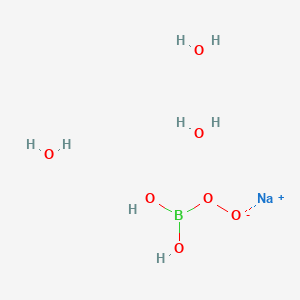
CAS 13517-20-9PubChem CID 177839929
Perboric acid (H3BO2(O2)), monosodium salt, trihydrate
- IUPAC name
- sodium;oxidooxyboronic acid;trihydrate
- Molecular formula
- BH8NaO7
- Molecular weight
- 153.86 g/mol
- Exact mass
- 154.0260770 Da
- Topological polar surface area
- 75.8 Ų
- Hydrogen-bond donors
- 5
- Hydrogen-bond acceptors
- 7
- Covalent units
- 5
- Defined stereocentres
- 0
External database identifiers
- EPA DTXSID:DTXSID501346206
Retrieved from NIH PubChem on 2026-09-02 by checksum-valid CAS matching. Chemical properties do not replace the regulatory decision on this page.
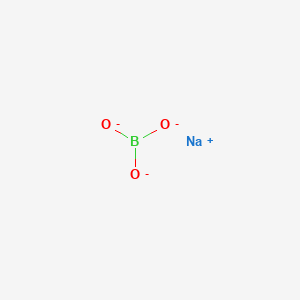
CAS 13840-56-7PubChem CID 160998
Boric acid (H3BO3), sodium salt (1:?)
- IUPAC name
- sodium borate
- Molecular formula
- BNaO3-2
- Molecular weight
- 81.80 g/mol
- Exact mass
- 81.9838183 Da
- Topological polar surface area
- 69.2 Ų
- Hydrogen-bond donors
- 0
- Hydrogen-bond acceptors
- 3
- Covalent units
- 2
- Defined stereocentres
- 0
Also known as
Boric acid (H3BO3), sodium saltTrisodium orthoborateOrthoboric acid, sodium saltEINECS 238-253-6EINECS 237-560-2RefChem:569982237-560-2238-253-6
2 more reported names
sodium;borateWJZOJDGNGVXSIK-UHFFFAOYSA-N
Retrieved from NIH PubChem on 2026-09-02 by checksum-valid CAS matching. Chemical properties do not replace the regulatory decision on this page.
Additional authoritative substance research
Each link searches that source for this identity. A link is a research route, not a claim that the source holds an exact record. What each source is, and its legal weight
Take this record further
Official source and scope
Imported from Commission Implementing Decision (EU) 2025/1175 (dataset version EU 2025/1175). The glossary supplies common ingredient names for the ingredient list required by Article 19(1)(g); it is not an approval or safety list.
Open official Decision