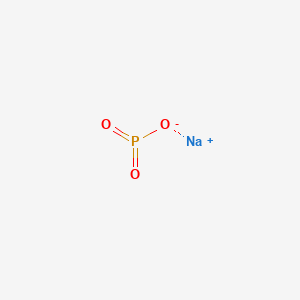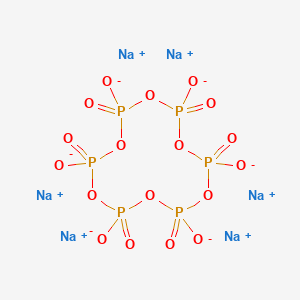
Hexasodium hexametaphosphate
The CIR Expert Panel concluded that the following 31 ingredients are safe in the present practices of use and concentration in cosmetics as described in this safety assessment, when formulated to be non-irritating...Sodium Hexametaphosphate... — Cosmetic Ingredient Review (CIR)
- IUPAC name
- hexasodium;2,4,6,8,10,12-hexaoxido-1,3,5,7,9,11-hexaoxa-2lambda5,4lambda5,6lambda5,8lambda5,10lambda5,12lambda5-hexaphosphacyclododecane 2,4,6,8,10,12-hexaoxide
- Molecular formula
- Na6O18P6
- Molecular weight
- 611.77 g/mol
- Exact mass
- 611.6896508 Da
- Topological polar surface area
- 296.0 Ų
- Hydrogen-bond donors
- 0
- Hydrogen-bond acceptors
- 18
- Covalent units
- 7
- Defined stereocentres
- 0
Also known as
16 more reported names
External database identifiers
- EPA DTXSID:DTXSID1047522
Evidence from additional scientific databases
NIH PubChem PUG-View
Attributed physical-property, hazard, environmental and use annotations.
- Physical Description: Polymeric sodium metaphosphates: Clear hygroscopic solid; Soluble in water; [HSDB] White odorless granules; [MSDSonline] Source: Haz-Map, Information on Hazardous Chemicals and Occupational Diseases
- Solubility: CLEAR, HYGROSCOPIC GLASS; MP 628 °C; SOL IN WATER, BUT DISSOLVES SLOWLY; DEPOLYMERIZES IN AQ SOLN TO FORM SODIUM TRIMETAPHOSPHATE & SODIUM ORTHOPHOSPHATES. /POLYMERIC SODIUM METAPHOSPHATES/ Source: Hazardous Substances Data Bank (HSDB)
- Solubility: SOL IN WATER; INSOL IN ORG SOLVENTS. /SODIUM HEXAMETAPHOSPHATE DETERGENTS/ Source: Hazardous Substances Data Bank (HSDB)
- Note: This chemical does not meet GHS hazard criteria for 100% (19 of 19) of all reports. Source: European Chemicals Agency (ECHA)
- GHS Hazard Statements: Not Classified; Reported as not meeting GHS hazard criteria by 19 of 19 companies. For more detailed information, please visit ECHA C&L website. Source: European Chemicals Agency (ECHA)
- ECHA C&L Notifications Summary: Aggregated GHS information provided per 19 reports by companies from 1 notifications to the ECHA C&L Inventory.; Reported as not meeting GHS hazard criteria per 19 of 19 reports by companies.; There are 0 notifications provided by 0 of 19 reports by companies with hazard statement code(s).; Information may vary between notifications depending on impurities, additives, and other factors. The percentage value in parenthesis indicates the notified classification ratio from companies that provide hazard codes. Only hazard codes with percentage values above 10% are shown. For more detailed information, please visit ECHA C&L website. Source: European Chemicals Agency (ECHA)
- Cosmetic Ingredient Review Conclusion: The CIR Expert Panel concluded that the following 31 ingredients are safe in the present practices of use and concentration in cosmetics as described in this safety assessment, when formulated to be non-irritating...Sodium Hexametaphosphate... Source: Cosmetic Ingredient Review (CIR)
- Cosmetic Ingredient Review Finding(s): Safe for use in cosmetics, with qualifications Source: Cosmetic Ingredient Review (CIR)
- Environmental Bioconcentration: A comprehensive examination of metal levels at various trophic levels within an undisturbed Precambrian Shield lake ecosystem was made. Concn of 21 naturally occurring elements including phosphorus were measured in sediments, clams, fish, birds, and mammals. Mercury was the only element to exhibit biomagnification. /Phosphorus/ Source: Hazardous Substances Data Bank (HSDB)
- Cosmetic Ingredient Review Link: CIR ingredient: Sodium Hexametaphosphate Source: Cosmetic Ingredient Review (CIR)
- Sources/Uses: Used in building and water treatment (60%), food processing (15%), and miscellaneous (25%); Used in photographic developing, in dairy substitutes in pudding, as a retarder in dental alginate impression materials, and as a thinner for petroleum drilling fluids; [HSDB] At low concentrations, it inhibits steel corrosion and the formation of scale-forming compounds (calcium carbonate and calcium sulfate); [Hawley] Source: Haz-Map, Information on Hazardous Chemicals and Occupational Diseases
- Industrial Processes with risk of exposure: Petroleum Production and Refining [Category: Industry]; Photographic Processing [Category: Other] Source: Haz-Map, Information on Hazardous Chemicals and Occupational Diseases
- Uses: Improves efficiency of the developing process in photographic work. Source: Hazardous Substances Data Bank (HSDB)
- Uses: Used as a dairy substitute in milk-based pudding. Source: Hazardous Substances Data Bank (HSDB)
- Uses: Dentistry: Retarder in alginate impression materials. Source: Hazardous Substances Data Bank (HSDB)
- Uses: Drilling mud thinner in petroleum drilling fluids. Source: Hazardous Substances Data Bank (HSDB)
- Uses: Softening water without precipitate formation, as in dyeing, laundering, textile processing, and washing operations; corrosion inhibitor in de-icing salt preparations; frozen desserts; pretanning hides in the manufacture of leather; dispersing clays and pigments; threshold treatment for scale; and corrosion prevention. /Calgon/ Source: Hazardous Substances Data Bank (HSDB)
Mapped by: Existing checksum-valid CAS to unique PubChem CID match. Retrieved: 2026-08-31. Open source record
Scientific classifications and hazard annotations provide context and do not replace the market-specific regulatory decision shown above.
Additional source coverage and match status
| Source | Result | Checked |
|---|---|---|
| EMBL-EBI ChEBI | No exact record | 2026-08-31 |
| NIH PubChem PUG-View | Exact match | 2026-08-31 |
A recorded no-match is useful evidence that the source was checked; it is not a claim that the substance does not exist elsewhere.
Retrieved from NIH PubChem on 2026-08-31 by checksum-valid CAS matching. Chemical properties do not replace the regulatory decision on this page.