
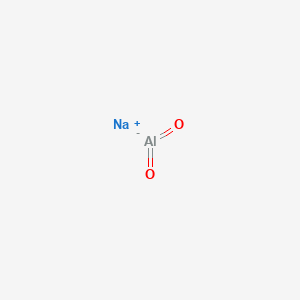
Sodium aluminate
Sodium aluminate, solid is an odorless white powdered solid. Toxic by ingestion and corrosive to tissue. Used in water purification. — CAMEO Chemicals
- IUPAC name
- sodium dioxoalumanuide
- Molecular formula
- AlNaO2
- Molecular weight
- 81.970 g/mol
- Exact mass
- 81.9611369 Da
- Topological polar surface area
- 34.1 Ų
- Hydrogen-bond donors
- 0
- Hydrogen-bond acceptors
- 3
- Covalent units
- 2
- Defined stereocentres
- 0
Also known as
16 more reported names
External database identifiers
- EPA DTXSID:DTXSID3051206
Evidence from additional scientific databases
NIH PubChem PUG-View
Attributed physical-property, hazard, environmental and use annotations.
- Color/Form: WHITE GRANULAR MASS Source: Hazardous Substances Data Bank (HSDB)
- Color/Form: WHITE AMORPHOUS POWDER Source: Hazardous Substances Data Bank (HSDB)
- Density: >1.5 g/cm³ Source: ILO-WHO International Chemical Safety Cards (ICSCs)
- Density: 1.55 @25 °C Source: PAC Chemical Database, U.S. Department of Energy
- Density: 4.63 @25 °C Source: PAC Chemical Database, U.S. Department of Energy
- Melting Point: 1650 °C Source: Hazardous Substances Data Bank (HSDB)
- Melting Point: 1650 °C Source: ILO-WHO International Chemical Safety Cards (ICSCs)
- Melting Point: 1650 °C Source: PAC Chemical Database, U.S. Department of Energy
- Physical Description: Sodium aluminate, solid is an odorless white powdered solid. Toxic by ingestion and corrosive to tissue. Used in water purification. Source: CAMEO Chemicals
- Physical Description: Liquid; Wet Solid Source: EPA Chemical Data Reporting (CDR)
- Physical Description: Liquid Source: EPA Chemical Data Reporting (CDR)
- Physical Description: White solid; [Merck Index] Hygroscopic; [ICSC] White crystalline solid, soluble in water; [Hawley] Source: Haz-Map, Information on Hazardous Chemicals and Occupational Diseases
- Physical Description: WHITE HYGROSCOPIC POWDER. Source: ILO-WHO International Chemical Safety Cards (ICSCs)
- Refractive Index: INDEX OF REFRACTION: 1.566; 1.595; 1.580 Source: Hazardous Substances Data Bank (HSDB)
- Solubility: SOL IN WATER; INSOL IN ALCOHOL Source: Hazardous Substances Data Bank (HSDB)
- Solubility: Solubility in water: very good Source: ILO-WHO International Chemical Safety Cards (ICSCs)
- pH: AQ SOLN IS STRONGLY ALKALINE Source: Hazardous Substances Data Bank (HSDB)
- Carcinogen Classification: Not listed by IARC. IARC classified aluminum production as carcinogenic to humans (Group 1), but did not implicate aluminum itself as a human carcinogen. (L135) A link between use of aluminum-containing antiperspirants and increased risk of breast cancer has been proposed (A235), but studies have not been able to establish a clear link (A15468). Source: Toxin and Toxin Target Database (T3DB)
- Exposure Routes: The substance can be absorbed into the body by inhalation of its aerosol and by ingestion. Source: ILO-WHO International Chemical Safety Cards (ICSCs)
- Exposure Routes: Oral (L739) ; inhalation (L739) Source: Toxin and Toxin Target Database (T3DB)
- First Aid: Excerpt from ERG Guide 154 [Substances - Toxic and/or Corrosive (Non-Combustible)]:; Refer to the "General First Aid" section. Specific First Aid: For corrosives, in case of contact, immediately flush skin or eyes with running water for at least 30 minutes. Additional flushing may be required. (ERG, 2024) Source: CAMEO Chemicals
- ERG2024, Guide 154 (Sodium aluminate, solution; Sodium aluminate, solid): General First Aid:; · Call 911 or emergency medical service.; · Ensure that medical personnel are aware of the material(s) involved, take precautions to protect themselves and avoid contamination.; · Move victim to fresh air if it can be done safely.; · Administer oxygen if breathing is difficult.; · If victim is not breathing:; -- DO NOT perform mouth-to-mouth resuscitation; the victim may have ingested or inhaled the substance.; -- If equipped and pulse detected, wash face and mouth, then give artificial respiration using a proper respiratory medical device (bag-valve mask, pocket mask equipped with a one-way valve or other device).; -- If no pulse detected or no respiratory medical device available, provide continuous compressions. Conduct a pulse check every two minutes or monitor for any signs of spontaneous respirations.; · Remove and isolate contaminated clothing and shoes.; · For minor skin contact, avoid spreading material on unaffected skin.; · In case of contact with substance, remove immediately by flushing skin or eyes with running water for at least 20 minutes.; · For severe burns, immediate medical attention is required.; · Effects of exposure (inhalation, ingestion, Source: Emergency Response Guidebook (ERG)
- ERG2024, Guide 154 (Sodium aluminate, solid; Sodium aluminate, solution): General First Aid:; · Call 911 or emergency medical service.; · Ensure that medical personnel are aware of the material(s) involved, take precautions to protect themselves and avoid contamination.; · Move victim to fresh air if it can be done safely.; · Administer oxygen if breathing is difficult.; · If victim is not breathing:; -- DO NOT perform mouth-to-mouth resuscitation; the victim may have ingested or inhaled the substance.; -- If equipped and pulse detected, wash face and mouth, then give artificial respiration using a proper respiratory medical device (bag-valve mask, pocket mask equipped with a one-way valve or other device).; -- If no pulse detected or no respiratory medical device available, provide continuous compressions. Conduct a pulse check every two minutes or monitor for any signs of spontaneous respirations.; · Remove and isolate contaminated clothing and shoes.; · For minor skin contact, avoid spreading material on unaffected skin.; · In case of contact with substance, remove immediately by flushing skin or eyes with running water for at least 20 minutes.; · For severe burns, immediate medical attention is required.; · Effects of exposure (inhalation, ingestion, Source: Emergency Response Guidebook (ERG)
- Note: This chemical does not meet GHS hazard criteria for 0.3% (1 of 372) of reports. Source: European Chemicals Agency (ECHA)
- Signal: Danger Source: European Chemicals Agency (ECHA)
- GHS Hazard Statements: H271 (15.9%): May cause fire or explosion; strong Oxidizer [Danger Oxidizing liquids; Oxidizing solids]; H290 (75%): May be corrosive to metals [Warning Corrosive to Metals]; H314 (98.4%): Causes severe skin burns and eye damage [Danger Skin corrosion/irritation]; H318 (65.9%): Causes serious eye damage [Danger Serious eye damage/eye irritation] Source: European Chemicals Agency (ECHA)
- Precautionary Statement Codes: P210, P220, P234, P260, P264, P264+P265, P280, P283, P301+P330+P331, P302+P361+P354, P304+P340, P305+P354+P338, P306+P360, P316, P317, P321, P363, P370+P378, P371+P380+P375, P390, P405, P406, P420, and P501 (click each P-code to see the statement) Source: European Chemicals Agency (ECHA)
- ECHA C&L Notifications Summary: Aggregated GHS information provided per 372 reports by companies from 13 notifications to the ECHA C&L Inventory. Each notification may be associated with multiple companies.; Reported as not meeting GHS hazard criteria per 1 of 372 reports by companies.; There are 12 notifications provided by 371 of 372 reports by companies with hazard statement code(s).; Information may vary between notifications depending on impurities, additives, and other factors. The percentage value in parenthesis indicates the notified classification ratio from companies that provide hazard codes. Only hazard codes with percentage values above 10% are shown. For more detailed information, please visit ECHA C&L website. Source: European Chemicals Agency (ECHA)
- GHS Hazard Statements: H290 (35.2%): May be corrosive to metals [Warning Corrosive to Metals]; H314 (90.5%): Causes severe skin burns and eye damage [Danger Skin corrosion/irritation]; H318 (69.3%): Causes serious eye damage [Danger Serious eye damage/eye irritation] Source: European Chemicals Agency (ECHA)
- Precautionary Statement Codes: P234, P260, P264, P264+P265, P280, P301+P330+P331, P302+P361+P354, P304+P340, P305+P354+P338, P316, P317, P321, P363, P390, P405, P406, and P501 (click each P-code to see the statement) Source: European Chemicals Agency (ECHA)
- ECHA C&L Notifications Summary: Aggregated GHS information provided per 264 reports by companies from 8 notifications to the ECHA C&L Inventory. Each notification may be associated with multiple companies.; Information may vary between notifications depending on impurities, additives, and other factors. The percentage value in parenthesis indicates the notified classification ratio from companies that provide hazard codes. Only hazard codes with percentage values above 10% are shown. For more detailed information, please visit ECHA C&L website. Source: European Chemicals Agency (ECHA)
- Signal: Danger Source: NITE-CMC
- GHS Hazard Statements: H314: Causes severe skin burns and eye damage [Danger Skin corrosion/irritation]; H318: Causes serious eye damage [Danger Serious eye damage/eye irritation] Source: NITE-CMC
- Precautionary Statement Codes: P260, P264, P264+P265, P280, P301+P330+P331, P302+P361+P354, P304+P340, P305+P354+P338, P316, P317, P321, P363, P405, and P501 (click each P-code to see the statement) Source: NITE-CMC
- Health Effects: Aluminum targets the nervous system and causes decreased nervous system performance and is associated with altered function of the blood-brain barrier. The accumulation of aluminum in the body may cause bone or brain diseases. High levels of aluminum have been linked to Alzheimer's disease. A small percentage of people are allergic to aluminium and experience contact dermatitis, digestive disorders, vomiting or other symptoms upon contact or ingestion of products containing aluminium. (L739, L740) Source: Toxin and Toxin Target Database (T3DB)
- Toxicity Summary: The main target organs of aluminum are the central nervous system and bone. Aluminum binds with dietary phosphorus and impairs gastrointestinal absorption of phosphorus. The decreased phosphate body burden results in osteomalacia (softening of the bones due to defective bone mineralization) and rickets. Aluminum's neurotoxicity is believed to involve several mechanisms. Changes in cytoskeletal protein functions as a results of altered phosphorylation, proteolysis, transport, and synthesis are believed to be one cause. Aluminum may induce neurobehavioral effects by affecting permeability of the blood-brain barrier, cholinergic activity, signal transduction pathways, lipid peroxidation, and impair neuronal glutamate nitric oxide-cyclic GMP pathway, as well as interfere with metabolism of essential trace elements because of similar coordination chemistries and consequent competitive interactions. It has been suggested that aluminum's interaction with estrogen receptors increases the expression of estrogen-related genes and thereby contributes to the progression of breast cancer (A235), but studies have not been able to establish a clear link between aluminum and increased risk of brea Source: Toxin and Toxin Target Database (T3DB)
- Environmental Fate: AQUATIC FATE: The adsorption of aluminum by fine particulates was studied in Whitray Beck, a hill stream in England. ... Uptake of aluminum by the particles increased with total aluminum , with pH, and with particle concentration, although the fraction of aluminum bound at a given pH and particle concentration decreased with total aluminum ... . /Total aluminum/ Source: Hazardous Substances Data Bank (HSDB)
- Environmental Fate: TERRESTRIAL FATE: Air dried, <2 mm fractions of 3 soil samples from The Netherlands and 1 from New Hampshire, were taken from the surface and subsurface horizons of two podzols (Haplorthods) and of a recent driftsand (Udipsamment). Duplicate samples of each emulsion soil horizon were leached ... with aqueous hydrogen chloride (pH 3.0). ... Charge balances of the leachates indicate that dissolved aluminum is present mainly as aquo-aluminum +3. Only in leachates of podzol Bhs horizons is a significant fraction (20-30%) of dissolved aluminum organically complexed. Dissolved aluminum concn are significantly correlated with the organic (tetrasodium pyrophosphate extractable) aluminum content of the soil sample. Mobility of aluminum in the Hubbard Brook soils is significantly lower than in the Dutch soils, because of higher soil solution pH values. /Aluminum cmpd/ Source: Hazardous Substances Data Bank (HSDB)
- Environmental Fate: TERRESTRIAL FATE: Albic and spodic soil horizons were sampled from old growth eastern white pine/mixed northern hardwoods. Adirondacks, and an ochric soil horizon was sampled from the Appalachian plateau of NY State. 21 Three horizon forest floor and 21 forest floor/mineral soil (field moist equivalent of 12.0 oven dry albic, spodic, or ochric mineral soil) columns were leached in triplicate with either 10 uM nitric acid (pH 5), 5 uM sulfuric acid (pH 5), 100 uM nitric acid (pH 4), 50 uM sulfuric acid (pH 4), 1000 uM nitric acid (pH 3), 500 uM sulfuric acid (pH 3), or distilled, deionized water (pH 5.7) control treatment). Nitric acid leached more aluminum than did sulfuric acid from forest floor/spodic soil columns. Increasing the nitric acid concn from pH 3-5 increased total aluminum concn in leachates from 0.70 to 0.85 mM, while increasing sulfuric acid had no effect. Addition of pH 3 sulfuric acid to forest floor/spodic columns raised leachate pH relative to pH 3 nitric acid and controls, and resulted in the lowest aluminum concn of all treatments in the first 3 of 4 sequential leachings. /Aluminum/ Source: Hazardous Substances Data Bank (HSDB)
- Environmental Fate: TERRESTRIAL FATE: Albic and spodic soil horizons were sampled from old growth eastern white pine/mixed northern hardwoods sites in the Adirondacks, and an ochric soil horizon was sampled from the Appalachian Plateau of NY State. 9 Three horizon forest floo, 9 mineral soil (field moist equivalent of 12.0 oven dry albic, spodic, or ochric mineral soil) and 9 forest floor/mineral soil columns were leached with 60 ml of (a) 10 mM ammonium nitrate (control), (b) 1.0 mM nitric acid in 10 mM ammonium nitrate (pH 3), and (c) 1.0 mM ammonium nitrate (pH 3) at the rate of 10 ml/h. The above procedure was repeated on each mineral soil without a forest floor, except leaching soln were 0.5 mM calcium nitrate or calcium sulfate, each in 10 mM ammonium nitrate. Adding 2 and 0.5 cmol sub c (H+)/kg to forest floor and mineral soils, respectively, simulated snowmelt additions. Total aluminum concn in leachates from forest floor/albic or forest floor/ochric columns were greater than the sum of concn in leachates from the forest floor and mineral horizon when leached separately. This positive synergistic behavior of the forest floor-mineral horizon sequences was also observed in the forest floor-spodi Source: Hazardous Substances Data Bank (HSDB)
- Consumer Uses: Flocculating agent Source: EPA Chemical Data Reporting (CDR)
- Consumer Uses: Other Source: EPA Chemical Data Reporting (CDR)
- Industry Uses: Processing aids not otherwise specified; Bleaching agent; pH regulating agent; Other; Solids separation (precipitating) agent, not otherwise specified; Flocculating agent; Pigment; Intermediate; Reducing agent Source: EPA Chemical Data Reporting (CDR)
- Industry Uses: Other; Flocculating agent; Intermediate Source: EPA Chemical Data Reporting (CDR)
- Sources/Uses: Used for printing on fabrics (mordant), making foundry molds (binder), to soften and purify water, to harden building stones, to process acrylic and polyester fibers, to remove carbonyl sulfide from gas streams, and to improve sizing and filler retention in the paper industry; Also used to make soap, lake colors, milk-glass, cleansing compounds, alumina-based catalysts, and zeolites; [HSDB] Source: Haz-Map, Information on Hazardous Chemicals and Occupational Diseases
- Industrial Processes with risk of exposure: Molding and Core Making [Category: Foundry]; Pulp and Paper Processing [Category: Industry]; Textiles (Printing, Dyeing, or Finishing) [Category: Industry]; Glass Manufacturing [Category: Industry] Source: Haz-Map, Information on Hazardous Chemicals and Occupational Diseases
- Uses: PRINTING ON FABRICS; SOAP; HARDENING BUILDING STONES; MFR LAKE COLORS & MILK-GLASS; SIZING PAPER; WATER SOFTENER. Source: Hazardous Substances Data Bank (HSDB)
- Uses: SIZING IMPROVER & FILLER RETENTION AID IN PAPER INDUSTRY; ADDITIVE TO TITANIUM DIOXIDE PIGMENTS FOR OUTDOOR PAINTS; COMPONENT OF ALKALINE WASHING SOLUTIONS, EG, FOR GLASS; ACRYLIC & POLYESTER FIBER PROCESSING ADDITIVE; CHEM INT FOR ALUMINA-BASED CATALYSTS; BINDER IN FOUNDRY MOLDS. Source: Hazardous Substances Data Bank (HSDB)
- Uses: Mordant, zeolites, water purification, sizing paper, manufacture of milk-glass, soap & cleansing compounds. Source: Hazardous Substances Data Bank (HSDB)
- Uses: /In removing/ carbonyl sulfide from a gas stream. Source: Hazardous Substances Data Bank (HSDB)
- Uses: MEDICATION Source: Hazardous Substances Data Bank (HSDB)
- Uses: Sodium aluminate is used in water treatment as an adjunct to water softening systems, as a coagulant aid to improve flocculation, and for removing dissolved silica and phosphates. In construction technology, sodium aluminate is employed to accelerate the solidification of concrete, mainly when working during frost. Sodium aluminate is also used in the paper industry, for fire brick production, alumina production and so forth. (L18) Source: Toxin and Toxin Target Database (T3DB)
Mapped by: Existing checksum-valid CAS to unique PubChem CID match. Retrieved: 2026-08-31. Open source record
Scientific classifications and hazard annotations provide context and do not replace the market-specific regulatory decision shown above.
Additional source coverage and match status
| Source | Result | Checked |
|---|---|---|
| NIH PubChem PUG-View | Exact match | 2026-08-31 |
A recorded no-match is useful evidence that the source was checked; it is not a claim that the substance does not exist elsewhere.
Retrieved from NIH PubChem on 2026-08-31 by checksum-valid CAS matching. Chemical properties do not replace the regulatory decision on this page.