
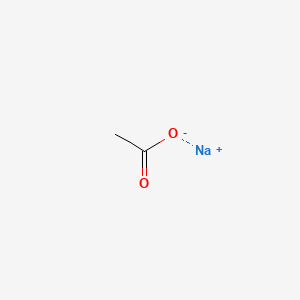
CAS 127-09-3PubChem CID 517045
Sodium Acetate
Sodium acetate is an organic sodium salt. It contains an acetate. — ChEBI
- IUPAC name
- sodium acetate
- Molecular formula
- C2H3NaO2
- Molecular weight
- 82.03 g/mol
- Exact mass
- 82.00307362 Da
- Topological polar surface area
- 40.1 Ų
- Hydrogen-bond donors
- 0
- Hydrogen-bond acceptors
- 2
- Covalent units
- 2
- Defined stereocentres
- 0
Also known as
Acetic acid, sodium saltSodium acetate anhydrousSodium acetate, anhydrousAnhydrous sodium acetateSodium ethanoateSodii acetasNatrium aceticumFEMA No. 3024
16 more reported names
NatriumacetatOctan sodnyFEMA Number 3024Acetic acid, sodium salt (1:1)Sodium acetate,anhydrousNVG71ZZ7P0Sodium acetate (3h2o)NSC-77459INS NO.262(I)CHEBI:32954INS-262(I)E-262(I)204-823-8Natrum AceticumRefChem:6683Monosodium acetate trihydrate
External database identifiers
- ChEBI:CHEBI:32954
- ChEMBL:CHEMBL1354
- EPA DTXSID:DTXSID2027044
Evidence from additional scientific databases
NIH PubChem PUG-View
Exact identifier match517045
Attributed physical-property, hazard, environmental and use annotations.
- Autoignition Temperature: 1125 °F /SODIUM ACETATE TRIHYDRATE/ Source: Hazardous Substances Data Bank (HSDB)
- Autoignition Temperature: 607 °C Source: ILO-WHO International Chemical Safety Cards (ICSCs)
- Color/Form: WHITE GRANULAR POWDER OR MONOCLINIC CRYSTALS Source: Hazardous Substances Data Bank (HSDB)
- Color/Form: Colorless Source: Hazardous Substances Data Bank (HSDB)
- Density: 1.528 g/ml Source: Hazardous Substances Data Bank (HSDB)
- Density: 1.5 g/cm³ Source: ILO-WHO International Chemical Safety Cards (ICSCs)
- Density: 1.528 @25 °C Source: PAC Chemical Database, U.S. Department of Energy
- Melting Point: 324 °C Source: Hazardous Substances Data Bank (HSDB)
- Melting Point: 328 °C Source: ILO-WHO International Chemical Safety Cards (ICSCs)
- Melting Point: 328.2 °C Source: PAC Chemical Database, U.S. Department of Energy
- Odor: Odorless Source: Hazardous Substances Data Bank (HSDB)
- Physical Description: Other Solid; Dry Powder; Large Crystals; Liquid; Other Solid; Liquid Source: EPA Chemical Data Reporting (CDR)
- Physical Description: Anhydrous:White, odourless, granular, hygroscopic powder Source: EU Food Improvement Agents
- Physical Description: White hygroscopic solid; [ICSC] Colorless odorless hygroscopic solid; [CHEMINFO] White odorless crystalline powder; [MSDSonline] Source: Haz-Map, Information on Hazardous Chemicals and Occupational Diseases
- Physical Description: WHITE HYGROSCOPIC CRYSTALLINE POWDER. Source: ILO-WHO International Chemical Safety Cards (ICSCs)
- Refractive Index: INDEX OF REFRACTION: 1.464 Source: Hazardous Substances Data Bank (HSDB)
- Solubility: WATER: 119 G/100 ML @ 0 °C, 170.15 G/100 ML @ 100 °C; SLIGHTLY SOL IN ALCOHOL Source: Hazardous Substances Data Bank (HSDB)
- Solubility: Solubility in water, g/100ml at 20 °C: 46.5 Source: ILO-WHO International Chemical Safety Cards (ICSCs)
- Vapor Pressure: 0.00000071 [mmHg] Source: Haz-Map, Information on Hazardous Chemicals and Occupational Diseases
- pH: 8,0-9,5 (1 % aqueous solution) Source: EU Food Improvement Agents
- Exposure Routes: The substance can be absorbed into the body by ingestion. Source: ILO-WHO International Chemical Safety Cards (ICSCs)
- Note: This chemical does not meet GHS hazard criteria for 95.4% (1320 of 1383) of all reports. Source: European Chemicals Agency (ECHA)
- GHS Hazard Statements: Not Classified; Reported as not meeting GHS hazard criteria by 1320 of 1383 companies (only 4.6% companies provided GHS information). For more detailed information, please visit ECHA C&L website. Source: European Chemicals Agency (ECHA)
- ECHA C&L Notifications Summary: Aggregated GHS information provided per 1383 reports by companies from 10 notifications to the ECHA C&L Inventory.; Reported as not meeting GHS hazard criteria per 1320 of 1383 reports by companies.; There are 7 notifications provided by 63 of 1383 reports by companies with hazard statement code(s).; Information may vary between notifications depending on impurities, additives, and other factors. The percentage value in parenthesis indicates the notified classification ratio from companies that provide hazard codes. Only hazard codes with percentage values above 10% are shown. For more detailed information, please visit ECHA C&L website. Source: European Chemicals Agency (ECHA)
- Cosmetic Ingredient Review Finding(s): Safe in the present practices of use and concentration. Ingredient, concentration, and use information are available in documents discoverable at https://cir-reports.cir-safety.org Source: Cosmetic Ingredient Review (CIR)
- Consumer Uses: Photosensitive agent; Preservative; Not Known or Reasonably Ascertainable; Soil amendments (fertilizers); Cleaning agent; pH regulating agent; Other Source: EPA Chemical Data Reporting (CDR)
- Industry Uses: Soil amendments (fertilizers); Not Known or Reasonably Ascertainable; Catalyst; Preservative; Cleaning agent; Etching agent; Chelating agent; Flavoring and nutrient; Antioxidant; pH regulating agent; Plating agent Source: EPA Chemical Data Reporting (CDR)
- Cosmetic Ingredient Review Link: CIR ingredient: Sodium Acetate Source: Cosmetic Ingredient Review (CIR)
- Sources/Uses: Used as an auxiliary in acetylations and to make acetyl chloride, cinnamic acid, cellulose acetate, and pharmaceuticals; Also used in soaps, meat preservatives, electroplating, tanning, and as a dehydrating agent, buffer in photography, catalyst for dyes and polyester resins, mordant for dyes; Also used in medicine (systemic and urinary alkalizer and bicarbonate precursor in parenteral nutrition) and veterinary medicine (electrolyte source and treatment of bovine ketosis); [HSDB] Source: Haz-Map, Information on Hazardous Chemicals and Occupational Diseases
- Industrial Processes with risk of exposure: Electroplating [Category: Plate]; Leather Tanning and Processing [Category: Industry]; Photographic Processing [Category: Other]; Textiles (Printing, Dyeing, or Finishing) [Category: Industry] Source: Haz-Map, Information on Hazardous Chemicals and Occupational Diseases
- Uses: AUXILIARY IN ACETYLATIONS /ANHYDROUS SODIUM ACETATE/ Source: Hazardous Substances Data Bank (HSDB)
- Uses: IN PHOTOGRAPHY; AS REAGENT ... TO ELIMINATE EFFECT OF STRONG ACIDS (BUFFER); FOR FOOT WARMERS & MILK BOTTLE WARMERS. /SODIUM ACETATE TRIHYDRATE/ Source: Hazardous Substances Data Bank (HSDB)
- Uses: IN MFR PHARMACEUTICALS; SOAPS; PURIFICATION OF GLUCOSE; MEAT PRESERVATION; ELECTROPLATING; TANNING; DEHYDRATING AGENT. Source: Hazardous Substances Data Bank (HSDB)
- Uses: BUFFER Source: Hazardous Substances Data Bank (HSDB)
- Uses: For more Uses (Complete) data for SODIUM ACETATE (10 total), please visit the HSDB record page. Source: Hazardous Substances Data Bank (HSDB)
Mapped by: Existing checksum-valid CAS to unique PubChem CID match. Retrieved: 2026-08-31. Open source record
Scientific classifications and hazard annotations provide context and do not replace the market-specific regulatory decision shown above.
Additional source coverage and match status
| Source | Result | Checked |
|---|---|---|
| NIH PubChem PUG-View | Exact match | 2026-08-31 |
A recorded no-match is useful evidence that the source was checked; it is not a claim that the substance does not exist elsewhere.
Retrieved from NIH PubChem on 2026-08-31 by checksum-valid CAS matching. Chemical properties do not replace the regulatory decision on this page.