Official EU label nameGlossary entry 2471

ASPARTIC ACID

This record confirms an official common ingredient name for EU cosmetic product labelling. It does not by itself confirm that the substance is permitted, unrestricted or safe.

Global evidence snapshot

The resolved identity has matching regulatory evidence in 0 of 13 indexed market datasets: 0 country records and 0 EU Annex records. Every result and evidence gap is listed below.

0 markets with evidence
Markets checked
13
Markets with evidence
0
Evidence gaps
13
Resolved identifiers
4

Resolved substance identity

CAS:56-84-8617-45-8
EC:200-291-6210-513-3
Ingredient index records:
ASPARTIC ACID
Cosmetic functions: ANTISTATIC, FRAGRANCE, HAIR CONDITIONING, SKIN CONDITIONING

Aspartic acid

2 matched or reported names
ASPARTIC ACIDaspartic acid

Regulatory evidence across markets

None of the 13 markets tracked here holds an imported rule under the name ASPARTIC ACID.

That is a statement about this inventory, not about the law: no imported rule is not evidence that a substance is permitted. A rule may exist under a different name, under a CAS or EC number this glossary entry does not carry, or in a dataset not yet imported.

Chemical identity and properties

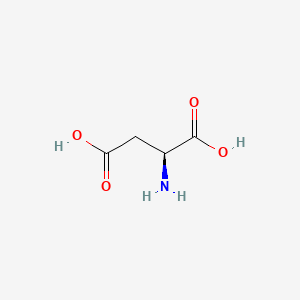
PubChem 2D chemical structure for CAS 56-84-8
CAS 56-84-8PubChem CID 5960

L-Aspartic Acid

L-aspartic acid is the L-enantiomer of aspartic acid. It has a role as a neurotransmitter, a mouse metabolite and an Escherichia coli metabolite. It is a L-alpha-amino acid, an aspartate family amino acid, an aspartic acid and a proteinogenic amino acid. It is a conjugate acid of a L-aspartate(1-). It is an enantiomer of a D-aspartic acid. — ChEBI

IUPAC name
(2S)-2-aminobutanedioic acid
Molecular formula
C4H7NO4
Molecular weight
133.10 g/mol
Exact mass
133.03750770 Da
XLogP3
-2.8
Topological polar surface area
101.0 Ų
Hydrogen-bond donors
3
Hydrogen-bond acceptors
5
Covalent units
1
Defined stereocentres
1

Also known as

aspartic acidAsparagic acidL-Aminosuccinic acid(S)-2-Aminosuccinic acidAsparaginic acidL-Asparaginic acidL-Asparagic acid(S)-Aspartic acid
16 more reported names
Aspartic acid, L-(S)-Aminobutanedioic acidL-AsparaginsaeureAcidum asparticumL-(+)-Aspartic acidAsparaginsaeureAcido aspartico2-aminosuccinic acidAcide aspartiqueAminosuccinic acidButanedioic acid, amino-, (S)-(L)-ASPARTIC ACIDDeamidated asparagine(S)-2-aminobutanedioic acid30KYC7MIAIFEMA NO. 3656
External database identifiers

Retrieved from NIH PubChem on 2026-08-31 by checksum-valid CAS matching. Chemical properties do not replace the regulatory decision on this page.
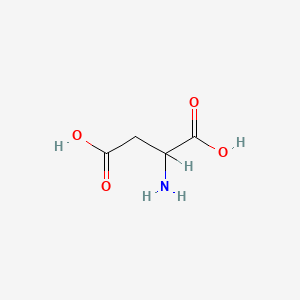
PubChem 2D chemical structure for CAS 617-45-8
CAS 617-45-8PubChem CID 424

(+-)-Aspartic Acid

Aspartic acid is an alpha-amino acid that consists of succinic acid bearing a single alpha-amino substituent. It has a role as a fundamental metabolite. It is a polar amino acid, an alpha-amino acid and a C4-dicarboxylic acid. It contains a carboxymethyl group. It is a conjugate acid of an aspartate and an aspartate(1-). — ChEBI

IUPAC name
2-aminobutanedioic acid
Molecular formula
C4H7NO4
Molecular weight
133.10 g/mol
Exact mass
133.03750770 Da
XLogP3
-2.8
Topological polar surface area
101.0 Ų
Hydrogen-bond donors
3
Hydrogen-bond acceptors
5
Covalent units
1
Defined stereocentres
0

Also known as

RefChem:905505DL-ASPARTIC ACIDDL-Aminosuccinic acidDL-Asparagic acidAspartic acid, DL-DL-Asp-OHAcid D,L-aspartH-DL-Asp-OH
16 more reported names
(+/-)-2-Aminosuccinic acid(+/-)-Aspartic AcidDL-ASPARTIC ACID (3-13C)L-ASPARTIC-4-13C ACIDD-Asparagic acid28XF4669EPNSC-141379Butanedioic acid, (S)-.alpha.-Aminosuccinic acidDL-ASPARTICACID(s)-butanedioicacid,l-aspartic acid(R)-(-)-Aminosuccinic acidEINECS 210-513-3NSC 141379NSC 620336
External database identifiers

Retrieved from NIH PubChem on 2026-08-31 by checksum-valid CAS matching. Chemical properties do not replace the regulatory decision on this page.

Take this record further

Screen in a formulaOpen standalone comparison

Official source and scope

Imported from Commission Implementing Decision (EU) 2025/1175 (dataset version EU 2025/1175). The glossary supplies common ingredient names for the ingredient list required by Article 19(1)(g); it is not an approval or safety list.

Open official Decision