Pyridoxine
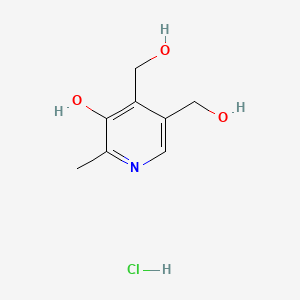
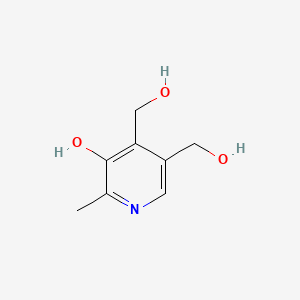
Pyridoxine is the 4-methanol form of vitamin B6, an important water-soluble vitamin that is naturally present in many foods. As its classification as a vitamin implies, Vitamin B6 (and pyridoxine) are essential nutrients required for normal functioning of many biological systems within the body. While many plants and microorganisms are able to synthesize pyridoxine through endogenous biological processes, animals must obtain it through their diet. More specifically, pyridoxine is converted to pyridoxal 5-phosphate in the body, which is an important coenzyme for synthesis of amino acids, neurotransmitters (serotonin, norepinephrine), sphingolipids, and aminolevulinic acid. It's important to note that Vitamin B6 is the collective term for a group of three related compounds, pyridoxine, pyridoxal, and pyridoxamine, and their phosphorylated derivatives, pyridoxine 5'-phosphate, pyridoxal 5'-phosphate and pyridoxamine 5'-phosphate. Although all six of these compounds should technically be referred to as vitamin B6, the term vitamin B6 is commonly used interchangeably with just one of them, pyridoxine. Vitamin B6, principally in its biologically active coenzyme form pyridoxal 5'-phosphate, is involved in a wide range of biochemical reactions, including the metabolism of amino acids and glycogen, the synthesis of nucleic acids, hemogloblin, sphingomyelin and other sphingolipids, and the synthesis of the neurotransmitters serotonin, dopamine, norepinephrine and gamma-aminobutyric acid (GABA). Pyridoxine is used medically for the treatment of vitamin B6 deficiency and for the prophylaxis of isoniazid-induced peripheral neuropathy (due to [DB00951]'s mechanism of action which competitively inhibits the action of pyridoxine in the above-mentioned metabolic functions). It is also used in combination with [DB00366] (as the commercially available product Diclectin) for the treatment of nausea and vomiting in pregnancy. — DrugBank
- IUPAC name
- 4,5-bis(hydroxymethyl)-2-methylpyridin-3-ol
- Molecular formula
- C8H11NO3
- Molecular weight
- 169.18 g/mol
- Exact mass
- 169.07389321 Da
- XLogP3
- -0.8
- Topological polar surface area
- 73.6 Ų
- Hydrogen-bond donors
- 3
- Hydrogen-bond acceptors
- 4
- Covalent units
- 1
- Defined stereocentres
- 0
Also known as
16 more reported names
External database identifiers
- ChEBI:CHEBI:16709
- ChEMBL:CHEMBL1364
- EPA DTXSID:DTXSID4023541
- PubMed:23112434
- PubMed:23105553
- PubMed:23056755
- PubMed:23022904
- PubMed:23022070
- PubMed:23001013
- PubMed:22980867
- PubMed:22972088
- PubMed:22970527
- PubMed:22956877
- PubMed:22938800
- PubMed:22908773
Evidence from additional scientific databases
NIH PubChem PUG-View
Attributed physical-property, hazard, environmental and use annotations.
- LogP: -0.77 Source: DrugBank
- LogP: -0.77 Source: Human Metabolome Database (HMDB)
- Melting Point: 159-162 °C Source: DrugBank
- Melting Point: 159 - 162 °C Source: Human Metabolome Database (HMDB)
- Physical Description: Dry Powder Source: EPA Chemical Data Reporting (CDR)
- Physical Description: White powder; [Alfa Aesar MSDS] Source: Haz-Map, Information on Hazardous Chemicals and Occupational Diseases
- Physical Description: Solid Source: Human Metabolome Database (HMDB)
- Solubility: 220000 mg/L Source: DrugBank
- Solubility: 79 mg/mL Source: Human Metabolome Database (HMDB)
- Vapor Pressure: 0.00000028 [mmHg] Source: Haz-Map, Information on Hazardous Chemicals and Occupational Diseases
- Carcinogen Classification: No indication of carcinogenicity to humans (not listed by IARC). Source: Toxin and Toxin Target Database (T3DB)
- Exposure Routes: Oral; parenteral (intramuscular). The B vitamins are readily absorbed from the gastrointestinal tract, except in malabsorption syndromes. Pyridoxine is absorbed mainly in the jejunum. Source: Toxin and Toxin Target Database (T3DB)
- Note: This chemical does not meet GHS hazard criteria for 3.8% (2 of 52) of reports. Source: European Chemicals Agency (ECHA)
- Signal: Warning Source: European Chemicals Agency (ECHA)
- GHS Hazard Statements: H315 (96.2%): Causes skin irritation [Warning Skin corrosion/irritation]; H319 (96.2%): Causes serious eye irritation [Warning Serious eye damage/eye irritation]; H335 (94.2%): May cause respiratory irritation [Warning Specific target organ toxicity, single exposure; Respiratory tract irritation] Source: European Chemicals Agency (ECHA)
- Precautionary Statement Codes: P261, P264, P264+P265, P271, P280, P302+P352, P304+P340, P305+P351+P338, P319, P321, P332+P317, P337+P317, P362+P364, P403+P233, P405, and P501 (click each P-code to see the statement) Source: European Chemicals Agency (ECHA)
- ECHA C&L Notifications Summary: Aggregated GHS information provided per 52 reports by companies from 8 notifications to the ECHA C&L Inventory. Each notification may be associated with multiple companies.; Reported as not meeting GHS hazard criteria per 2 of 52 reports by companies.; There are 7 notifications provided by 50 of 52 reports by companies with hazard statement code(s).; Information may vary between notifications depending on impurities, additives, and other factors. The percentage value in parenthesis indicates the notified classification ratio from companies that provide hazard codes. Only hazard codes with percentage values above 10% are shown. For more detailed information, please visit ECHA C&L website. Source: European Chemicals Agency (ECHA)
- Toxicity Summary: Vitamin B6 is the collective term for a group of three related compounds, pyridoxine (PN), pyridoxal (PL) and pyridoxamine (PM), and their phosphorylated derivatives, pyridoxine 5'-phosphate (PNP), pyridoxal 5'-phosphate (PLP) and pyridoxamine 5'-phosphate (PMP). Although all six of these compounds should technically be referred to as vitamin B6, the term vitamin B6 is commonly used interchangeably with just one of them, pyridoxine. Vitamin B6, principally in its biologically active coenzyme form pyridoxal 5'-phosphate, is involved in a wide range of biochemical reactions, including the metabolism of amino acids and glycogen, the synthesis of nucleic acids, hemogloblin, sphingomyelin and other sphingolipids, and the synthesis of the neurotransmitters serotonin, dopamine, norepinephrine and gamma-aminobutyric acid (GABA). Source: Toxin and Toxin Target Database (T3DB)
- Consumer Uses: Other Source: EPA Chemical Data Reporting (CDR)
- Industry Uses: Other Source: EPA Chemical Data Reporting (CDR)
- Sources/Uses: The 4-methanol form of vitamin B6 that is converted to the coenzyme pyridoxal phosphate; [ChemIDplus] Permitted for use as an inert ingredient in non-food pesticide products; [EPA] Source: Haz-Map, Information on Hazardous Chemicals and Occupational Diseases
- Uses: Use (kg; approx.) in Germany (2009): >7500; Consumption (g per capita; approx.) in Germany (2009): 0.0916; Excretion rate: 1; Calculated removal (%): 92.1 Source: NORMAN Suspect List Exchange
- Uses: For the treatment of vitamin B6 deficiency and for the prophylaxis of isoniazid-induced peripheral neuropathy. Source: Toxin and Toxin Target Database (T3DB)
Mapped by: Existing checksum-valid CAS to unique PubChem CID match. Retrieved: 2026-08-31. Open source record
Scientific classifications and hazard annotations provide context and do not replace the market-specific regulatory decision shown above.
Additional source coverage and match status
| Source | Result | Checked |
|---|---|---|
| NIH PubChem PUG-View | Exact match | 2026-08-31 |
A recorded no-match is useful evidence that the source was checked; it is not a claim that the substance does not exist elsewhere.
Retrieved from NIH PubChem on 2026-08-31 by checksum-valid CAS matching. Chemical properties do not replace the regulatory decision on this page.