
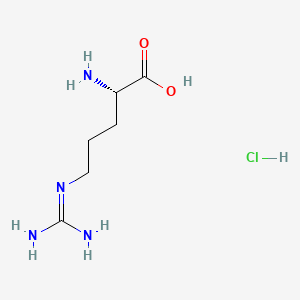
CAS 1119-34-2PubChem CID 66250
L-Arginine, monohydrochloride
Arginine hydrochloride is a L-alpha-amino acid. — ChEBI
- IUPAC name
- (2S)-2-amino-5-(diaminomethylideneamino)pentanoic acid;hydrochloride
- Molecular formula
- C6H15ClN4O2
- Molecular weight
- 210.66 g/mol
- Exact mass
- 210.0883534 Da
- Topological polar surface area
- 128.0 Ų
- Hydrogen-bond donors
- 5
- Hydrogen-bond acceptors
- 4
- Covalent units
- 2
- Defined stereocentres
- 1
Also known as
Arginine HydrochlorideL-ARGININE HCLR-GeneR-gene 10F7LTH1E20YNSC-203450NSC-7914Hydrochloride, arginine
16 more reported names
NSC7914RefChem:5562214-275-1L-Arginine hydrochlorideL-Arginine monohydrochlorideH-Arg-OH.HClArginine HClArginine monohydrochlorideArgamineArgiveneDetoxarginL-(+)-Arginine monohydrochlorideLevarginL-Arginine, hydrochloride (1:1)Minophagen A(+)-L-Arginine hydrochloride
External database identifiers
- ChEBI:CHEBI:31235
- ChEMBL:CHEMBL1200381
- EPA DTXSID:DTXSID20883650
- PubMed:1175
Evidence from additional scientific databases
NIH PubChem PUG-View
Exact identifier match66250
Attributed physical-property, hazard, environmental and use annotations.
- Carcinogen Classification: No indication of carcinogenicity to humans (not listed by IARC). Source: Toxin and Toxin Target Database (T3DB)
- Exposure Routes: Absorbed from the lumen of the small intestine into the enterocytes. Absorption is efficient and occurs by an active transport mechanism. Source: Toxin and Toxin Target Database (T3DB)
- Note: This chemical does not meet GHS hazard criteria for 67.8% (269 of 397) of all reports. Source: European Chemicals Agency (ECHA)
- Signal: Warning Source: European Chemicals Agency (ECHA)
- GHS Hazard Statements: H315 (31.7%): Causes skin irritation [Warning Skin corrosion/irritation]; H319 (32.2%): Causes serious eye irritation [Warning Serious eye damage/eye irritation] Source: European Chemicals Agency (ECHA)
- Precautionary Statement Codes: P264, P264+P265, P280, P302+P352, P305+P351+P338, P321, P332+P317, P337+P317, and P362+P364 (click each P-code to see the statement) Source: European Chemicals Agency (ECHA)
- ECHA C&L Notifications Summary: Aggregated GHS information provided per 397 reports by companies from 5 notifications to the ECHA C&L Inventory. Each notification may be associated with multiple companies.; Reported as not meeting GHS hazard criteria per 269 of 397 reports by companies.; There are 3 notifications provided by 128 of 397 reports by companies with hazard statement code(s).; Information may vary between notifications depending on impurities, additives, and other factors. The percentage value in parenthesis indicates the notified classification ratio from companies that provide hazard codes. Only hazard codes with percentage values above 10% are shown. For more detailed information, please visit ECHA C&L website. Source: European Chemicals Agency (ECHA)
- Cosmetic Ingredient Review Finding(s): Safe in the present practices of use and concentration. Ingredient, concentration, and use information are available in documents discoverable at https://cir-reports.cir-safety.org Source: Cosmetic Ingredient Review (CIR)
- Toxicity Summary: Many of supplemental L-arginine's activities, including its possible anti-atherogenic actions, may be accounted for by its role as the precursor to nitric oxide or NO. NO is produced by all tissues of the body and plays very important roles in the cardiovascular system, immune system and nervous system. NO is formed from L-arginine via the enzyme nitric oxide synthase or synthetase (NOS), and the effects of NO are mainly mediated by 3,'5' -cyclic guanylate or cyclic GMP. NO activates the enzyme guanylate cyclase, which catalyzes the synthesis of cyclic GMP from guanosine triphosphate or GTP. Cyclic GMP is converted to guanylic acid via the enzyme cyclic GMP phosphodiesterase. NOS is a heme-containing enzyme with some sequences similar to cytochrome P-450 reductase. Several isoforms of NOS exist, two of which are constitutive and one of which is inducible by immunological stimuli. The constitutive NOS found in the vascular endothelium is designated eNOS and that present in the brain, spinal cord and peripheral nervous system is designated nNOS. The form of NOS induced by immunological or inflammatory stimuli is known as iNOS. iNOS may be expressed constitutively in select tissues su Source: Toxin and Toxin Target Database (T3DB)
- Industry Uses: Catalyst Source: EPA Chemical Data Reporting (CDR)
- Cosmetic Ingredient Review Link: CIR ingredient: Arginine HCl Source: Cosmetic Ingredient Review (CIR)
- Sources/Uses: An essential amino acid; [Merck Index] Source: Haz-Map, Information on Hazardous Chemicals and Occupational Diseases
- Uses: Used for nutritional supplementation, also for treating dietary shortage or imbalance. Source: Toxin and Toxin Target Database (T3DB)
Mapped by: Existing checksum-valid CAS to unique PubChem CID match. Retrieved: 2026-08-31. Open source record
Scientific classifications and hazard annotations provide context and do not replace the market-specific regulatory decision shown above.
Additional source coverage and match status
| Source | Result | Checked |
|---|---|---|
| NIH PubChem PUG-View | Exact match | 2026-08-31 |
A recorded no-match is useful evidence that the source was checked; it is not a claim that the substance does not exist elsewhere.
Retrieved from NIH PubChem on 2026-08-31 by checksum-valid CAS matching. Chemical properties do not replace the regulatory decision on this page.