
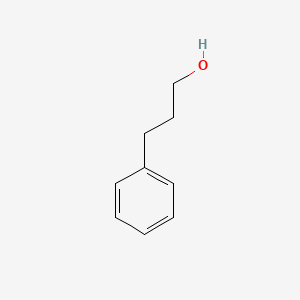
CAS 122-97-4CAS 1335-12-2PubChem CID 31234
Benzenepropanol
3-Phenyl-1-propanol is a monocyclic arene. — ChEBI
- IUPAC name
- 3-phenylpropan-1-ol
- Molecular formula
- C9H12O
- Molecular weight
- 136.19 g/mol
- Exact mass
- 136.088815002 Da
- XLogP3
- 1.9
- Topological polar surface area
- 20.2 Ų
- Hydrogen-bond donors
- 1
- Hydrogen-bond acceptors
- 1
- Covalent units
- 1
- Defined stereocentres
- 0
Also known as
3-PHENYL-1-PROPANOL3-Phenylpropanol3-Phenylpropyl alcohol3-BenzenepropanolHydrocinnamic alcohol3-Phenyl-n-propanol1-Propanol, 3-phenyl-Benzylethyl alcohol
16 more reported names
gamma-Phenylpropanol1-Hydroxy-3-phenylpropaneDihydrocinnamal alcoholFEMA No. 2885U04IC2765CNSC-16942RefChem:916891204-587-6Hydrocinnamyl alcoholPhenylpropyl alcohol(3-Hydroxypropyl)benzene3-Phenylpropanol-1dihydrocinnamyl alcohol.gamma.-Phenylpropanol3-Phenyl-1-propanol (natural).gamma.-Phenylpropyl alcohol
External database identifiers
- ChEBI:CHEBI:88817
- ChEMBL:CHEMBL1606391
- EPA DTXSID:DTXSID6041638
- PubMed:23016952
- PubMed:22589903
- PubMed:22489149
- PubMed:22455592
- PubMed:22384054
- PubMed:22242720
- PubMed:22064838
- PubMed:21855595
- PubMed:21820026
- PubMed:21235243
- PubMed:21120035
- PubMed:20955755
Evidence from additional scientific databases
NIH PubChem PUG-View
Exact identifier match31234
Attributed physical-property, hazard, environmental and use annotations.
- Boiling Point: 241 °C Source: Hazardous Substances Data Bank (HSDB)
- Boiling Point: Boiling point: 508.2 - 515.15 deg K; boiling point: 119 °C at 12 mm Hg Source: Hazardous Substances Data Bank (HSDB)
- Boiling Point: 235.00 to 236.00 °C. @ 760.00 mm Hg Source: Human Metabolome Database (HMDB)
- Boiling Point: 235-236 °C Source: Joint FAO/WHO Expert Committee on Food Additives (JECFA)
- Color/Form: Colorless liquid Source: Hazardous Substances Data Bank (HSDB)
- Color/Form: Slightly viscous, colorless liquid Source: Hazardous Substances Data Bank (HSDB)
- Density: 0.995 g/cu cm at 25 °C Source: Hazardous Substances Data Bank (HSDB)
- Density: 0.993-1.002 Source: Joint FAO/WHO Expert Committee on Food Additives (JECFA)
- Flash Point: Flash Point: 212 °F/ 100 °C/ closed cup Source: Hazardous Substances Data Bank (HSDB)
- LogP: log Kow = 1.88 Source: Hazardous Substances Data Bank (HSDB)
- LogP: 1.88 Source: Human Metabolome Database (HMDB)
- Melting Point: <-18 °C Source: Hazardous Substances Data Bank (HSDB)
- Melting Point: < -18 °C Source: Human Metabolome Database (HMDB)
- Odor: Floral odor Source: Hazardous Substances Data Bank (HSDB)
- Odor: Blossomy-balsamic odor, slightly reminiscent of hyacinths Source: Hazardous Substances Data Bank (HSDB)
- Odor: Sweet, hyacinth-mignonette odor Source: Hazardous Substances Data Bank (HSDB)
- Physical Description: Liquid Source: EPA Chemical Data Reporting (CDR)
- Physical Description: Clear light yellow liquid; [Sigma-Aldrich MSDS] Source: Haz-Map, Information on Hazardous Chemicals and Occupational Diseases
- Physical Description: Liquid Source: Human Metabolome Database (HMDB)
- Physical Description: Colourless, slightly viscous liquid, sweet hyacinth odour Source: Joint FAO/WHO Expert Committee on Food Additives (JECFA)
- Refractive Index: Index of refraction: 1.5357 at 25 °C Source: Hazardous Substances Data Bank (HSDB)
- Refractive Index: Index of refraction: 1.5278 at 20 °C/D Source: Hazardous Substances Data Bank (HSDB)
- Refractive Index: 1.524-1.528 Source: Joint FAO/WHO Expert Committee on Food Additives (JECFA)
- Solubility: In water, 5,680 mg/L at 25 °C Source: Hazardous Substances Data Bank (HSDB)
- Solubility: Soluble in carbon tetrachloride; miscible with ethanol, ether Source: Hazardous Substances Data Bank (HSDB)
- Solubility: Soluble in fixed oils, propylene glycol; insoluble in glycerin Source: Hazardous Substances Data Bank (HSDB)
- Solubility: 5.68 mg/mL at 25 °C Source: Human Metabolome Database (HMDB)
- Solubility: slightly soluble in water; soluble in oils Source: Joint FAO/WHO Expert Committee on Food Additives (JECFA)
- Solubility: miscible (in ethanol) Source: Joint FAO/WHO Expert Committee on Food Additives (JECFA)
- Vapor Pressure: 0.0234 mm Hg at 25 °C (extrapolated from higher temperatures) Source: Hazardous Substances Data Bank (HSDB)
- Note: This chemical does not meet GHS hazard criteria for < 0.1% (1 of 1996) of reports. Source: European Chemicals Agency (ECHA)
- Signal: Danger Source: European Chemicals Agency (ECHA)
- GHS Hazard Statements: H314 (11.5%): Causes severe skin burns and eye damage [Danger Skin corrosion/irritation]; H315 (88.4%): Causes skin irritation [Warning Skin corrosion/irritation]; H318 (10.4%): Causes serious eye damage [Danger Serious eye damage/eye irritation]; H319 (87.1%): Causes serious eye irritation [Warning Serious eye damage/eye irritation] Source: European Chemicals Agency (ECHA)
- Precautionary Statement Codes: P260, P264, P264+P265, P280, P301+P330+P331, P302+P352, P302+P361+P354, P304+P340, P305+P351+P338, P305+P354+P338, P316, P317, P321, P332+P317, P337+P317, P362+P364, P363, P405, and P501 (click each P-code to see the statement) Source: European Chemicals Agency (ECHA)
- ECHA C&L Notifications Summary: Aggregated GHS information provided per 1996 reports by companies from 13 notifications to the ECHA C&L Inventory. Each notification may be associated with multiple companies.; Reported as not meeting GHS hazard criteria per 1 of 1996 reports by companies.; There are 12 notifications provided by 1995 of 1996 reports by companies with hazard statement code(s).; Information may vary between notifications depending on impurities, additives, and other factors. The percentage value in parenthesis indicates the notified classification ratio from companies that provide hazard codes. Only hazard codes with percentage values above 10% are shown. For more detailed information, please visit ECHA C&L website. Source: European Chemicals Agency (ECHA)
- Signal: Warning Source: Hazardous Substances Data Bank (HSDB)
- GHS Hazard Statements: H315: Causes skin irritation [Warning Skin corrosion/irritation]; H319: Causes serious eye irritation [Warning Serious eye damage/eye irritation]; H335: May cause respiratory irritation [Warning Specific target organ toxicity, single exposure; Respiratory tract irritation] Source: Hazardous Substances Data Bank (HSDB)
- Precautionary Statement Codes: P261, P264, P264+P265, P271, P280, P302+P352, P304+P340, P305+P351+P338, P319, P321, P332+P317, P337+P317, P362+P364, P403+P233, P405, and P501 (click each P-code to see the statement) Source: Hazardous Substances Data Bank (HSDB)
- NFPA Health Rating: 1 - Materials that, under emergency conditions, can cause significant irritation. Source: Hazardous Substances Data Bank (HSDB)
- NFPA Fire Rating: 1 - Materials that must be preheated before ignition can occur. Materials require considerable preheating, under all ambient temperature conditions, before ignition and combustion can occur. Source: Hazardous Substances Data Bank (HSDB)
- NFPA Instability Rating: 1 - Materials that in themselves are normally stable but that can become unstable at elevated temperatures and pressures. Source: Hazardous Substances Data Bank (HSDB)
- Toxicity Summary: IDENTIFICATION AND USE: 3-Phenylpropanol is a colorless liquid. It smells like hyacinths and tastes similar to apricot. It occurs in many fruits and berries, cinnamon and some types of balsam. 3-Phenylpropanol occurs in tobacco smoke. 3-Phenylpropanol is typically used as a perfume for applications such as antiperspirants, creams-lotions, lipsticks, talcum powder, tablet soap, shampoo, hair conditioner, bath/shower gel, detergent powder, liquid detergent, fabric softener, candles, incense. Also used in blossom compositions for balsamic and oriental notes. It is not registered for current pesticide use in the U.S., but approved pesticide uses may change periodically and so federal, state and local authorities must be consulted for currently approved uses. HUMAN EXPOSURE AND TOXICITY: In a multicenter study, 218 fragrance sensitive patients with proven contact dermatitis were patch tested. Reactions (0.9%) in fragrance sensitive patients were observed with 3-phenylpropanol at 5% in petrolatum. ANIMAL STUDIES: In rats dosed orally with 3-phenylpropanol at dose levels of 1.31, 2.56 and 5.0 g/kg/bw deaths occurred within the first 2 days. The clinical signs observed were slight lethargy Source: Hazardous Substances Data Bank (HSDB)
- Environmental Bioconcentration: An estimated BCF of 4.5 was calculated in fish for 3-phenylpropanol(SRC), using a log Kow of 1.88(1) and a regression-derived equation(2). According to a classification scheme(3), this BCF suggests the potential for bioconcentration in aquatic organisms is low(SRC). Source: Hazardous Substances Data Bank (HSDB)
- Environmental Fate: TERRESTRIAL FATE: Based on a classification scheme(1), an estimated Koc value of 71(SRC), determined from a structure estimation method(2), indicates that 3-phenylpropanol is expected to have high mobility in soil(SRC). Volatilization of 3-phenylpropanol from moist soil surfaces is not expected to be an important fate process(SRC) given a measured Henry's Law constant of <5.6X10⁻⁸ atm-cu m/mole(3). Even though the extrapolated vapor pressure is low environmentally at standard temperature and pressure, 0.0234 mm Hg at 25 °C(5), there is a detectable odor; therefore, 3-phenylpropanol may volatilize from dry soil(SRC). Utilizing the Zahn-Wellens test, 100% biodegradation was reached in 4 days(6) indicating that biodegradation is an important environmental fate procession soil(SRC). Source: Hazardous Substances Data Bank (HSDB)
- Environmental Fate: AQUATIC FATE: Based on a classification scheme(1), an estimated Koc value of 71(SRC), determined from a structure estimation method(2), indicates that 3-phenylpropanol is not expected to adsorb to suspended solids and sediment(SRC). Volatilization from water surfaces is not expected(3) based upon a measured Henry's Law constant of <5.6X10⁻⁸ atm-cu m/mole(4). According to a classification scheme(5), an estimated BCF of 4.5(SRC), from its log Kow of 1.88(6) and a regression-derived equation(2), suggests the potential for bioconcentration in aquatic organisms is low(SRC). Utilizing the Zahn-Wellens test, 100% biodegradation was reached in 4 days(7) indicating that biodegradation is an important environmental fate process in water(SRC). Source: Hazardous Substances Data Bank (HSDB)
- Environmental Fate: ATMOSPHERIC FATE: According to a model of gas/particle partitioning of semivolatile organic compounds in the atmosphere(1), 3-phenylpropanol, which has an extrapolated vapor pressure of 0.0234 mm Hg at 25 °C(2), is expected to exist solely as a vapor in the ambient atmosphere. Vapor-phase 3-phenylpropanol is degraded in the atmosphere by reaction with photochemically-produced hydroxyl radicals(SRC); the half-life for this reaction in air is estimated to be 1.4 days(SRC), calculated from its rate constant of 1.2X1-11 cu cm/molecule-sec at 25 °C(SRC) (that was derived using a structure estimation method(3). 3-Phenylpropanol does not contain chromophores that absorb at wavelengths >290 nm(4) and, therefore, is not expected to be susceptible to direct photolysis by sunlight(SRC). Source: Hazardous Substances Data Bank (HSDB)
- Consumer Uses: Solvent; Fragrance Source: EPA Chemical Data Reporting (CDR)
- Industry Uses: Flavoring and nutrient; Solvent; Fixing agent (mordant); Fragrance Source: EPA Chemical Data Reporting (CDR)
- Sources/Uses: Used as a flavoring agent; [FDA] Source: Haz-Map, Information on Hazardous Chemicals and Occupational Diseases
- Uses: For 3-phenyl-1-propanol (USEPA/OPP Pesticide Code: 040511) there are 0 labels match. /SRP: Not registered for current use in the U.S., but approved pesticide uses may change periodically and so federal, state and local authorities must be consulted for currently approved uses./ Source: Hazardous Substances Data Bank (HSDB)
- Uses: Perfumery, flavoring, laboratory reagent Source: Hazardous Substances Data Bank (HSDB)
- Uses: Used in blossom compositions for balsamic and oriental notes ... Esterification with aliphatic carboxylic acids is important because it leads to additional fragrance and flavor compounds. Source: Hazardous Substances Data Bank (HSDB)
- Uses: Preservative in cosmetics - This alcohol a natural fragrance with antimicrobial properties against bacteria and molds. It is used in combination with Heliotropin or Piperonal as a preservative for cosmetic products. Source: Hazardous Substances Data Bank (HSDB)
- Uses: For more Uses (Complete) data for 3-Phenylpropanol (6 total), please visit the HSDB record page. Source: Hazardous Substances Data Bank (HSDB)
Mapped by: Existing checksum-valid CAS to unique PubChem CID match. Retrieved: 2026-08-31. Open source record
Scientific classifications and hazard annotations provide context and do not replace the market-specific regulatory decision shown above.
Additional source coverage and match status
| Source | Result | Checked |
|---|---|---|
| NIH PubChem PUG-View | Exact match | 2026-08-31 |
A recorded no-match is useful evidence that the source was checked; it is not a claim that the substance does not exist elsewhere.
Retrieved from NIH PubChem on 2026-08-31 by checksum-valid CAS matching. Chemical properties do not replace the regulatory decision on this page.