
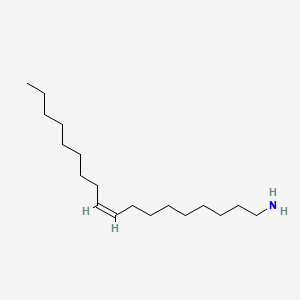
CAS 112-90-3PubChem CID 5356789
Oleylamine
- IUPAC name
- (Z)-octadec-9-en-1-amine
- Molecular formula
- C18H37N
- Molecular weight
- 267.5 g/mol
- Exact mass
- 267.292600184 Da
- XLogP3
- 7.6
- Topological polar surface area
- 26.0 Ų
- Hydrogen-bond donors
- 1
- Hydrogen-bond acceptors
- 1
- Covalent units
- 1
- Defined stereocentres
- 0
Also known as
OleamineOleyl amineArmeen OOleinamineNoram OCIS-9-OCTADECENYLAMINEAlamine 11Oleylamin
16 more reported names
Kemamine P 9899-Octadecenylamine, (Z)-(Z)-Octadec-9-enylamineZDQ1JWQ8DTNSC-664611-octadeceneamine hydrofluorideoleoylamineRefChem:577369oleylamine phosphate (1:1), (Z)-204-015-5(Z)-9-Octadecen-1-amine(z)-9-octadecenylamine9-Octadecen-1-amine, (Z)-9-Octadecen-1-amine, (9Z)-C18H37Ncis-1-Amino-9-octadecene
External database identifiers
- ChEMBL:CHEMBL1976606
- EPA DTXSID:DTXSID8026933
Evidence from additional scientific databases
NIH PubChem PUG-View
Exact identifier match5356789
Attributed physical-property, hazard, environmental and use annotations.
- Physical Description: Liquid; CBI Source: EPA Chemical Data Reporting (CDR)
- Physical Description: Liquid; mp = 10-20 deg C; [IUCLID] Light yellow pasty liquid with an amine-like odor (mp = 15-30 deg C); [ECHA] Slightly beige paste; [MSDSonline] Source: Haz-Map, Information on Hazardous Chemicals and Occupational Diseases
- Vapor Pressure: 0.0001 [mmHg] Source: Haz-Map, Information on Hazardous Chemicals and Occupational Diseases
- Signal: Danger Source: Regulation (EC) No 1272/2008 of the European Parliament and of the Council
- GHS Hazard Statements: H302: Harmful if swallowed [Warning Acute toxicity, oral]; H304: May be fatal if swallowed and enters airways [Danger Aspiration hazard]; H314: Causes severe skin burns and eye damage [Danger Skin corrosion/irritation]; H335: May cause respiratory irritation [Warning Specific target organ toxicity, single exposure; Respiratory tract irritation]; H373: May causes damage to organs through prolonged or repeated exposure [Warning Specific target organ toxicity, repeated exposure]; H400: Very toxic to aquatic life [Warning Hazardous to the aquatic environment, acute hazard]; H410: Very toxic to aquatic life with long lasting effects [Warning Hazardous to the aquatic environment, long-term hazard] Source: Regulation (EC) No 1272/2008 of the European Parliament and of the Council
- Precautionary Statement Codes: P260, P261, P264, P270, P271, P273, P280, P301+P316, P301+P317, P301+P330+P331, P302+P361+P354, P304+P340, P305+P354+P338, P316, P319, P321, P330, P331, P363, P391, P403+P233, P405, and P501 (click each P-code to see the statement) Source: Regulation (EC) No 1272/2008 of the European Parliament and of the Council
- Note: This chemical does not meet GHS hazard criteria for 3.7% (60 of 1620) of reports. Source: European Chemicals Agency (ECHA)
- Signal: Danger Source: European Chemicals Agency (ECHA)
- GHS Hazard Statements: H302 (90.6%): Harmful if swallowed [Warning Acute toxicity, oral]; H304 (69.2%): May be fatal if swallowed and enters airways [Danger Aspiration hazard]; H314 (95.7%): Causes severe skin burns and eye damage [Danger Skin corrosion/irritation]; H317 (13.8%): May cause an allergic skin reaction [Warning Sensitization, Skin]; H318 (56.7%): Causes serious eye damage [Danger Serious eye damage/eye irritation]; H335 (69.8%): May cause respiratory irritation [Warning Specific target organ toxicity, single exposure; Respiratory tract irritation]; H373 (70.6%): May causes damage to organs through prolonged or repeated exposure [Warning Specific target organ toxicity, repeated exposure]; H400 (95%): Very toxic to aquatic life [Warning Hazardous to the aquatic environment, acute hazard]; H410 (74%): Very toxic to aquatic life with long lasting effects [Warning Hazardous to the aquatic environment, long-term hazard] Source: European Chemicals Agency (ECHA)
- Precautionary Statement Codes: P260, P261, P264, P264+P265, P270, P271, P272, P273, P280, P301+P316, P301+P317, P301+P330+P331, P302+P352, P302+P361+P354, P304+P340, P305+P354+P338, P316, P317, P319, P321, P330, P331, P333+P317, P362+P364, P363, P391, P403+P233, P405, and P501 (click each P-code to see the statement) Source: European Chemicals Agency (ECHA)
- ECHA C&L Notifications Summary: Aggregated GHS information provided per 1620 reports by companies from 37 notifications to the ECHA C&L Inventory. Each notification may be associated with multiple companies.; Reported as not meeting GHS hazard criteria per 60 of 1620 reports by companies.; There are 36 notifications provided by 1560 of 1620 reports by companies with hazard statement code(s).; Information may vary between notifications depending on impurities, additives, and other factors. The percentage value in parenthesis indicates the notified classification ratio from companies that provide hazard codes. Only hazard codes with percentage values above 10% are shown. For more detailed information, please visit ECHA C&L website. Source: European Chemicals Agency (ECHA)
- Signal: Danger Source: NITE-CMC
- GHS Hazard Statements: H302: Harmful if swallowed [Warning Acute toxicity, oral]; H314: Causes severe skin burns and eye damage [Danger Skin corrosion/irritation]; H318: Causes serious eye damage [Danger Serious eye damage/eye irritation]; H371: May cause damage to organs [Warning Specific target organ toxicity, single exposure]; H400: Very toxic to aquatic life [Warning Hazardous to the aquatic environment, acute hazard]; H410: Very toxic to aquatic life with long lasting effects [Warning Hazardous to the aquatic environment, long-term hazard] Source: NITE-CMC
- Precautionary Statement Codes: P260, P264, P264+P265, P270, P273, P280, P301+P317, P301+P330+P331, P302+P361+P354, P304+P340, P305+P354+P338, P308+P316, P316, P317, P321, P330, P363, P391, P405, and P501 (click each P-code to see the statement) Source: NITE-CMC
- Signal: Danger Source: Hazardous Chemical Information System (HCIS), Safe Work Australia
- Consumer Uses: Other Source: EPA Chemical Data Reporting (CDR)
- Industry Uses: Intermediate; Corrosion inhibitor; Other; CBI Source: EPA Chemical Data Reporting (CDR)
- Sources/Uses: Used as an intermediate, surfactant in textile production, and cosmetic ingredient; Amine and organic salts: Used as petroleum product and lubricant additives, corrosion inhibitors (i.e. in oil fields), ore flotation reagents, wetting agents for asphalt, and emulsifiers; [HSDB] Used in the EU as intermediate, flotation agent for metals, lubricant in metal processing, fuel additive, corrosion inhibitor, and antistatic agent for paints; [ECHA] Source: Haz-Map, Information on Hazardous Chemicals and Occupational Diseases
- Industrial Processes with risk of exposure: Petroleum Production and Refining [Category: Industry]; Textiles (Fiber & Fabric Manufacturing) [Category: Industry]; Painting (Pigments, Binders, and Biocides) [Category: Paint]; Metal Extraction and Refining [Category: Industry] Source: Haz-Map, Information on Hazardous Chemicals and Occupational Diseases
- Uses: ...SERIES OF PRIMARY, SECONDARY, & ALIPHATIC AMINES, ORG SUBSTITUTED AMMONIA DERIV.../USED AS/ CORROSION INHIBITORS, ORE FLOTATION AGENTS, TEXTILE FINISHING AGENTS, ASPHALT ANTISTRIPPING AGENTS, RUBBER COMPOUNDING, COLOR PARTICLE DISPERSION, PETROLEUM PRODUCT ADDITIVES, CHEMICAL INTERMEDIATES /ALAMINE/ Source: Hazardous Substances Data Bank (HSDB)
- Uses: ...SERIES OF STRAIGHT CHAIN AMINES...FROM C12 THROUGH C22... /WHICH/ ARE STRONGLY HYDROPHOBIC & ARE BIODEGRADABLE. .../USED AS/ CATIONIC INTERMEDIATES; REMOVAL OF MOISTURE FROM SURFACES /KEMAMINES/ Source: Hazardous Substances Data Bank (HSDB)
- Uses: CHEM INT FOR QUATERNARY AMMONIUM SALTS Source: Hazardous Substances Data Bank (HSDB)
- Uses: CHEM INT FOR OLEYL DIAMINE & ETHOXYLATED OLEYLAMINE Source: Hazardous Substances Data Bank (HSDB)
- Uses: For more Uses (Complete) data for CIS-9-OCTADECENYLAMINE (11 total), please visit the HSDB record page. Source: Hazardous Substances Data Bank (HSDB)
Mapped by: Existing checksum-valid CAS to unique PubChem CID match. Retrieved: 2026-08-31. Open source record
Scientific classifications and hazard annotations provide context and do not replace the market-specific regulatory decision shown above.
Additional source coverage and match status
| Source | Result | Checked |
|---|---|---|
| NIH PubChem PUG-View | Exact match | 2026-08-31 |
A recorded no-match is useful evidence that the source was checked; it is not a claim that the substance does not exist elsewhere.
Retrieved from NIH PubChem on 2026-08-31 by checksum-valid CAS matching. Chemical properties do not replace the regulatory decision on this page.