
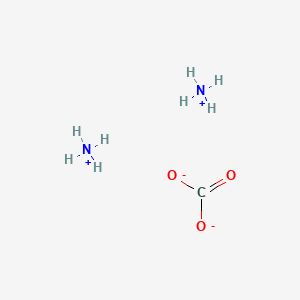
Ammonium Carbonate
Ammonium carbonate appears as a colorless crystalline solid or a white powder with a strong odor of ammonia. Noncombustible. The primary hazard is the threat to the environment. Immediate steps should be taken to limit spread to the environment. Used to make other ammonium compounds, in pharmaceuticals, in food processing. — CAMEO Chemicals
- IUPAC name
- diazanium;carbonate
- Molecular formula
- CH8N2O3
- Molecular weight
- 96.09 g/mol
- Exact mass
- 96.05349212 Da
- Topological polar surface area
- 65.2 Ų
- Hydrogen-bond donors
- 2
- Hydrogen-bond acceptors
- 3
- Covalent units
- 3
- Defined stereocentres
- 0
Also known as
16 more reported names
External database identifiers
- ChEBI:CHEBI:229630
- EPA DTXSID:DTXSID5047457
- PubMed:17506977
Evidence from additional scientific databases
NIH PubChem PUG-View
Attributed physical-property, hazard, environmental and use annotations.
- Color/Form: Colorless crystalline powder Source: Hazardous Substances Data Bank (HSDB)
- Color/Form: Colorless, hard, translucent, crystal masses, white cubes or powder Source: Hazardous Substances Data Bank (HSDB)
- Density: 1.5 at 68 °F (USCG, 1999) - Denser than water; will sink Source: CAMEO Chemicals
- Density: 1.586 @25 °C Source: PAC Chemical Database, U.S. Department of Energy
- Melting Point: 58 °C (decomposes) Source: Hazardous Substances Data Bank (HSDB)
- Melting Point: 58 °C Source: PAC Chemical Database, U.S. Department of Energy
- Odor: Strong odor of ammonia Source: Hazardous Substances Data Bank (HSDB)
- Physical Description: Ammonium carbonate appears as a colorless crystalline solid or a white powder with a strong odor of ammonia. Noncombustible. The primary hazard is the threat to the environment. Immediate steps should be taken to limit spread to the environment. Used to make other ammonium compounds, in pharmaceuticals, in food processing. Source: CAMEO Chemicals
- Physical Description: Dry Powder; Liquid Source: EPA Chemical Data Reporting (CDR)
- Physical Description: Dry Powder; Large Crystals Source: EPA Chemical Data Reporting (CDR)
- Physical Description: White powder or hard, white or translucent masses or crystals. Becomes opaque on exposure to air and is finally converted into white porous lumps or powder (of ammonium bicarbonate) due to loss of ammonia and carbon dioxide Source: EU Food Improvement Agents
- Physical Description: Colorless crystals or white powder with strong ammonia odor; [CAMEO] Source: Haz-Map, Information on Hazardous Chemicals and Occupational Diseases
- Solubility: Soluble in water Source: EU Food Improvement Agents
- Solubility: 100g/100 g water at 15 °C Source: Hazardous Substances Data Bank (HSDB)
- Solubility: Slowly soluble in 4 parts water Source: Hazardous Substances Data Bank (HSDB)
- pH: About 8,6 (5 % solution) Source: EU Food Improvement Agents
- First Aid: INHALATION: leave contaminated area.; INGESTION: give large amount of water.; EYES: flush with copious amounts of water.; SKIN: (USCG, 1999) Source: CAMEO Chemicals
- Signal: Warning Source: European Chemicals Agency (ECHA)
- GHS Hazard Statements: H302 (90.5%): Harmful if swallowed [Warning Acute toxicity, oral] Source: European Chemicals Agency (ECHA)
- Precautionary Statement Codes: P264, P270, P301+P317, P330, and P501 (click each P-code to see the statement) Source: European Chemicals Agency (ECHA)
- ECHA C&L Notifications Summary: Aggregated GHS information provided per 1585 reports by companies from 4 notifications to the ECHA C&L Inventory.; Information may vary between notifications depending on impurities, additives, and other factors. The percentage value in parenthesis indicates the notified classification ratio from companies that provide hazard codes. Only hazard codes with percentage values above 10% are shown. For more detailed information, please visit ECHA C&L website. Source: European Chemicals Agency (ECHA)
- Note: This chemical does not meet GHS hazard criteria for 6.8% (16 of 234) of reports. Source: European Chemicals Agency (ECHA)
- GHS Hazard Statements: H302 (92.3%): Harmful if swallowed [Warning Acute toxicity, oral]; H412 (22.6%): Harmful to aquatic life with long lasting effects [Hazardous to the aquatic environment, long-term hazard] Source: European Chemicals Agency (ECHA)
- Precautionary Statement Codes: P264, P270, P273, P301+P317, P330, and P501 (click each P-code to see the statement) Source: European Chemicals Agency (ECHA)
- ECHA C&L Notifications Summary: Aggregated GHS information provided per 234 reports by companies from 8 notifications to the ECHA C&L Inventory. Each notification may be associated with multiple companies.; Reported as not meeting GHS hazard criteria per 16 of 234 reports by companies.; There are 7 notifications provided by 218 of 234 reports by companies with hazard statement code(s).; Information may vary between notifications depending on impurities, additives, and other factors. The percentage value in parenthesis indicates the notified classification ratio from companies that provide hazard codes. Only hazard codes with percentage values above 10% are shown. For more detailed information, please visit ECHA C&L website. Source: European Chemicals Agency (ECHA)
- Cosmetic Ingredient Review Conclusion: The CIR Expert Panel concluded that the following 6 carbonate salts are safe in the present practices of use and concentration, as described in this safety assessment, when formulated to be non-irritating...Ammonium Carbonate... Source: Cosmetic Ingredient Review (CIR)
- Cosmetic Ingredient Review Finding(s): Safe for use in cosmetics, with qualifications Source: Cosmetic Ingredient Review (CIR)
- Consumer Uses: Not Known or Reasonably Ascertainable; Chelating agent Source: EPA Chemical Data Reporting (CDR)
- Industry Uses: Not Known or Reasonably Ascertainable; Intermediate; Solids separation (precipitating) agent, not otherwise specified Source: EPA Chemical Data Reporting (CDR)
- Industry Uses: Chemical reaction regulator; pH regulating agent; Ion exchange agent Source: EPA Chemical Data Reporting (CDR)
- Cosmetic Ingredient Review Link: CIR ingredient: Ammonium Carbonate Source: Cosmetic Ingredient Review (CIR)
- Sources/Uses: Used in synthesis of other chemicals; [CAMEO] Has been use therapeutically in smelling salts and expectorants; [HSDB] Used in baking powder, fire extinguishers, plastics, ceramics, compost heaps, and cold wave solutions; Also used to defat wool, to tan leather, to process cacao, to manufacture rubber, and to fix dyes in fabrics (mordant); [Merck Index] Source: Haz-Map, Information on Hazardous Chemicals and Occupational Diseases
- Industrial Processes with risk of exposure: Textiles (Fiber & Fabric Manufacturing) [Category: Industry]; Leather Tanning and Processing [Category: Industry]; Textiles (Printing, Dyeing, or Finishing) [Category: Industry]; Dressing Hair [Category: Other] Source: Haz-Map, Information on Hazardous Chemicals and Occupational Diseases
- Uses: Ammonium salts, baking powders, smelling-salts, fire-extinguishing compounds, pharmaceuticals, textiles (mordant), fermentation accelerator in wine manufacture, organic chemicals, ceramics, washing wool. Source: Hazardous Substances Data Bank (HSDB)
- Uses: For ammonium carbonate (USEPA/OPP Pesticide Code: 073501) there are 0 labels match. /SRP: Not registered for current use in the U.S., but approved pesticide uses may change periodically and so federal, state and local authorities must be consulted for currently approved uses./ Source: Hazardous Substances Data Bank (HSDB)
- Uses: In baking powders, for washing and defatting woolens, tanning; as mordant in dyeing; in manufacture of rubber articles; casein glue, casein colors; in fire extinguishers, smelling salts; for separating cocao constituents; as a reagent in analytical chemistry. Pharmaceutical aid (source of ammonia) Source: Hazardous Substances Data Bank (HSDB)
- Uses: Therapeutic Category: Expectorant Source: Hazardous Substances Data Bank (HSDB)
- Uses: For more Uses (Complete) data for AMMONIUM CARBONATE (9 total), please visit the HSDB record page. Source: Hazardous Substances Data Bank (HSDB)
Mapped by: Existing checksum-valid CAS to unique PubChem CID match. Retrieved: 2026-08-31. Open source record
Scientific classifications and hazard annotations provide context and do not replace the market-specific regulatory decision shown above.
Additional source coverage and match status
| Source | Result | Checked |
|---|---|---|
| EMBL-EBI ChEBI | No exact record | 2026-08-31 |
| NIH PubChem PUG-View | Exact match | 2026-08-31 |
A recorded no-match is useful evidence that the source was checked; it is not a claim that the substance does not exist elsewhere.
Retrieved from NIH PubChem on 2026-08-31 by checksum-valid CAS matching. Chemical properties do not replace the regulatory decision on this page.