
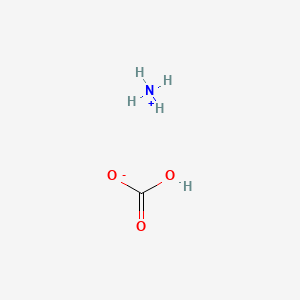
Ammonium Bicarbonate
Ammonium bicarbonate appears as a white crystalline solid having the odor of ammonia. Soluble in water. The primary hazard is the threat to the environment. Immediate steps should be taken to limit spread to the environment. Used to make other ammonium compounds, in food processing, and for other uses. — CAMEO Chemicals
- IUPAC name
- azanium hydrogen carbonate
- Molecular formula
- CH5NO3
- Molecular weight
- 79.056 g/mol
- Exact mass
- 79.026943022 Da
- Topological polar surface area
- 61.4 Ų
- Hydrogen-bond donors
- 2
- Hydrogen-bond acceptors
- 3
- Covalent units
- 2
- Defined stereocentres
- 0
Also known as
16 more reported names
External database identifiers
- ChEBI:CHEBI:184335
- EPA DTXSID:DTXSID5035618
Evidence from additional scientific databases
EMBL-EBI ChEBI
Ammonium bicarbonate
- Formula
- CHO3.H4N
- Average mass
- 79.055 g/mol
- Monoisotopic mass
- 79.02694 Da
- Formal charge
- 0
- organooxygen compound — is a (CHEBI:36963)
- organooxygen compound — is a (CHEBI:36963)
Additional curated names
Cross-references from this source
Mapped by: Exact CAS cross-reference in the ChEBI compound record. Retrieved: 2026-08-31. Open source record
NIH PubChem PUG-View
Attributed physical-property, hazard, environmental and use annotations.
- Color/Form: Colorless or white crystals Source: Hazardous Substances Data Bank (HSDB)
- Color/Form: Shiny, hard, colorless or white prisms or crystalline mass Source: Hazardous Substances Data Bank (HSDB)
- Density: 1.57 at 68 °F (USCG, 1999) - Denser than water; will sink Source: CAMEO Chemicals
- Density: 1.586 g/cu cm Source: Hazardous Substances Data Bank (HSDB)
- Density: 1.58 g/cm³ Source: ILO-WHO International Chemical Safety Cards (ICSCs)
- Density: 1.586 @25 °C Source: PAC Chemical Database, U.S. Department of Energy
- Dissociation Constants: Dissociation constant (Kd): 1.45 Source: Hazardous Substances Data Bank (HSDB)
- Melting Point: 95 °F (USCG, 1999) Source: CAMEO Chemicals
- Melting Point: 107 °C (decomposes) Source: Hazardous Substances Data Bank (HSDB)
- Melting Point: Decomposes below its melting point, dissociating into ammonia, carbon dioxide and water. Source: Hazardous Substances Data Bank (HSDB)
- Melting Point: 36 °C Source: PAC Chemical Database, U.S. Department of Energy
- Odor: Faint odor of ammonia Source: Hazardous Substances Data Bank (HSDB)
- Physical Description: Ammonium bicarbonate appears as a white crystalline solid having the odor of ammonia. Soluble in water. The primary hazard is the threat to the environment. Immediate steps should be taken to limit spread to the environment. Used to make other ammonium compounds, in food processing, and for other uses. Source: CAMEO Chemicals
- Physical Description: Dry Powder; Liquid Source: EPA Chemical Data Reporting (CDR)
- Physical Description: White crystals or crystalline powder Source: EU Food Improvement Agents
- Physical Description: Colorless or white solid with a faint odor of ammonia; [Merck Index] White crystalline solid; [MSDSonline] Source: Haz-Map, Information on Hazardous Chemicals and Occupational Diseases
- Physical Description: COLOURLESS OR WHITE CRYSTALS WITH CHARACTERISTIC ODOUR. Source: ILO-WHO International Chemical Safety Cards (ICSCs)
- Refractive Index: INDEX OF REFRACTION: 1.423, 1.536, 1.555 Source: Hazardous Substances Data Bank (HSDB)
- Solubility: Freely soluble in water. Insoluble in ethanol Source: EU Food Improvement Agents
- Solubility: Insoluble in alcohol, acetone ... One gram dissolves in 10 mL glycerol (pharmaceutical grade) Source: Hazardous Substances Data Bank (HSDB)
- Solubility: Insoluble in ethanol, benzene Source: Hazardous Substances Data Bank (HSDB)
- Solubility: 24.8 g/100 g water at 25 °C Source: Hazardous Substances Data Bank (HSDB)
- Solubility: In water: 14% at 10 °C; 17.4% at 20 °C; 21.3% at 30 °C. Decomposed by hot water. Source: Hazardous Substances Data Bank (HSDB)
- Solubility: Solubility in water, g/100ml at 20 °C: 17.4 (good) Source: ILO-WHO International Chemical Safety Cards (ICSCs)
- Vapor Pressure: 58.9 [mmHg] Source: Haz-Map, Information on Hazardous Chemicals and Occupational Diseases
- Vapor Pressure: 7.85 kPa (58.9 mm Hg) at 25.4 °C Source: Hazardous Substances Data Bank (HSDB)
- pH: About 8,0 (5 % solution) Source: EU Food Improvement Agents
- pH: pH of 0.1N solution in water at 25 °C = 7.8 Source: Hazardous Substances Data Bank (HSDB)
- Exposure Routes: The substance can be absorbed into the body by inhalation of its aerosol. Source: ILO-WHO International Chemical Safety Cards (ICSCs)
- First Aid: Consult physician in case of ingestion or severe irritation.; INHALATION: move to uncontaminated atmosphere. If not breathing, give artificial respiration. If breathing is difficult, give oxygen.; INGESTION: if conscious, give water and induce vomiting.; SKIN: Wash with large amounts of soap and water.; EYES: wash with large amounts of water. (USCG, 1999) Source: CAMEO Chemicals
- Note: This chemical does not meet GHS hazard criteria for 1.6% (8 of 514) of reports. Source: European Chemicals Agency (ECHA)
- Signal: Warning Source: European Chemicals Agency (ECHA)
- GHS Hazard Statements: H302 (98.4%): Harmful if swallowed [Warning Acute toxicity, oral]; H412 (10.3%): Harmful to aquatic life with long lasting effects [Hazardous to the aquatic environment, long-term hazard] Source: European Chemicals Agency (ECHA)
- Precautionary Statement Codes: P264, P270, P273, P301+P317, P330, and P501 (click each P-code to see the statement) Source: European Chemicals Agency (ECHA)
- ECHA C&L Notifications Summary: Aggregated GHS information provided per 514 reports by companies from 10 notifications to the ECHA C&L Inventory. Each notification may be associated with multiple companies.; Reported as not meeting GHS hazard criteria per 8 of 514 reports by companies.; There are 9 notifications provided by 506 of 514 reports by companies with hazard statement code(s).; Information may vary between notifications depending on impurities, additives, and other factors. The percentage value in parenthesis indicates the notified classification ratio from companies that provide hazard codes. Only hazard codes with percentage values above 10% are shown. For more detailed information, please visit ECHA C&L website. Source: European Chemicals Agency (ECHA)
- Cosmetic Ingredient Review Conclusion: The CIR Expert Panel concluded that the following 6 carbonate salts are safe in the present practices of use and concentration, as described in this safety assessment, when formulated to be non-irritating...Ammonium Bicarbonate... Source: Cosmetic Ingredient Review (CIR)
- Cosmetic Ingredient Review Finding(s): Safe for use in cosmetics, with qualifications Source: Cosmetic Ingredient Review (CIR)
- Consumer Uses: Not Known or Reasonably Ascertainable; Cleaning agent Source: EPA Chemical Data Reporting (CDR)
- Industry Uses: Not Known or Reasonably Ascertainable; Ion exchange agent; Other; Swelling agent; Cleaning agent; Foamant; Intermediate Source: EPA Chemical Data Reporting (CDR)
- Cosmetic Ingredient Review Link: CIR ingredient: Ammonium Bicarbonate Source: Cosmetic Ingredient Review (CIR)
- Sources/Uses: Used in baking powder, cooling baths, fire extinguishers, scale and gypsum removing agents, cold wave solutions, fertilizers, and pharmaceuticals (antacids, stimulants, and expectorants); Also used in chrome leather tanning and as a blowing agent for foam rubber, a leavening agent for baked goods, a defatting agent for textiles, a compost heap additive, and in manufacturing (porous plastics, ceramics, ammonium salts, dyes, and pigments); [HSDB] Source: Haz-Map, Information on Hazardous Chemicals and Occupational Diseases
- Industrial Processes with risk of exposure: Textiles (Fiber & Fabric Manufacturing) [Category: Industry]; Leather Tanning and Processing [Category: Industry]; Dressing Hair [Category: Other] Source: Haz-Map, Information on Hazardous Chemicals and Occupational Diseases
- Activities with risk of exposure: Ceramics making [Category: Hobbies]; Enameling [Category: Hobbies] Source: Haz-Map, Information on Hazardous Chemicals and Occupational Diseases
- Uses: For ammonium bicarbonate (USEPA/OPP Pesticide Code: 073401) ACTIVE products with label matches. /SRP: Registered for use in the U.S. but approved pesticide uses may change periodically and so federal, state and local authorities must be consulted for currently approved uses./ Source: Hazardous Substances Data Bank (HSDB)
- Uses: In baking powder formulations; in cooling baths (one kg dissolved in 5 L H2O at 17 °C lowers it to 7 °C); in fire extinguishers; manufacture of porous plastics, ceramics; manufacture of dyes, pigments; in compost heaps to accelerate decomposition; as fertilizer; for defatting textiles; in cold wave solutions; in chrome leather tanning; to remove gypsum from heat exchanges and other processing equipment. Source: Hazardous Substances Data Bank (HSDB)
- Uses: Production of ammonuim salts, dyes; leavening agent for cookies, crackers, cream-puff doughs; fire-extinguishing compounds; pharmaceuticals; degreasing tectiles; blowing agent for foam rubber; boiler scale removal; compost treatment. Source: Hazardous Substances Data Bank (HSDB)
- Uses: Leavening agent for certain baked goods; in pharmaceuticals; in formulation of fire-extinguishing agents; scale removal Source: Hazardous Substances Data Bank (HSDB)
- Uses: For more Uses (Complete) data for AMMONIUM BICARBONATE (8 total), please visit the HSDB record page. Source: Hazardous Substances Data Bank (HSDB)
Mapped by: Existing checksum-valid CAS to unique PubChem CID match. Retrieved: 2026-08-31. Open source record
Scientific classifications and hazard annotations provide context and do not replace the market-specific regulatory decision shown above.
Additional source coverage and match status
| Source | Result | Checked |
|---|---|---|
| EMBL-EBI ChEBI | Exact match | 2026-08-31 |
| NIH PubChem PUG-View | Exact match | 2026-08-31 |
A recorded no-match is useful evidence that the source was checked; it is not a claim that the substance does not exist elsewhere.
Retrieved from NIH PubChem on 2026-08-31 by checksum-valid CAS matching. Chemical properties do not replace the regulatory decision on this page.