
Nitrous Oxide
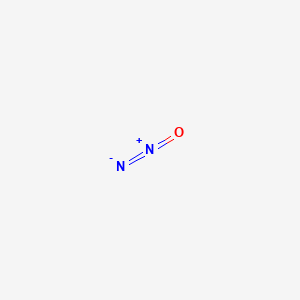
Dinitrogen oxide is a nitrogen oxide consisting of linear unsymmetrical molecules with formula N2O. While it is the most used gaseous anaesthetic in the world, its major commercial use, due to its solubility under pressure in vegetable fats combined with its non-toxicity in low concentrations, is as an aerosol spray propellant and aerating agent for canisters of 'whipped' cream. It has a role as an analgesic, a vasodilator agent, a general anaesthetic, an inhalation anaesthetic, a NMDA receptor antagonist, a member of greenhouse gas, a bacterial metabolite, a raising agent, a member of food packaging gas, a food propellant and a refrigerant. It is a gas molecular entity and a nitrogen oxide. — ChEBI
- IUPAC name
- nitrous oxide
- Molecular formula
- N2O
- Molecular weight
- 44.013 g/mol
- Exact mass
- 44.001062628 Da
- XLogP3
- 0.5
- Topological polar surface area
- 19.1 Ų
- Hydrogen-bond donors
- 0
- Hydrogen-bond acceptors
- 2
- Covalent units
- 1
- Defined stereocentres
- 0
Also known as
16 more reported names
External database identifiers
- ChEBI:CHEBI:17045
- ChEMBL:CHEMBL1234579
- EPA DTXSID:DTXSID8021066
- PubMed:35247505
- PubMed:21356620
- PubMed:19340552
- PubMed:19301825
- PubMed:18499598
- PubMed:18472229
- PubMed:18458035
- PubMed:16861150
- PubMed:16733821
- PubMed:16569935
- PubMed:16192778
- PubMed:15960645
Evidence from additional scientific databases
EMBL-EBI ChEBI
dinitrogen oxide
A nitrogen oxide consisting of linear unsymmetrical molecules with formula N2O. While it is the most used gaseous anaesthetic in the world, its major commercial use, due to its solubility under pressure in vegetable fats combined with its non-toxicity in low concentrations, is as an aerosol spray propellant and aerating agent for canisters of 'whipped' cream.
- Formula
- N2O
- Average mass
- 44.013 g/mol
- Monoisotopic mass
- 44.00106 Da
- Formal charge
- 0
- gas molecular entity — is a (CHEBI:138675)
- nitrogen oxide — is a (CHEBI:35196)
- NMDA receptor antagonist — has role (CHEBI:60643)
- inhalation anaesthetic — has role (CHEBI:38870)
- bacterial metabolite — has role (CHEBI:76969)
- general anaesthetic — has role (CHEBI:38869)
- vasodilator agent — has role (CHEBI:35620)
- analgesic — has role (CHEBI:35480)
- food packaging gas — has role (CHEBI:77974)
- refrigerant — has role (CHEBI:78433)
- greenhouse gas — has role (CHEBI:76413)
- raising agent — has role (CHEBI:77971)
- food propellant — has role (CHEBI:78017)
- NMDA receptor antagonist — has role (CHEBI:60643)
- inhalation anaesthetic — has role (CHEBI:38870)
- bacterial metabolite — has role (CHEBI:76969)
- general anaesthetic — has role (CHEBI:38869)
- vasodilator agent — has role (CHEBI:35620)
- analgesic — has role (CHEBI:35480)
- food packaging gas — has role (CHEBI:77974)
- refrigerant — has role (CHEBI:78433)
- greenhouse gas — has role (CHEBI:76413)
- raising agent — has role (CHEBI:77971)
- food propellant — has role (CHEBI:78017)
- gas molecular entity — is a (CHEBI:138675)
- nitrogen oxide — is a (CHEBI:35196)
Additional curated names
Cross-references from this source
- CAS: 10024-97-2 — KEGG COMPOUND
- CAS: 10024-97-2 — ChemIDplus
- CAS: 10024-97-2 — NIST Chemistry WebBook
- REGISTRY_NUMBER: 2153410 — Gmelin
- REGISTRY_NUMBER: 8137358 — Reaxys
- MANUAL_X_REF: 4238 — DrugCentral
- MANUAL_X_REF: C00887 — KEGG COMPOUND
- MANUAL_X_REF: c0650 — UM-BBD
- MANUAL_X_REF: D00102 — KEGG DRUG
- MANUAL_X_REF: N2O — PDBeChem
- MANUAL_X_REF: Nitrous_oxide — Wikipedia
Mapped by: Exact CAS cross-reference in the ChEBI compound record. Source updated: 2017-10-13. Retrieved: 2026-08-31. Open source record
NIH PubChem PUG-View
Attributed physical-property, hazard, environmental and use annotations.
- Boiling Point: -129.1 °F at 760 mmHg (USCG, 1999) Source: CAMEO Chemicals
- Boiling Point: -127 °F at 760 mmHg (NIOSH, 2024) Source: CAMEO Chemicals
- Boiling Point: -88.46 °C Source: DrugBank
- Boiling Point: -88.48 °C Source: Hazardous Substances Data Bank (HSDB)
- Boiling Point: -88.00 °C. @ 760.00 mm Hg Source: Human Metabolome Database (HMDB)
- Boiling Point: -88.5 °C Source: ILO-WHO International Chemical Safety Cards (ICSCs)
- Boiling Point: -127 °F Source: Occupational Safety and Health Administration (OSHA)
- Boiling Point: -88.48 °C @760 [mm Hg] Source: PAC Chemical Database, U.S. Department of Energy
- Boiling Point: -127 °F Source: The National Institute for Occupational Safety and Health (NIOSH)
- Color/Form: Colorless gas [Note: Shipped as a liquified compressed gas] Source: Hazardous Substances Data Bank (HSDB)
- Density: 1.266 at -128.2 °F (USCG, 1999) - Denser than water; will sink Source: CAMEO Chemicals
- Density: 1.799 g/L Source: Hazardous Substances Data Bank (HSDB)
- Density: Density: 1.226 at -89 °C (liquid); 1.967 at standard temperature and pressure Source: Hazardous Substances Data Bank (HSDB)
- Density: Density: 1.9775 kg/cu m (gas, 0 °C, 101.3 kPa); 793 kg/cu m (liquid, 20 °C, 101.3 kPa) Source: Hazardous Substances Data Bank (HSDB)
- Density: Density (at the boiling point of the liquid): 1.28 kg/l Source: ILO-WHO International Chemical Safety Cards (ICSCs)
- Density: 1.266 at -128.2 °F Source: Occupational Safety and Health Administration (OSHA)
- Density: 1.799 @25 °C Source: PAC Chemical Database, U.S. Department of Energy
- Density: 1.53(relative gas density) Source: The National Institute for Occupational Safety and Health (NIOSH)
- LogP: 0.36 Source: DrugBank
- LogP: log Kow = 0.36 Source: Hazardous Substances Data Bank (HSDB)
- LogP: 0.36 Source: Human Metabolome Database (HMDB)
- Melting Point: -131.5 °F (USCG, 1999) Source: CAMEO Chemicals
- Melting Point: -132 °F (NIOSH, 2024) Source: CAMEO Chemicals
- Melting Point: -90.81 °C Source: DrugBank
- Melting Point: -90.8 °C Source: Hazardous Substances Data Bank (HSDB)
- Melting Point: -90.6 °C Source: Human Metabolome Database (HMDB)
- Melting Point: -90.8 °C Source: ILO-WHO International Chemical Safety Cards (ICSCs)
- Melting Point: 132 °F Source: Occupational Safety and Health Administration (OSHA)
- Melting Point: -90.8 °C Source: PAC Chemical Database, U.S. Department of Energy
- Melting Point: -132 °F Source: The National Institute for Occupational Safety and Health (NIOSH)
- Odor: Slightly sweetish Source: Hazardous Substances Data Bank (HSDB)
- Odor: Weak, pleasant odor Source: Hazardous Substances Data Bank (HSDB)
- Physical Description: Nitrous oxide is a colorless, sweet-tasting gas. It is also known as "laughing gas". Continued breathing of the vapors may impair the decision making process. It is noncombustible but it will accelerate the burning of combustible material in a fire. It is soluble in water. Its vapors are heavier than air. Exposure of the container to prolonged heat or fire can cause it to rupture violently and rocket. It is used as an anesthetic, in pressure packaging, and to manufacture other chemicals. Source: CAMEO Chemicals
- Physical Description: Nitrous oxide, refrigerated liquid appears as a colorless liquid. Density 1.22 g / cm3 at its boiling point of -89 °C. Boils to give a colorless gas that is sweet-smelling and moderately toxic. The gas has narcotic effects when inhaled (laughing gas). Shipped under refrigeration. Vapor pressure is at about 745 psig at 70 °F. Used to freeze foods and to manufacture other chemicals. Source: CAMEO Chemicals
- Physical Description: CBI; Gas Vapor Source: EPA Chemical Data Reporting (CDR)
- Physical Description: Colourless, non-flammable gas, sweetish odour Source: EU Food Improvement Agents
- Physical Description: Colorless gas with a slightly sweet odor. [inhalation anesthetic] [Note: Shipped as a liquefied compressed gas.] [NIOSH] Source: Haz-Map, Information on Hazardous Chemicals and Occupational Diseases
- Physical Description: Liquid Source: Human Metabolome Database (HMDB)
- Physical Description: COLOURLESS COMPRESSED LIQUEFIED GAS WITH CHARACTERISTIC ODOUR. Source: ILO-WHO International Chemical Safety Cards (ICSCs)
- Physical Description: Colorless gas with a slightly sweet odor. Source: Occupational Safety and Health Administration (OSHA)
- Physical Description: Colorless gas with a slightly sweet odor. [inhalation anesthetic] [Note: Shipped as a liquefied compressed gas.] Source: The National Institute for Occupational Safety and Health (NIOSH)
- Refractive Index: Index of refraction: 1.000516 at 0 °C/D, 1 atmosphere, 0.5893 um Source: Hazardous Substances Data Bank (HSDB)
- Solubility: 0.1 % at 77 °F (NIOSH, 2024) Source: CAMEO Chemicals
- Solubility: Slightly soluble in water Source: Hazardous Substances Data Bank (HSDB)
- Solubility: At 20 °C and 2 atm one liter of the gas dissolves in 1.5 liters of water Source: Hazardous Substances Data Bank (HSDB)
- Solubility: 130 mL/100 mL water at 0 °C, 56.7 mL/100 mL water at 25 °C Source: Hazardous Substances Data Bank (HSDB)
- Solubility: Soluble in ethanol, ethyl ether Source: Hazardous Substances Data Bank (HSDB)
- Solubility: Soluble in alcohol, ether, oils; freely soluble in sulfuric acid Source: Hazardous Substances Data Bank (HSDB)
- Solubility: Solubility in water, g/l at 20 °C: 1.2 Source: ILO-WHO International Chemical Safety Cards (ICSCs)
- Solubility: (77 °F): 0.1% Source: The National Institute for Occupational Safety and Health (NIOSH)
- Vapor Pressure: 51.3 atm (NIOSH, 2024) Source: CAMEO Chemicals
- Vapor Pressure: 4.29X10+4 mm Hg at 25 °C Source: Hazardous Substances Data Bank (HSDB)
- Vapor Pressure: Vapor pressure, kPa at 20 °C: 5060 Source: ILO-WHO International Chemical Safety Cards (ICSCs)
- Vapor Pressure: 51.3 atm Source: Occupational Safety and Health Administration (OSHA)
- Vapor Pressure: 750 [mm Hg] @-88.7 °C Source: PAC Chemical Database, U.S. Department of Energy
- Vapor Pressure: 51.3 atm Source: The National Institute for Occupational Safety and Health (NIOSH)
- Viscosity: 0.0145 cP at 25 °C at 101.325 KPa (gas) Source: Hazardous Substances Data Bank (HSDB)
- Exposure Routes: The substance can be absorbed into the body by inhalation. Source: ILO-WHO International Chemical Safety Cards (ICSCs)
- Exposure Routes: inhalation, skin and/or eye contact (liquid) Source: The National Institute for Occupational Safety and Health (NIOSH)
- First Aid: Excerpt from NIOSH Pocket Guide for Nitrous oxide:; Eye: FROSTBITE - If eye tissue is frozen, seek medical attention immediately; if tissue is not frozen, immediately and thoroughly flush the eyes with large amounts of water for at least 15 minutes, occasionally lifting the lower and upper eyelids. If irritation, pain, swelling, lacrimation, or photophobia persist, get medical attention as soon as possible.; Skin: FROSTBITE - If frostbite has occurred, seek medical attention immediately; do NOT rub the affected areas or flush them with water. In order to prevent further tissue damage, do NOT attempt to remove frozen clothing from frostbitten areas. If frostbite has NOT occurred, immediately and thoroughly wash contaminated skin with soap and water.; Breathing: FRESH AIR - If a person breathes large amounts of this chemical, move the exposed person to fresh air at once. Other measures are usually unnecessary. (NIOSH, 2024) Source: CAMEO Chemicals
- ERG2024, Guide 122 (Nitrous oxide, compressed; Nitrous oxide, refrigerated liquid; Nitrous oxide): General First Aid:; · Call 911 or emergency medical service.; · Ensure that medical personnel are aware of the material(s) involved, take precautions to protect themselves and avoid contamination.; · Move victim to fresh air if it can be done safely.; · Administer oxygen if breathing is difficult.; · If victim is not breathing:; -- DO NOT perform mouth-to-mouth resuscitation; the victim may have ingested or inhaled the substance.; -- If equipped and pulse detected, wash face and mouth, then give artificial respiration using a proper respiratory medical device (bag-valve mask, pocket mask equipped with a one-way valve or other device).; -- If no pulse detected or no respiratory medical device available, provide continuous compressions. Conduct a pulse check every two minutes or monitor for any signs of spontaneous respirations.; · Remove and isolate contaminated clothing and shoes.; · For minor skin contact, avoid spreading material on unaffected skin.; · In case of contact with substance, remove immediately by flushing skin or eyes with running water for at least 20 minutes.; · For severe burns, immediate medical attention is required.; · Effects of exposure (inhalation, ingestion, Source: Emergency Response Guidebook (ERG)
- ERG2024, Guide 122 (Nitrous oxide; Nitrous oxide, compressed; Nitrous oxide, refrigerated liquid): General First Aid:; · Call 911 or emergency medical service.; · Ensure that medical personnel are aware of the material(s) involved, take precautions to protect themselves and avoid contamination.; · Move victim to fresh air if it can be done safely.; · Administer oxygen if breathing is difficult.; · If victim is not breathing:; -- DO NOT perform mouth-to-mouth resuscitation; the victim may have ingested or inhaled the substance.; -- If equipped and pulse detected, wash face and mouth, then give artificial respiration using a proper respiratory medical device (bag-valve mask, pocket mask equipped with a one-way valve or other device).; -- If no pulse detected or no respiratory medical device available, provide continuous compressions. Conduct a pulse check every two minutes or monitor for any signs of spontaneous respirations.; · Remove and isolate contaminated clothing and shoes.; · For minor skin contact, avoid spreading material on unaffected skin.; · In case of contact with substance, remove immediately by flushing skin or eyes with running water for at least 20 minutes.; · For severe burns, immediate medical attention is required.; · Effects of exposure (inhalation, ingestion, Source: Emergency Response Guidebook (ERG)
- First Aid: (General first aid procedures); Eye: Frostbite - If eye tissue is frozen, seek medical attention immediately; if tissue is not frozen, immediately and thoroughly flush the eyes with large amounts of water for at least 15 minutes, occasionally lifting the lower and upper eyelids. If irritation, pain, swelling, lacrimation, or photophobia persist, get medical attention as soon as possible.; Skin: Frostbite - Compressed gases may create low temperatures when they expand rapidly. Leaks and uses that allow rapid expansion may cause a frostbite hazard. Wear appropriate personal protective clothing to prevent the skin from becoming frozen.; Breathing: Fresh air Source: The National Institute for Occupational Safety and Health (NIOSH)
- Signal: Danger Source: European Chemicals Agency (ECHA)
- GHS Hazard Statements: H270 (100%): May cause or intensify fire; oxidizer [Danger Oxidizing gases]; H280 (56.4%): Contains gas under pressure; may explode if heated [Warning Gases under pressure]; H281 (40.6%): Contains refrigerated gas; may cause cryogenic burns or injury [Warning Gases under pressure]; H336 (31.7%): May cause drowsiness or dizziness [Warning Specific target organ toxicity, single exposure; Narcotic effects] Source: European Chemicals Agency (ECHA)
- Precautionary Statement Codes: P220, P244, P261, P271, P282, P304+P340, P319, P336+P317, P370+P376, P403, P403+P233, P405, P410+P403, and P501 (click each P-code to see the statement) Source: European Chemicals Agency (ECHA)
- ECHA C&L Notifications Summary: Aggregated GHS information provided per 663 reports by companies from 15 notifications to the ECHA C&L Inventory. Each notification may be associated with multiple companies.; Information may vary between notifications depending on impurities, additives, and other factors. The percentage value in parenthesis indicates the notified classification ratio from companies that provide hazard codes. Only hazard codes with percentage values above 10% are shown. For more detailed information, please visit ECHA C&L website. Source: European Chemicals Agency (ECHA)
- Signal: Danger Source: NITE-CMC
- GHS Hazard Statements: H270: May cause or intensify fire; oxidizer [Danger Oxidizing gases]; H336: May cause drowsiness or dizziness [Warning Specific target organ toxicity, single exposure; Narcotic effects]; H360: May damage fertility or the unborn child [Danger Reproductive toxicity]; H372: Causes damage to organs through prolonged or repeated exposure [Danger Specific target organ toxicity, repeated exposure] Source: NITE-CMC
- Precautionary Statement Codes: P203, P220, P244, P260, P261, P264, P270, P271, P280, P304+P340, P318, P319, P370+P376, P403, P403+P233, P405, and P501 (click each P-code to see the statement) Source: NITE-CMC
- GHS Hazard Statements: H270: May cause or intensify fire; oxidizer [Danger Oxidizing gases]; H280: Contains gas under pressure; may explode if heated [Warning Gases under pressure]; H336: May cause drowsiness or dizziness [Warning Specific target organ toxicity, single exposure; Narcotic effects]; H360: May damage fertility or the unborn child [Danger Reproductive toxicity]; H372: Causes damage to organs through prolonged or repeated exposure [Danger Specific target organ toxicity, repeated exposure] Source: NITE-CMC
- Precautionary Statement Codes: P203, P220, P244, P260, P261, P264, P270, P271, P280, P304+P340, P318, P319, P370+P376, P403, P403+P233, P405, P410+P403, and P501 (click each P-code to see the statement) Source: NITE-CMC
- Signal: Danger Source: Hazardous Substances Data Bank (HSDB)
- GHS Hazard Statements: H270: May cause or intensify fire; oxidizer [Danger Oxidizing gases]; H280: Contains gas under pressure; may explode if heated [Warning Gases under pressure] Source: Hazardous Substances Data Bank (HSDB)
- Precautionary Statement Codes: P220, P244, P370+P376, P403, and P410+P403 (click each P-code to see the statement) Source: Hazardous Substances Data Bank (HSDB)
- Target Organs: respiratory system, central nervous system, reproductive system Source: The National Institute for Occupational Safety and Health (NIOSH)
- Toxicity Summary: IDENTIFICATION AND USE: Nitrous Oxide is a stable, non-irritating colorless gas with slightly sweetish odor and taste. It is used as anesthetic in dentistry and surgery, propellant gas in food aerosols, leak detection. HUMAN EXPOSURE AND TOXICITY: The main complication following inhalation of nitrous oxide is varying degrees of hypoxia, affecting the functions of the heart and the brain. This may be associated with hypotension, fatal cardiac arrhythmias, headache, dizziness, anoxic brain damage, cerebral edema and permanent mental deficit. Chronic exposure can cause neurological and hematological changes including megaloblastic erythropoiesis and neurological features similar to subacute combined degeneration of the spinal cord. Nitrous oxide should not be administered for more than 24 hours because of the risk of bone marrow depression. During induction with high concentrations of nitrous oxide, the oxygen in the lungs is rapidly used up and the anoxia with increased respiratory effort causes rapid depletion of carbon dioxide in the issues. Absence of carbon dioxide and depression of the medullary centers by the anesthetic quickly lead to respiratory failure, and rarely, the patie Source: Hazardous Substances Data Bank (HSDB)
- Toxicity Summary: While nitrous oxide inactivates methionine synthase, intraoperative use results in a transient metabolic abnormality that soon reverses upon replacing the degrading enzyme.; When nitrous oxide is used recurrently (during occupational exposure or as a drug of abuse), it may lead to megaloblastic anemia with neurologic dysfunction. This situation also may occur in patients with an unrecognized cobalamin deficiency (vegans, pernicious anemia, hereditary disorders of cobalamin, and folate metabolism). Subacute combined degeneration of the spinal cord (SACD) and death is reported with repeated exposure in a case of a rare congenital 5,10-methylenetetrahydrofolate reductase (MTHFR) deficiency. Source: StatPearls
- Environmental Fate: ATMOSPHERIC FATE: Nitrous oxide has an atmospheric lifetime of 114 years. The Global Warming Potential = 298 (100-year)(1). Source: Hazardous Substances Data Bank (HSDB)
- Consumer Uses: Semiconductor and photovoltaic agent Source: EPA Chemical Data Reporting (CDR)
- Industry Uses: Other; Semiconductor and photovoltaic agent; Etching agent Source: EPA Chemical Data Reporting (CDR)
- Sources/Uses: Nitrous oxide has been used as an anesthetic since 1844. It has also been used as a foaming agent for whipped cream, as an oxidant in organic chemical production and as a component of rocket fuel. Occupational exposures have been measured in the 400 to 3000 ppm range without anesthetic waste gas scavenging and 50 ppm with waste gas scavenging. [ACGIH] Source: Haz-Map, Information on Hazardous Chemicals and Occupational Diseases
- Uses: To oxidize organic compounds at temperatures greater than 300 °C; to make nitrites from alkali metals at their boiling points; in rocket fuel formulations (with carbon disulfide); in the preparation of whipped cream. Source: Hazardous Substances Data Bank (HSDB)
- Uses: Anesthetic in dentistry and surgery, propellant gas in food aerosols, leak detection. Source: Hazardous Substances Data Bank (HSDB)
- Uses: Agent in detection of leaks in natural gas pipelines Source: Hazardous Substances Data Bank (HSDB)
- Uses: In the munitions-explosives industry, as propellant. Source: Hazardous Substances Data Bank (HSDB)
- Uses: For more Uses (Complete) data for Nitrous oxide (7 total), please visit the HSDB record page. Source: Hazardous Substances Data Bank (HSDB)
Mapped by: Existing checksum-valid CAS to unique PubChem CID match. Retrieved: 2026-08-31. Open source record
Scientific classifications and hazard annotations provide context and do not replace the market-specific regulatory decision shown above.
Additional source coverage and match status
| Source | Result | Checked |
|---|---|---|
| EMBL-EBI ChEBI | Exact match | 2026-08-31 |
| NIH PubChem PUG-View | Exact match | 2026-08-31 |
A recorded no-match is useful evidence that the source was checked; it is not a claim that the substance does not exist elsewhere.
Retrieved from NIH PubChem on 2026-08-31 by checksum-valid CAS matching. Chemical properties do not replace the regulatory decision on this page.