
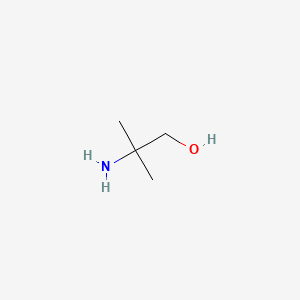
2-Amino-2-methyl-1-propanol
2-amino-2-methyl-1-propanol appears as a clear light colored liquid. Insoluble in water and about the same density as water. Flash point 172 °F. Used to make other chemicals. — CAMEO Chemicals
- IUPAC name
- 2-amino-2-methylpropan-1-ol
- Molecular formula
- C4H11NO
- Molecular weight
- 89.14 g/mol
- Exact mass
- 89.084063974 Da
- XLogP3
- -0.8
- Topological polar surface area
- 46.3 Ų
- Hydrogen-bond donors
- 2
- Hydrogen-bond acceptors
- 2
- Covalent units
- 1
- Defined stereocentres
- 0
Also known as
16 more reported names
External database identifiers
Evidence from additional scientific databases
NIH PubChem PUG-View
Attributed physical-property, hazard, environmental and use annotations.
- Boiling Point: 329 °F at 760 mmHg (99+% compound) (USCG, 1999) Source: CAMEO Chemicals
- Boiling Point: 165 °C @ 760 MM HG Source: Hazardous Substances Data Bank (HSDB)
- Boiling Point: 165 °C Source: ILO-WHO International Chemical Safety Cards (ICSCs)
- Boiling Point: 329 °F Source: Occupational Safety and Health Administration (OSHA)
- Boiling Point: 165 °C @760 [mm Hg] Source: PAC Chemical Database, U.S. Department of Energy
- Color/Form: CRYSTALLINE MASS Source: Hazardous Substances Data Bank (HSDB)
- Density: 0.935 (USCG, 1999) - Less dense than water; will float Source: CAMEO Chemicals
- Density: 0.934 @ 20 °C/20 °C Source: Hazardous Substances Data Bank (HSDB)
- Density: 0.93 g/cm³ Source: ILO-WHO International Chemical Safety Cards (ICSCs)
- Density: 0.935 Source: Occupational Safety and Health Administration (OSHA)
- Density: 0.934 @25 °C Source: PAC Chemical Database, U.S. Department of Energy
- Flash Point: 153 °F (USCG, 1999) Source: CAMEO Chemicals
- Flash Point: 67 °C Source: Haz-Map, Information on Hazardous Chemicals and Occupational Diseases
- Flash Point: 67 °C CC Source: Hazardous Substances Data Bank (HSDB)
- Flash Point: 67 °C c.c. Source: ILO-WHO International Chemical Safety Cards (ICSCs)
- Flash Point: 153 °F Source: Occupational Safety and Health Administration (OSHA)
- Melting Point: 89.6 °F (USCG, 1999) Source: CAMEO Chemicals
- Melting Point: 31 °C Source: Hazardous Substances Data Bank (HSDB)
- Melting Point: 31 °C Source: ILO-WHO International Chemical Safety Cards (ICSCs)
- Melting Point: 89.6 °F Source: Occupational Safety and Health Administration (OSHA)
- Physical Description: 2-amino-2-methyl-1-propanol appears as a clear light colored liquid. Insoluble in water and about the same density as water. Flash point 172 °F. Used to make other chemicals. Source: CAMEO Chemicals
- Physical Description: Liquid; Wet Solid; Large Crystals; Liquid Source: EPA Chemical Data Reporting (CDR)
- Physical Description: Solid; mp = 30-31 deg C; Commercial form may be thick liquid; [Merck Index] Colorless viscous liquid; mp = 24-28 deg C; [MSDSonline] Source: Haz-Map, Information on Hazardous Chemicals and Occupational Diseases
- Physical Description: CRYSTALS OR COLOURLESS LIQUID. Source: ILO-WHO International Chemical Safety Cards (ICSCs)
- Physical Description: A clear light colored liquid. Source: Occupational Safety and Health Administration (OSHA)
- Refractive Index: INDEX OF REFRACTION: 1.449 @ 20 °C/D Source: Hazardous Substances Data Bank (HSDB)
- Solubility: MISCIBLE WITH WATER; SOL IN ALCOHOLS Source: Hazardous Substances Data Bank (HSDB)
- Solubility: Solubility in water: miscible Source: ILO-WHO International Chemical Safety Cards (ICSCs)
- Vapor Pressure: 1.0 [mmHg] Source: Haz-Map, Information on Hazardous Chemicals and Occupational Diseases
- Vapor Pressure: Vapor pressure, Pa at 20 °C: 133 Source: ILO-WHO International Chemical Safety Cards (ICSCs)
- pH: PH OF 0.1 AQ SOLN 11.3 Source: Hazardous Substances Data Bank (HSDB)
- Exposure Routes: The substance can be absorbed into the body by inhalation and by ingestion. Source: ILO-WHO International Chemical Safety Cards (ICSCs)
- First Aid: INHALATION: Call for medical aid. Remove victim to fresh air. If breathing has stopped, give artificial respiration. If breathing is difficult, give oxygen.; EYES - OR - SKIN: Flush with copious amounts of water for at least 15 minutes while removing contaminated clothing and shoes. Assure adequate flushing of the eyes by separating the eyelids with the fingers. (USCG, 1999) Source: CAMEO Chemicals
- Signal: Warning Source: Regulation (EC) No 1272/2008 of the European Parliament and of the Council
- GHS Hazard Statements: H315: Causes skin irritation [Warning Skin corrosion/irritation]; H319: Causes serious eye irritation [Warning Serious eye damage/eye irritation]; H412: Harmful to aquatic life with long lasting effects [Hazardous to the aquatic environment, long-term hazard] Source: Regulation (EC) No 1272/2008 of the European Parliament and of the Council
- Precautionary Statement Codes: P264, P264+P265, P273, P280, P302+P352, P305+P351+P338, P321, P332+P317, P337+P317, P362+P364, and P501 (click each P-code to see the statement) Source: Regulation (EC) No 1272/2008 of the European Parliament and of the Council
- Note: This chemical does not meet GHS hazard criteria for 0.3% (12 of 4294) of reports. Source: European Chemicals Agency (ECHA)
- Signal: Warning Source: European Chemicals Agency (ECHA)
- GHS Hazard Statements: H315 (99.7%): Causes skin irritation [Warning Skin corrosion/irritation]; H319 (97%): Causes serious eye irritation [Warning Serious eye damage/eye irritation]; H412 (95.9%): Harmful to aquatic life with long lasting effects [Hazardous to the aquatic environment, long-term hazard] Source: European Chemicals Agency (ECHA)
- Precautionary Statement Codes: P264, P264+P265, P273, P280, P302+P352, P305+P351+P338, P321, P332+P317, P337+P317, P362+P364, and P501 (click each P-code to see the statement) Source: European Chemicals Agency (ECHA)
- ECHA C&L Notifications Summary: Aggregated GHS information provided per 4294 reports by companies from 16 notifications to the ECHA C&L Inventory. Each notification may be associated with multiple companies.; Reported as not meeting GHS hazard criteria per 12 of 4294 reports by companies.; There are 15 notifications provided by 4282 of 4294 reports by companies with hazard statement code(s).; Information may vary between notifications depending on impurities, additives, and other factors. The percentage value in parenthesis indicates the notified classification ratio from companies that provide hazard codes. Only hazard codes with percentage values above 10% are shown. For more detailed information, please visit ECHA C&L website. Source: European Chemicals Agency (ECHA)
- Signal: Danger Source: NITE-CMC
- GHS Hazard Statements: H314: Causes severe skin burns and eye damage [Danger Skin corrosion/irritation]; H318: Causes serious eye damage [Danger Serious eye damage/eye irritation]; H360: May damage fertility or the unborn child [Danger Reproductive toxicity]; H373: May causes damage to organs through prolonged or repeated exposure [Warning Specific target organ toxicity, repeated exposure] Source: NITE-CMC
- Precautionary Statement Codes: P203, P260, P264, P264+P265, P280, P301+P330+P331, P302+P361+P354, P304+P340, P305+P354+P338, P316, P317, P318, P319, P321, P363, P405, and P501 (click each P-code to see the statement) Source: NITE-CMC
- GHS Hazard Statements: Not Classified Source: NITE-CMC
- NFPA Health Rating: 2 - Materials that, under emergency conditions, can cause temporary incapacitation or residual injury. Source: Hazardous Substances Data Bank (HSDB)
- NFPA Fire Rating: 2 - Materials that must be moderately heated or exposed to relatively high ambient temperatures before ignition can occur. Materials would not under normal conditions form hazardous atmospheres with air, but under high ambient temperatures or under moderate heating could release vapor in sufficient quantities to produce hazardous atmospheres with air. Source: Hazardous Substances Data Bank (HSDB)
- NFPA Instability Rating: 0 - Materials that in themselves are normally stable, even under fire conditions. Source: Hazardous Substances Data Bank (HSDB)
- Cosmetic Ingredient Review Finding(s): Safe in the present practices of use and concentration. Ingredient, concentration, and use information are available in documents discoverable at https://cir-reports.cir-safety.org Source: Cosmetic Ingredient Review (CIR)
- Consumer Uses: Not Known or Reasonably Ascertainable; Pigment; Lubricating agent; Solvent; pH regulating agent Source: EPA Chemical Data Reporting (CDR)
- Industry Uses: Pigment; Absorbent; Not Known or Reasonably Ascertainable; pH regulating agent; Lubricating agent Source: EPA Chemical Data Reporting (CDR)
- Cosmetic Ingredient Review Link: CIR ingredient: Aminomethyl Propanol Source: Cosmetic Ingredient Review (CIR)
- Cosmetic Ingredient Review Link: CIR ingredient: Aminomethylpropanol Source: Cosmetic Ingredient Review (CIR)
- Sources/Uses: Used to make other chemicals (surface-active agents, vulcanization accelerators, and pharmaceuticals) and as an emulsifying agent for cosmetic creams and lotions, mineral oil and paraffin wax emulsions, leather dressings, textile specialties, polishes, cleaning compounds, and so-called soluble oils; Also used in hair sprays, wave sets, hair dyes, Pamabrom (drug), and absorbents for acidic gases; [Merck Index] Used as a pigment dispersant for water-based paints, resin solubilizer, corrosion inhibitor, protecting agent for carbonyl groups and in boiler-water treatment; [CHEMINFO] Source: Haz-Map, Information on Hazardous Chemicals and Occupational Diseases
- Industrial Processes with risk of exposure: Painting (Pigments, Binders, and Biocides) [Category: Paint]; Leather Tanning and Processing [Category: Industry]; Textiles (Printing, Dyeing, or Finishing) [Category: Industry]; Dressing Hair [Category: Other] Source: Haz-Map, Information on Hazardous Chemicals and Occupational Diseases
- Uses: IN SYNTH OF SURFACE-ACTIVE AGENTS, VULCANIZATION ACCELERATORS, PHARMACEUTICALS; ABSORBENT FOR ACIDIC GASES; EMULSIFYING AGENT FOR COSMETIC CREAMS AND LOTIONS, MINERAL OIL & PARAFFIN WAX EMULSIONS, LEATHER DRESSINGS, TEXTILE SPECIALTIES, POLISHES, CLEANING COMPOUNDS, SO-CALLED SOL OILS; INGREDIENT OF DIURETIC PAMABROM Source: Hazardous Substances Data Bank (HSDB)
Mapped by: Existing checksum-valid CAS to unique PubChem CID match. Retrieved: 2026-08-31. Open source record
Scientific classifications and hazard annotations provide context and do not replace the market-specific regulatory decision shown above.
Additional source coverage and match status
| Source | Result | Checked |
|---|---|---|
| NIH PubChem PUG-View | Exact match | 2026-08-31 |
A recorded no-match is useful evidence that the source was checked; it is not a claim that the substance does not exist elsewhere.
Retrieved from NIH PubChem on 2026-08-31 by checksum-valid CAS matching. Chemical properties do not replace the regulatory decision on this page.