
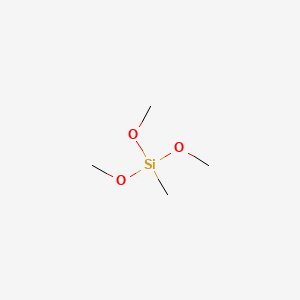
CAS 1185-55-3PubChem CID 14456
Methyltrimethoxysilane
- IUPAC name
- trimethoxy(methyl)silane
- Molecular formula
- C4H12O3Si
- Molecular weight
- 136.22 g/mol
- Exact mass
- 136.05557077 Da
- Topological polar surface area
- 27.7 Ų
- Hydrogen-bond donors
- 0
- Hydrogen-bond acceptors
- 3
- Covalent units
- 1
- Defined stereocentres
- 0
Also known as
TrimethoxymethylsilaneSilane, trimethoxymethyl-Z 60700HI0D71MCIGLASCA BNSC-93883SILQUEST A 1630DOW CORNING 7-5300 FILM-IN-PLACE COATING
16 more reported names
DOW CORNING (R) 7-5310 FILM-IN-PLACE BASERefChem:818737214-685-0Union carbide A-163SILANE, METHYLTRIMETHOXY-(TRIMETHOXYSILYL)METHANESilane A-163Dynasylan MTMSC4H12O3Simethyl trimethoxysilanemethyl-trimethoxysilaneEINECS 214-685-0CM9100NSC 93883UNII-0HI0D71MCImethyltrimetoxysilane
External database identifiers
Evidence from additional scientific databases
NIH PubChem PUG-View
Exact identifier match14456
Attributed physical-property, hazard, environmental and use annotations.
- Boiling Point: 103.5 °C @760 [mm Hg] Source: PAC Chemical Database, U.S. Department of Energy
- Density: 0.949 @ 20°C Source: PAC Chemical Database, U.S. Department of Energy
- Physical Description: Liquid; Liquid; Other Solid; CBI Source: EPA Chemical Data Reporting (CDR)
- Physical Description: Colorless liquid; [Sigma-Aldrich MSDS] Source: Haz-Map, Information on Hazardous Chemicals and Occupational Diseases
- Note: This chemical does not meet GHS hazard criteria for 1.7% (22 of 1271) of reports. Source: European Chemicals Agency (ECHA)
- Signal: Danger Source: European Chemicals Agency (ECHA)
- GHS Hazard Statements: H225 (97.6%): Highly Flammable liquid and vapor [Danger Flammable liquids]; H315 (57.2%): Causes skin irritation [Warning Skin corrosion/irritation]; H317 (14.8%): May cause an allergic skin reaction [Warning Sensitization, Skin]; H319 (53.7%): Causes serious eye irritation [Warning Serious eye damage/eye irritation]; H335 (43.4%): May cause respiratory irritation [Warning Specific target organ toxicity, single exposure; Respiratory tract irritation] Source: European Chemicals Agency (ECHA)
- Precautionary Statement Codes: P210, P233, P240, P241, P242, P243, P261, P264, P264+P265, P271, P272, P280, P302+P352, P303+P361+P353, P304+P340, P305+P351+P338, P319, P321, P332+P317, P333+P317, P337+P317, P362+P364, P370+P378, P403+P233, P403+P235, P405, and P501 (click each P-code to see the statement) Source: European Chemicals Agency (ECHA)
- ECHA C&L Notifications Summary: Aggregated GHS information provided per 1271 reports by companies from 23 notifications to the ECHA C&L Inventory. Each notification may be associated with multiple companies.; Reported as not meeting GHS hazard criteria per 22 of 1271 reports by companies.; There are 22 notifications provided by 1249 of 1271 reports by companies with hazard statement code(s).; Information may vary between notifications depending on impurities, additives, and other factors. The percentage value in parenthesis indicates the notified classification ratio from companies that provide hazard codes. Only hazard codes with percentage values above 10% are shown. For more detailed information, please visit ECHA C&L website. Source: European Chemicals Agency (ECHA)
- GHS Hazard Statements: H225 (33.3%): Highly Flammable liquid and vapor [Danger Flammable liquids]; H315 (66.7%): Causes skin irritation [Warning Skin corrosion/irritation]; H318 (66.7%): Causes serious eye damage [Danger Serious eye damage/eye irritation]; H319 (33.3%): Causes serious eye irritation [Warning Serious eye damage/eye irritation]; H335 (66.7%): May cause respiratory irritation [Warning Specific target organ toxicity, single exposure; Respiratory tract irritation] Source: European Chemicals Agency (ECHA)
- Precautionary Statement Codes: P210, P233, P240, P241, P242, P243, P261, P264, P264+P265, P271, P280, P302+P352, P303+P361+P353, P304+P340, P305+P351+P338, P305+P354+P338, P317, P319, P321, P332+P317, P337+P317, P362+P364, P370+P378, P403+P233, P403+P235, P405, and P501 (click each P-code to see the statement) Source: European Chemicals Agency (ECHA)
- ECHA C&L Notifications Summary: Aggregated GHS information provided per 3 reports by companies from 2 notifications to the ECHA C&L Inventory. Each notification may be associated with multiple companies.; Information may vary between notifications depending on impurities, additives, and other factors. The percentage value in parenthesis indicates the notified classification ratio from companies that provide hazard codes. Only hazard codes with percentage values above 10% are shown. For more detailed information, please visit ECHA C&L website. Source: European Chemicals Agency (ECHA)
- GHS Hazard Statements: Not Classified Source: NITE-CMC
- Signal: Danger Source: NITE-CMC
- GHS Hazard Statements: H225: Highly Flammable liquid and vapor [Danger Flammable liquids]; H320: Causes eye irritation [Warning Serious eye damage/eye irritation]; H332: Harmful if inhaled [Warning Acute toxicity, inhalation]; H336: May cause drowsiness or dizziness [Warning Specific target organ toxicity, single exposure; Narcotic effects]; H373: May causes damage to organs through prolonged or repeated exposure [Warning Specific target organ toxicity, repeated exposure] Source: NITE-CMC
- Precautionary Statement Codes: P210, P233, P240, P241, P242, P243, P260, P261, P264+P265, P271, P280, P303+P361+P353, P304+P340, P305+P351+P338, P317, P319, P337+P317, P370+P378, P403+P233, P403+P235, P405, and P501 (click each P-code to see the statement) Source: NITE-CMC
- Toxicity Summary: Studies showed a low order of acute toxicity for MTMS. MTMS was slightly irritating to both eyes and skin in rabbits, and a weight of evidence assessment supports that MTMS is not a dermal sensitizer. In vitro and in vivo assays indicated MTMS has a low potential for genotoxicity. MTMS did not produce any changes in reproductive or developmental parameters in a rat study. In a 90-day inhalation study in rats, MTMS was associated with urinary bladder epithelial hyperplasia, calculi formation, and moderate kidney dilation with hyperplasia of the pelvic epithelium and granulomatous inflammation; however, an expert panel review concluded that changes in the bladder and kidney were adaptive responses to a physical or chemical irritant present within the urine and were not considered to represent a preneoplastic change. Source: Pertti (Bert) Hakkinen's Toxicology and Other Annotations
- Consumer Uses: Other; Catalyst Source: EPA Chemical Data Reporting (CDR)
- Industry Uses: Monomers; Not Known or Reasonably Ascertainable; Catalyst; Sealant (barrier); Surface modifier; Intermediate; Adhesion/cohesion promoter Source: EPA Chemical Data Reporting (CDR)
- Sources/Uses: Used in household products for conditioning and waterproofing leather; [REPROTOX] Source: Haz-Map, Information on Hazardous Chemicals and Occupational Diseases
- Uses: The uses of Methyltrimethoxysilane (MTMS) include as a coupling agent in thermoplastics and thermosetting resins, a cross-linker in silicone sealants, a water repellent component, and in silicone hard-coats for plastics. Source: Pertti (Bert) Hakkinen's Toxicology and Other Annotations
Mapped by: Existing checksum-valid CAS to unique PubChem CID match. Retrieved: 2026-08-31. Open source record
Scientific classifications and hazard annotations provide context and do not replace the market-specific regulatory decision shown above.
Additional source coverage and match status
| Source | Result | Checked |
|---|---|---|
| NIH PubChem PUG-View | Exact match | 2026-08-31 |
A recorded no-match is useful evidence that the source was checked; it is not a claim that the substance does not exist elsewhere.
Retrieved from NIH PubChem on 2026-08-31 by checksum-valid CAS matching. Chemical properties do not replace the regulatory decision on this page.