
Manganese Sulfate
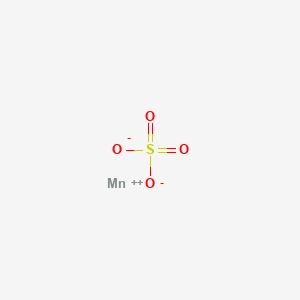
Manganese(II) sulfate is a metal sulfate in which the metal component is manganese in the +2 oxidation state. It has a role as a nutraceutical. It is a manganese molecular entity and a metal sulfate. It contains a manganese(2+). — ChEBI
- IUPAC name
- manganese(2+) sulfate
- Molecular formula
- MnO4S
- Molecular weight
- 151.00 g/mol
- Exact mass
- 150.889773 Da
- Topological polar surface area
- 88.6 Ų
- Hydrogen-bond donors
- 0
- Hydrogen-bond acceptors
- 4
- Covalent units
- 2
- Defined stereocentres
- 0
Also known as
16 more reported names
External database identifiers
- ChEBI:CHEBI:86360
- EPA DTXSID:DTXSID9044160
Evidence from additional scientific databases
NIH PubChem PUG-View
Attributed physical-property, hazard, environmental and use annotations.
- Boiling Point: Decomp @ 850 °C Source: Hazardous Substances Data Bank (HSDB)
- Color/Form: White orthorhombic crystals Source: Hazardous Substances Data Bank (HSDB)
- Density: 3.25 Source: Hazardous Substances Data Bank (HSDB)
- Density: Translucent, pale-rose-red, efflorescent prisms; density 2.107 g/cu cm; MP 30 °C; decomposes at 850 °C; soluble in water; insoluble in alcohol. /Tetrahydrate/ Source: Hazardous Substances Data Bank (HSDB)
- Density: 3.25 @25 °C Source: PAC Chemical Database, U.S. Department of Energy
- Melting Point: 700 °C Source: Hazardous Substances Data Bank (HSDB)
- Melting Point: 700 °C Source: PAC Chemical Database, U.S. Department of Energy
- Physical Description: Dry Powder; Large Crystals; Liquid; Other Solid; Other Solid; Dry Powder; CBI; Large Crystals Source: EPA Chemical Data Reporting (CDR)
- Physical Description: White solid; [HSDB] Pale pink powder, soluble in one part water; [MSDSonline] Source: Haz-Map, Information on Hazardous Chemicals and Occupational Diseases
- Solubility: Pale red, slightly efflorescent crystals; sol in about 1 part cold, 0.6 part boiling water; insol in alcohol; loses all water @ 400-450 °C. /Monohydrate/ Source: Hazardous Substances Data Bank (HSDB)
- Solubility: 52 G/100 CC OF WATER @ 5 °C Source: Hazardous Substances Data Bank (HSDB)
- Solubility: 70 G/100 CC OF WATER @ 70 °C Source: Hazardous Substances Data Bank (HSDB)
- Solubility: SOL IN ALCOHOL; INSOL IN ETHER Source: Hazardous Substances Data Bank (HSDB)
- Solubility: Slightly soluble in methanol. Source: Hazardous Substances Data Bank (HSDB)
- Carcinogen Classification: No indication of carcinogenicity to humans (not listed by IARC). Source: Toxin and Toxin Target Database (T3DB)
- Exposure Routes: Oral (L228) ; inhalation (L228) Source: Toxin and Toxin Target Database (T3DB)
- Signal: Warning Source: Regulation (EC) No 1272/2008 of the European Parliament and of the Council
- GHS Hazard Statements: H373 **: May causes damage to organs through prolonged or repeated exposure [Warning Specific target organ toxicity, repeated exposure]; H411: Toxic to aquatic life with long lasting effects [Hazardous to the aquatic environment, long-term hazard] Source: Regulation (EC) No 1272/2008 of the European Parliament and of the Council
- Precautionary Statement Codes: P260, P273, P319, P391, and P501 (click each P-code to see the statement) Source: Regulation (EC) No 1272/2008 of the European Parliament and of the Council
- Note: This chemical does not meet GHS hazard criteria for 1.7% (11 of 642) of reports. Source: European Chemicals Agency (ECHA)
- Signal: Danger Source: European Chemicals Agency (ECHA)
- GHS Hazard Statements: H318 (48.3%): Causes serious eye damage [Danger Serious eye damage/eye irritation]; H372 (16.4%): Causes damage to organs through prolonged or repeated exposure [Danger Specific target organ toxicity, repeated exposure]; H373 (81.9%): May causes damage to organs through prolonged or repeated exposure [Warning Specific target organ toxicity, repeated exposure]; H411 (98.1%): Toxic to aquatic life with long lasting effects [Hazardous to the aquatic environment, long-term hazard] Source: European Chemicals Agency (ECHA)
- Precautionary Statement Codes: P260, P264, P264+P265, P270, P273, P280, P305+P354+P338, P317, P319, P391, and P501 (click each P-code to see the statement) Source: European Chemicals Agency (ECHA)
- ECHA C&L Notifications Summary: Aggregated GHS information provided per 642 reports by companies from 41 notifications to the ECHA C&L Inventory. Each notification may be associated with multiple companies.; Reported as not meeting GHS hazard criteria per 11 of 642 reports by companies.; There are 40 notifications provided by 631 of 642 reports by companies with hazard statement code(s).; Information may vary between notifications depending on impurities, additives, and other factors. The percentage value in parenthesis indicates the notified classification ratio from companies that provide hazard codes. Only hazard codes with percentage values above 10% are shown. For more detailed information, please visit ECHA C&L website. Source: European Chemicals Agency (ECHA)
- Signal: Danger Source: NITE-CMC
- GHS Hazard Statements: H302: Harmful if swallowed [Warning Acute toxicity, oral]; H341: Suspected of causing genetic defects [Warning Germ cell mutagenicity]; H360: May damage fertility or the unborn child [Danger Reproductive toxicity]; H372: Causes damage to organs through prolonged or repeated exposure [Danger Specific target organ toxicity, repeated exposure]; H402: Harmful to aquatic life [Hazardous to the aquatic environment, acute hazard]; H412: Harmful to aquatic life with long lasting effects [Hazardous to the aquatic environment, long-term hazard] Source: NITE-CMC
- Precautionary Statement Codes: P203, P260, P264, P270, P273, P280, P301+P317, P318, P319, P330, P405, and P501 (click each P-code to see the statement) Source: NITE-CMC
- GHS Hazard Statements: H302: Harmful if swallowed [Warning Acute toxicity, oral]; H341: Suspected of causing genetic defects [Warning Germ cell mutagenicity]; H361: Suspected of damaging fertility or the unborn child [Warning Reproductive toxicity]; H370: Causes damage to organs [Danger Specific target organ toxicity, single exposure]; H372: Causes damage to organs through prolonged or repeated exposure [Danger Specific target organ toxicity, repeated exposure] Source: NITE-CMC
- Health Effects: Manganese mainly affects the nervous system and may cause behavioral changes and other nervous system effects, which include movements that may become slow and clumsy. This combination of symptoms when sufficiently severe is referred to as “manganism”. (L228) Source: Toxin and Toxin Target Database (T3DB)
- Toxicity Summary: Manganese is a cellular toxicant that can impair transport systems, enzyme activities, and receptor functions. It primarily targets the central nervous system, particularily the globus pallidus of the basal ganglia. It is believed that the manganese ion, Mn(II), enhances the autoxidation or turnover of various intracellular catecholamines, leading to increased production of free radicals, reactive oxygen species, and other cytotoxic metabolites, along with a depletion of cellular antioxidant defense mechanisms, leading to oxidative damage and selective destruction of dopaminergic neurons. In addition to dopamine, manganese is thought to perturbations other neurotransmitters, such as GABA and glutamate. In order to produce oxidative damage, manganese must first overwhelm the antioxidant enzyme manganese superoxide dismutase. The neurotoxicity of Mn(II) has also been linked to its ability to substitute for Ca(II) under physiological conditions. It can enter mitochondria via the calcium uniporter and inhibit mitochondrial oxidative phosphorylation. It may also inhibit the efflux of Ca(II), which can result in a loss of mitochondrial membrane integrity. Mn(II) has been shown to inhibit Source: Toxin and Toxin Target Database (T3DB)
- Consumer Uses: Not Known or Reasonably Ascertainable; Soil amendments (fertilizers); Other Source: EPA Chemical Data Reporting (CDR)
- Industry Uses: Other; Not Known or Reasonably Ascertainable; Soil amendments (fertilizers) Source: EPA Chemical Data Reporting (CDR)
- Sources/Uses: Used in textile dyes, porcelain glazes, fertilizers, and animal feeds; [Merck Index] Used in fungicides, ore flotation, and catalysts; [Hawley] Source: Haz-Map, Information on Hazardous Chemicals and Occupational Diseases
- Industrial Processes with risk of exposure: Textiles (Printing, Dyeing, or Finishing) [Category: Industry]; Metal Extraction and Refining [Category: Industry]; Farming (Feed Additives) [Category: Industry] Source: Haz-Map, Information on Hazardous Chemicals and Occupational Diseases
- Uses: In dyeing; for red glazes on porcelain; boiling oils for varnishes; in fertilizers for vines, tobacco; in feeds. Source: Hazardous Substances Data Bank (HSDB)
- Uses: Starting material for electrolytic manganese metal, electrolytic manganese dioxide, and other manganese compounds such as manganese carbonate, manganese soaps, and certain inorganic pigments; use in textile printing and glass making; fertilizer for manganese-deficient soils; animals feeds Source: Hazardous Substances Data Bank (HSDB)
- Uses: Therap Cat(Vet): Nutritional factor (essential trace element in all animals); prevention of perois in poultry. Source: Hazardous Substances Data Bank (HSDB)
- Uses: Manganese sulfate is the precursor to manganese metal and many chemical compounds, such as manganese dioxide. (L236) Source: Toxin and Toxin Target Database (T3DB)
Mapped by: Existing checksum-valid CAS to unique PubChem CID match. Retrieved: 2026-08-31. Open source record
Scientific classifications and hazard annotations provide context and do not replace the market-specific regulatory decision shown above.
Additional source coverage and match status
| Source | Result | Checked |
|---|---|---|
| EMBL-EBI ChEBI | No exact record | 2026-08-31 |
| NIH PubChem PUG-View | Exact match | 2026-08-31 |
A recorded no-match is useful evidence that the source was checked; it is not a claim that the substance does not exist elsewhere.
Retrieved from NIH PubChem on 2026-08-31 by checksum-valid CAS matching. Chemical properties do not replace the regulatory decision on this page.