
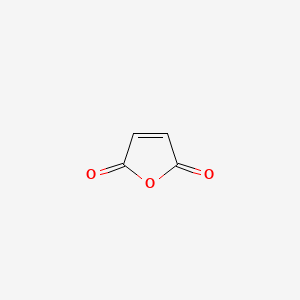
Maleic Anhydride
Maleic anhydride appears as colorless crystalline needles, flakes, pellets, rods, briquettes, lumps or a fused mass. Melts at 113 °F. Shipped both as a solid and in the molten state. Vapors, fumes and dusts strong irritate the eyes, skin and mucous membranes. Flash point 218 °F. Autoignition temperature 890 °F. Used to make paints and plastics and other chemicals. — CAMEO Chemicals
- IUPAC name
- furan-2,5-dione
- Molecular formula
- C4H2O3
- Molecular weight
- 98.06 g/mol
- Exact mass
- 98.000393922 Da
- XLogP3
- -0.1
- Topological polar surface area
- 43.4 Ų
- Hydrogen-bond donors
- 0
- Hydrogen-bond acceptors
- 3
- Covalent units
- 1
- Defined stereocentres
- 0
Also known as
16 more reported names
External database identifiers
- ChEBI:CHEBI:474859
- ChEMBL:CHEMBL374159
- EPA DTXSID:DTXSID7024166
- PubMed:38360295
- PubMed:29540657
- PubMed:26795242
- PubMed:24211530
- PubMed:23016360
- PubMed:22941771
- PubMed:22889067
- PubMed:22870665
- PubMed:22867432
- PubMed:22855404
- PubMed:22847991
- PubMed:22796348
Evidence from additional scientific databases
NIH PubChem PUG-View
Attributed physical-property, hazard, environmental and use annotations.
- Autoignition Temperature: 878 °F (USCG, 1999) Source: CAMEO Chemicals
- Autoignition Temperature: 477 °C Source: Hazardous Substances Data Bank (HSDB)
- Autoignition Temperature: 477 °C Source: ILO-WHO International Chemical Safety Cards (ICSCs)
- Boiling Point: 387 to 390 °F at 760 mmHg (NTP, 1992) Source: CAMEO Chemicals
- Boiling Point: 202.0 °C at 760 mm Hg Source: Hazardous Substances Data Bank (HSDB)
- Boiling Point: 202 °C Source: ILO-WHO International Chemical Safety Cards (ICSCs)
- Boiling Point: 396 °F Source: Occupational Safety and Health Administration (OSHA)
- Boiling Point: 202 °C @760 [mm Hg] Source: PAC Chemical Database, U.S. Department of Energy
- Boiling Point: 396 °F Source: The National Institute for Occupational Safety and Health (NIOSH)
- Color/Form: Orthorhombic needles from chloroform; commercial grades furnished in fused form, as briquettes Source: Hazardous Substances Data Bank (HSDB)
- Color/Form: Colorless needles or white lumps or pellets Source: Hazardous Substances Data Bank (HSDB)
- Color/Form: Needles from ether or chloroform Source: Hazardous Substances Data Bank (HSDB)
- Density: 1.43 at 59 °F (USCG, 1999) - Denser than water; will sink Source: CAMEO Chemicals
- Density: 0.934 at 20 °C/4 °C Source: Hazardous Substances Data Bank (HSDB)
- Density: 1.5 g/cm³ Source: ILO-WHO International Chemical Safety Cards (ICSCs)
- Density: 1.43 at 59 °F Source: Occupational Safety and Health Administration (OSHA)
- Density: 1.314 @ 60°C Source: PAC Chemical Database, U.S. Department of Energy
- Density: 1.48 Source: The National Institute for Occupational Safety and Health (NIOSH)
- Flash Point: 218 °F (NTP, 1992) Source: CAMEO Chemicals
- Flash Point: 102 °C (closed cup) Source: Hazardous Substances Data Bank (HSDB)
- Flash Point: 110 °C (open cup) Source: Hazardous Substances Data Bank (HSDB)
- Flash Point: 102 °C c.c. Source: ILO-WHO International Chemical Safety Cards (ICSCs)
- Flash Point: 218 °F Source: Occupational Safety and Health Administration (OSHA)
- Flash Point: 218 °F Source: The National Institute for Occupational Safety and Health (NIOSH)
- LogP: log Kow = 1.62 Source: Hazardous Substances Data Bank (HSDB)
- LogP: 1.62 (calculated) Source: ILO-WHO International Chemical Safety Cards (ICSCs)
- Melting Point: 127 °F (NTP, 1992) Source: CAMEO Chemicals
- Melting Point: 52.56 °C Source: Hazardous Substances Data Bank (HSDB)
- Melting Point: 53 °C Source: ILO-WHO International Chemical Safety Cards (ICSCs)
- Melting Point: 127 °F Source: Occupational Safety and Health Administration (OSHA)
- Melting Point: 52.56 °C Source: PAC Chemical Database, U.S. Department of Energy
- Melting Point: 127 °F Source: The National Institute for Occupational Safety and Health (NIOSH)
- Odor: Pungent odor Source: Hazardous Substances Data Bank (HSDB)
- Odor: ... Irritating, choking odor Source: Hazardous Substances Data Bank (HSDB)
- Physical Description: Maleic anhydride appears as colorless crystalline needles, flakes, pellets, rods, briquettes, lumps or a fused mass. Melts at 113 °F. Shipped both as a solid and in the molten state. Vapors, fumes and dusts strong irritate the eyes, skin and mucous membranes. Flash point 218 °F. Autoignition temperature 890 °F. Used to make paints and plastics and other chemicals. Source: CAMEO Chemicals
- Physical Description: Large Crystals; Other Solid; Dry Powder; Liquid Source: EPA Chemical Data Reporting (CDR)
- Physical Description: Colorless needles, white lumps, or pellets with an irritating, choking odor; [NIOSH] Deliquescent; [CHEMINFO] Source: Haz-Map, Information on Hazardous Chemicals and Occupational Diseases
- Physical Description: COLOURLESS OR WHITE CRYSTALS WITH PUNGENT ODOUR. Source: ILO-WHO International Chemical Safety Cards (ICSCs)
- Physical Description: Colorless needles, white lumps, or pellets with an irritating, choking odor. Source: Occupational Safety and Health Administration (OSHA)
- Physical Description: Colorless needles, white lumps, or pellets with an irritating, choking odor. Source: The National Institute for Occupational Safety and Health (NIOSH)
- Solubility: Soluble; decomposes in hot solvent (NTP, 1992) Source: CAMEO Chemicals
- Solubility: In water: reaction with water Source: Hazardous Substances Data Bank (HSDB)
- Solubility: Soluble in water, forming maleic acids Source: Hazardous Substances Data Bank (HSDB)
- Solubility: Solubility at 25 °C: 227 g/100 g acetone; 112 g/100 g ethyl acetate; 52.5 g/100 g chloroform; 50 g/100 g benzene; 23.4 g/100 toluene; 19.4 g/100 g o-xylene; 0.60 g/100 g carbon tetrachloride; 0.25 g/100 g ligroin; soluble in dioxane; soluble in alcohol with ester formation Source: Hazardous Substances Data Bank (HSDB)
- Solubility: Soluble in ether Source: Hazardous Substances Data Bank (HSDB)
- Solubility: Solubility in water: reaction, releasing heat Source: ILO-WHO International Chemical Safety Cards (ICSCs)
- Solubility: Reacts Source: The National Institute for Occupational Safety and Health (NIOSH)
- Vapor Pressure: 0.2 mmHg (NIOSH, 2024) Source: CAMEO Chemicals
- Vapor Pressure: 0.25 [mmHg] Source: Haz-Map, Information on Hazardous Chemicals and Occupational Diseases
- Vapor Pressure: 2.5X10⁻¹ mm Hg at 25 °C Source: Hazardous Substances Data Bank (HSDB)
- Vapor Pressure: Vapor pressure, Pa at 20 °C: 21 Source: ILO-WHO International Chemical Safety Cards (ICSCs)
- Vapor Pressure: 0.2 mmHg Source: Occupational Safety and Health Administration (OSHA)
- Vapor Pressure: 7.5 [mm Hg] @73.7 °C Source: PAC Chemical Database, U.S. Department of Energy
- Vapor Pressure: 0.2 mmHg Source: The National Institute for Occupational Safety and Health (NIOSH)
- Viscosity: Viscosity in mPa.s (cP): 0.61 at 60 °C; 1.07 at 90 °C; 0.6 at 150 °C Source: Hazardous Substances Data Bank (HSDB)
- pH: pH of water solutions: 2.42 at 1X10⁻² M; 2.62 at 5X10⁻³ M; 3.10 at 1X10⁻⁴ M Source: Hazardous Substances Data Bank (HSDB)
- Exposure Routes: The substance can be absorbed into the body by inhalation of its aerosol, through the skin and by ingestion. Source: ILO-WHO International Chemical Safety Cards (ICSCs)
- Exposure Routes: inhalation, ingestion, skin and/or eye contact Source: The National Institute for Occupational Safety and Health (NIOSH)
- First Aid: EYES: First check the victim for contact lenses and remove if present. Flush victim's eyes with water or normal saline solution for 20 to 30 minutes while simultaneously calling a hospital or poison control center. Do not put any ointments, oils, or medication in the victim's eyes without specific instructions from a physician. IMMEDIATELY transport the victim after flushing eyes to a hospital even if no symptoms (such as redness or irritation) develop.; SKIN: IMMEDIATELY flood affected skin with water while removing and isolating all contaminated clothing. Gently wash all affected skin areas thoroughly with soap and water. IMMEDIATELY call a hospital or poison control center even if no symptoms (such as redness or irritation) develop. IMMEDIATELY transport the victim to a hospital for treatment after washing the affected areas.; INHALATION: IMMEDIATELY leave the contaminated area; take deep breaths of fresh air. If symptoms (such as wheezing, coughing, shortness of breath, or burning in the mouth, throat, or chest) develop, call a physician and be prepared to transport the victim to a hospital. Provide proper respiratory protection to rescuers entering an unknown atmosphere. Whene Source: CAMEO Chemicals
- ERG2024, Guide 156 (Maleic anhydride): General First Aid:; · Call 911 or emergency medical service.; · Ensure that medical personnel are aware of the material(s) involved, take precautions to protect themselves and avoid contamination.; · Move victim to fresh air if it can be done safely.; · Administer oxygen if breathing is difficult.; · If victim is not breathing:; -- DO NOT perform mouth-to-mouth resuscitation; the victim may have ingested or inhaled the substance.; -- If equipped and pulse detected, wash face and mouth, then give artificial respiration using a proper respiratory medical device (bag-valve mask, pocket mask equipped with a one-way valve or other device).; -- If no pulse detected or no respiratory medical device available, provide continuous compressions. Conduct a pulse check every two minutes or monitor for any signs of spontaneous respirations.; · Remove and isolate contaminated clothing and shoes.; · For minor skin contact, avoid spreading material on unaffected skin.; · In case of contact with substance, remove immediately by flushing skin or eyes with running water for at least 20 minutes.; · For severe burns, immediate medical attention is required.; · Effects of exposure (inhalation, ingestion, Source: Emergency Response Guidebook (ERG)
- First Aid: (General first aid procedures); Eye: Irrigate immediately - If this chemical contacts the eyes, immediately wash (irrigate) the eyes with large amounts of water, occasionally lifting the lower and upper lids. Get medical attention immediately.; Skin: Soap wash immediately - If this chemical contacts the skin, immediately wash the contaminated skin with soap and water. If this chemical penetrates the clothing, immediately remove the clothing, wash the skin with soap and water, and get medical attention promptly.; Breathing: Respiratory support; Swallow: Medical attention immediately - If this chemical has been swallowed, get medical attention immediately. Source: The National Institute for Occupational Safety and Health (NIOSH)
- Signal: Danger Source: Regulation (EC) No 1272/2008 of the European Parliament and of the Council
- GHS Hazard Statements: H302: Harmful if swallowed [Warning Acute toxicity, oral]; H314: Causes severe skin burns and eye damage [Danger Skin corrosion/irritation]; H317: May cause an allergic skin reaction [Warning Sensitization, Skin]; H318: Causes serious eye damage [Danger Serious eye damage/eye irritation]; H334: May cause allergy or asthma symptoms or breathing difficulties if inhaled [Danger Sensitization, respiratory]; H372: Causes damage to organs through prolonged or repeated exposure [Danger Specific target organ toxicity, repeated exposure] Source: Regulation (EC) No 1272/2008 of the European Parliament and of the Council
- Precautionary Statement Codes: P233, P260, P261, P264, P264+P265, P270, P271, P272, P280, P284, P301+P317, P301+P330+P331, P302+P352, P302+P361+P354, P304+P340, P305+P354+P338, P316, P317, P319, P321, P330, P333+P317, P342+P316, P362+P364, P363, P403, P405, and P501 (click each P-code to see the statement) Source: Regulation (EC) No 1272/2008 of the European Parliament and of the Council
- Note: This chemical does not meet GHS hazard criteria for < 0.1% (2 of 4575) of reports. Source: European Chemicals Agency (ECHA)
- Signal: Danger Source: European Chemicals Agency (ECHA)
- GHS Hazard Statements: H302 (> 99.9%): Harmful if swallowed [Warning Acute toxicity, oral]; H314 (> 99.9%): Causes severe skin burns and eye damage [Danger Skin corrosion/irritation]; H317 (> 99.9%): May cause an allergic skin reaction [Warning Sensitization, Skin]; H318 (26.1%): Causes serious eye damage [Danger Serious eye damage/eye irritation]; H334 (> 99.9%): May cause allergy or asthma symptoms or breathing difficulties if inhaled [Danger Sensitization, respiratory]; H372 (16.8%): Causes damage to organs through prolonged or repeated exposure [Danger Specific target organ toxicity, repeated exposure] Source: European Chemicals Agency (ECHA)
- Precautionary Statement Codes: P233, P260, P261, P264, P264+P265, P270, P271, P272, P280, P284, P301+P317, P301+P330+P331, P302+P352, P302+P361+P354, P304+P340, P305+P354+P338, P316, P317, P319, P321, P330, P333+P317, P342+P316, P362+P364, P363, P403, P405, and P501 (click each P-code to see the statement) Source: European Chemicals Agency (ECHA)
- ECHA C&L Notifications Summary: Aggregated GHS information provided per 4575 reports by companies from 67 notifications to the ECHA C&L Inventory. Each notification may be associated with multiple companies.; Reported as not meeting GHS hazard criteria per 2 of 4575 reports by companies.; There are 66 notifications provided by 4573 of 4575 reports by companies with hazard statement code(s).; Information may vary between notifications depending on impurities, additives, and other factors. The percentage value in parenthesis indicates the notified classification ratio from companies that provide hazard codes. Only hazard codes with percentage values above 10% are shown. For more detailed information, please visit ECHA C&L website. Source: European Chemicals Agency (ECHA)
- Signal: Danger Source: NITE-CMC
- GHS Hazard Statements: H302: Harmful if swallowed [Warning Acute toxicity, oral]; H314: Causes severe skin burns and eye damage [Danger Skin corrosion/irritation]; H317: May cause an allergic skin reaction [Warning Sensitization, Skin]; H318: Causes serious eye damage [Danger Serious eye damage/eye irritation]; H334: May cause allergy or asthma symptoms or breathing difficulties if inhaled [Danger Sensitization, respiratory]; H370: Causes damage to organs [Danger Specific target organ toxicity, single exposure]; H372: Causes damage to organs through prolonged or repeated exposure [Danger Specific target organ toxicity, repeated exposure]; H373: May causes damage to organs through prolonged or repeated exposure [Warning Specific target organ toxicity, repeated exposure]; H402: Harmful to aquatic life [Hazardous to the aquatic environment, acute hazard]; H412: Harmful to aquatic life with long lasting effects [Hazardous to the aquatic environment, long-term hazard] Source: NITE-CMC
- Precautionary Statement Codes: P233, P260, P261, P264, P264+P265, P270, P271, P272, P273, P280, P284, P301+P317, P301+P330+P331, P302+P352, P302+P361+P354, P304+P340, P305+P354+P338, P308+P316, P316, P317, P319, P321, P330, P333+P317, P342+P316, P362+P364, P363, P403, P405, and P501 (click each P-code to see the statement) Source: NITE-CMC
- GHS Hazard Statements: H302: Harmful if swallowed [Warning Acute toxicity, oral]; H311: Toxic in contact with skin [Danger Acute toxicity, dermal]; H314: Causes severe skin burns and eye damage [Danger Skin corrosion/irritation]; H317: May cause an allergic skin reaction [Warning Sensitization, Skin]; H318: Causes serious eye damage [Danger Serious eye damage/eye irritation]; H330: Fatal if inhaled [Danger Acute toxicity, inhalation]; H334: May cause allergy or asthma symptoms or breathing difficulties if inhaled [Danger Sensitization, respiratory]; H370: Causes damage to organs [Danger Specific target organ toxicity, single exposure]; H371: May cause damage to organs [Warning Specific target organ toxicity, single exposure]; H372: Causes damage to organs through prolonged or repeated exposure [Danger Specific target organ toxicity, repeated exposure]; H373: May causes damage to organs through prolonged or repeated exposure [Warning Specific target organ toxicity, repeated exposure] Source: NITE-CMC
- NFPA Health Rating: 3 - Materials that, under emergency conditions, can cause serious or permanent injury. Source: Hazardous Substances Data Bank (HSDB)
- NFPA Fire Rating: 1 - Materials that must be preheated before ignition can occur. Materials require considerable preheating, under all ambient temperature conditions, before ignition and combustion can occur. Source: Hazardous Substances Data Bank (HSDB)
- NFPA Instability Rating: 1 - Materials that in themselves are normally stable but that can become unstable at elevated temperatures and pressures. Source: Hazardous Substances Data Bank (HSDB)
- Target Organs: Urinary Source: EPA Integrated Risk Information System (IRIS)
- Target Organs: Eyes, skin, respiratory system Source: The National Institute for Occupational Safety and Health (NIOSH)
- Toxicity Summary: IDENTIFICATION AND USE: Maleic anhydride is a solid substance appearing as colorless needles or white crystalline solid. Maleic anhydride is an intermediate, which is used in a wide range of products, mainly in the manufacture of unsaturated polyester resins. HUMAN EXPOSURE AND TOXICITY: Maleic anhydride is irritating to skin in humans. Severe skin burns and itching have been reported following dermal contact. Dust or vapor has been reported to cause conjunctivitis, inflammation and swelling of the eyelids, severe lacrymation and photophobia. Case reports of respiratory irritation, and feelings of nasal irritation and pulmonary discomfort in a volunteer study indicate that maleic anhydride is a respiratory irritant. In the volunteer study, impairment of smell was also reported. A single worker showed a positive skin reaction to a patch test, indicating that skin sensitisation was present. Repeated exposure of workers is associated with asthma as evidenced by a number of case reports. It is not known if the asthma has an immunological background. ANIMAL STUDIES: Inhalation exposure for 6 hours to up to 199 mg/cu m of maleic anhydride vapor did not cause mortality in rats. At the hig Source: Hazardous Substances Data Bank (HSDB)
- Environmental Bioconcentration: An estimated BCF of 5 was calculated in fish for maleic anhydride(SRC), using an estimated log Kow of 1.62(1) and a regression-derived equation(1). According to a classification scheme(2), this BCF suggests the potential for bioconcentration in aquatic organisms is low(SRC). In addition, maleic anhydride hydrolyzes rapidly in water forming maleic acid with hydrolysis half-lives of 3.32 and 0.37 minutes at 0 and 25.1 °C respectively(3). Bioconcentration of maleic anhydride in aquatic organisms is unlikely due its rapid hydrolysis(SRC). Source: Hazardous Substances Data Bank (HSDB)
- Environmental Fate: TERRESTRIAL FATE: Based on a classification scheme(1), an estimated Koc value of 1(SRC), determined from a structure estimation method(2), indicates that maleic anhydride is expected to have very high mobility in soil(SRC). However, maleic anhydride hydrolyzes rapidly in water forming maleic acid with hydrolysis half-lives of 3.32 and 0.37 minutes at 0 and 25.1 °C respectively(3). Therefore, potential leaching in soil is expected to be dominated by degradation to maleic acid(SRC). Volatilization of maleic anhydride from moist soil surfaces is not expected to be an important fate process due to hydrolysis(SRC). Maleic anhydride is not expected to volatilize from dry soil surfaces(SRC) based upon a vapor pressure of 0.25 mm Hg at 25 °C(4). Various biodegradation screening tests have found maleic anhydride to be readily biodegradable(5,6). However, available biodegradation rates for maleic anhydride are expected to reflect the hydrolysis product maleic acid(SRC). Source: Hazardous Substances Data Bank (HSDB)
- Environmental Fate: AQUATIC FATE: Based on a classification scheme(1), an estimated Koc value of 1(SRC), determined from a structure estimation method(2), indicates that maleic anhydride is not expected to adsorb to suspended solids and sediment(SRC). Volatilization from water surfaces is expected(3) based upon an estimated Henry's Law constant of 3.9X10⁻⁶ atm-cu m/mole(SRC), developed using a fragment constant estimation method(2). However, maleic anhydride hydrolyzes rapidly in water forming maleic acid with hydrolysis half-lives of 3.32 and 0.37 minutes at 0 and 25.1 °C, respectively(3). Therefore, volatilization is not expected to be an important fate process in water due to hydrolysis(SRC). Bioconcentration of maleic anhydride in aquatic organisms is unlikely due its rapid hydrolysis(SRC). Various biodegradation screening tests have found maleic anhydride to be readily biodegradable(5,6). However, available biodegradation rates for maleic anhydride are expected to reflect the hydrolysis product maleic acid(SRC). Source: Hazardous Substances Data Bank (HSDB)
- Environmental Fate: ATMOSPHERIC FATE: According to a model of gas/particle partitioning of semivolatile organic compounds in the atmosphere(1), maleic anhydride, which has a vapor pressure of 0.25 mm Hg at 25 °C(2) is expected to exist solely as a vapor in the ambient atmosphere. Vapor-phase maleic anhydride is degraded in the atmosphere by reaction with photochemically-produced hydroxyl radicals(SRC); the half-life for this reaction in air is estimated to be 11 days(SRC), calculated from its rate constant of 1.45X10⁻¹² cu cm/molecule-sec at 23 °C(3). Vapor-phase maleic anhydride is also degraded in the atmosphere by reaction with ozone(SRC); the half-life for this reaction in air is estimated to be 6.5 days, calculated from its estimated rate constant of 0.18X10⁻¹⁷ cu cm/molecule-sec at 25 °C that was derived using a structure estimation method(4). The nitrate radical (NO3) is the dominant atmospheric oxidant during the night-time in most atmospheric environments(5). Vapor-phase maleic anhydride is degraded in the atmosphere by reaction with nitrate radicals(SRC); the half-life for this reaction in air is estimated to be 8 hours(SRC), calculated from its rate constant of 1.0X10⁻¹³ cu cm/molecule-sec Source: Hazardous Substances Data Bank (HSDB)
- Consumer Uses: Intermediate; Not Known or Reasonably Ascertainable; Stabilizing agent Source: EPA Chemical Data Reporting (CDR)
- Industry Uses: Binder; Monomers; Not Known or Reasonably Ascertainable; Stabilizing agent; Dehydrating agent (desiccant); Intermediate Source: EPA Chemical Data Reporting (CDR)
- Uses: Maleic anhydride is used primarily in the formation of unsaturated polyester resins for use in boats, autos, trucks, buildings, piping, and electrical goods. Lube oil adhesives synthesized from maleic anhydride are used to prolong oil-change intervals and improve engine efficiency. Maleic anhydride is also used to make copolymers, pesticides, and other organic compounds, and in Diels-Alder syntheses. Source: EPA Hazardous Air Pollutants
- Sources/Uses: Used in Diel-Alder syntheses; copolymerization reactions; and manufacturing of alkyd-type resins, dye intermediates, pharmaceuticals, and pesticides (Malathion). [Merck Index] Other uses are coatings, epoxies, and paper sizing resins; [ACGIH] Source: Haz-Map, Information on Hazardous Chemicals and Occupational Diseases
- Industrial Processes with risk of exposure: Pulp and Paper Processing [Category: Industry]; Painting (Pigments, Binders, and Biocides) [Category: Paint]; Plastic Composites Manufacturing [Category: Industry] Source: Haz-Map, Information on Hazardous Chemicals and Occupational Diseases
- Uses: In Diels-Alder syntheses (as a dienophile), manufacture of alkyd-type of resins, dye intermediates, pharmaceuticals, agricultural chemicals (maleic hydrazide, malathion), in copolymerization reactions. Source: Hazardous Substances Data Bank (HSDB)
- Uses: ... Fumaric and tartaric acid manufacture; pesticides; preservative for oils and fats; permanent-press resins (textiles), Diels-Alder reactions. Source: Hazardous Substances Data Bank (HSDB)
- Uses: Because of its properties as a dicarboxylic anhydride with a double bond, MA /maleic anhydride/ can be used for both polycondensation and polyaddition. Polyester and alkyd resins, lacquers, plasticizers, copolymers, and lubricants are the most important technical end products. Examples of industrially important copolymers are: MA-styrene (for engineering plastics) and MA-acrylic acid (used in the detergent industry). Polyester and alkyd resins, in particular, are used in the production of fiberglass reinforced plastics, in the construction and electrical industries, and in pipeline and marine construction. ... Smaller amounts of MA are used in the production of pesticides (captan, malathion) and growth inhibitors (maleic acid hydrazide). ... When added to drying oils, MA reduces the drying time and improves the coating quality of lacquers. Source: Hazardous Substances Data Bank (HSDB)
- Uses: Chem int for lube oil dispersants & corrosion inhibitors Source: Hazardous Substances Data Bank (HSDB)
- Uses: For more Uses (Complete) data for MALEIC ANHYDRIDE (16 total), please visit the HSDB record page. Source: Hazardous Substances Data Bank (HSDB)
Mapped by: Existing checksum-valid CAS to unique PubChem CID match. Retrieved: 2026-08-31. Open source record
Scientific classifications and hazard annotations provide context and do not replace the market-specific regulatory decision shown above.
Additional source coverage and match status
| Source | Result | Checked |
|---|---|---|
| NIH PubChem PUG-View | Exact match | 2026-08-31 |
A recorded no-match is useful evidence that the source was checked; it is not a claim that the substance does not exist elsewhere.
Retrieved from NIH PubChem on 2026-08-31 by checksum-valid CAS matching. Chemical properties do not replace the regulatory decision on this page.