
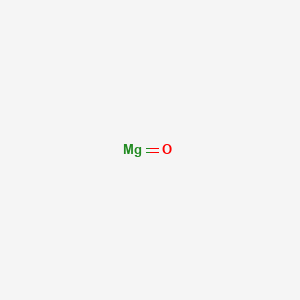
Magnesium Oxide
Magnesium oxide appears as a white solid, often found as a powder. When fine particles of magnesium oxide are dispersed in air, whether directly or when generated by the burning or cutting of magnesium metal, the resulting magnesium oxide fume is an inhalation hazard. — CAMEO Chemicals
- IUPAC name
- oxomagnesium
- Molecular formula
- MgO
- Molecular weight
- 40.305 g/mol
- Exact mass
- 39.9799563 Da
- Topological polar surface area
- 17.1 Ų
- Hydrogen-bond donors
- 0
- Hydrogen-bond acceptors
- 1
- Covalent units
- 1
- Defined stereocentres
- 0
Also known as
16 more reported names
External database identifiers
- ChEMBL:CHEMBL1200572
- PubMed:29282847
- PubMed:27920530
- PubMed:24096598
Evidence from additional scientific databases
NIH PubChem PUG-View
Attributed physical-property, hazard, environmental and use annotations.
- Boiling Point: 6512 °F at 760 mmHg (NIOSH, 2024) Source: CAMEO Chemicals
- Boiling Point: 3,600 °C Source: Hazardous Substances Data Bank (HSDB)
- Boiling Point: 3600 °C Source: ILO-WHO International Chemical Safety Cards (ICSCs)
- Boiling Point: 6512 °F Source: Occupational Safety and Health Administration (OSHA)
- Boiling Point: 3600 °C @760 [mm Hg] Source: PAC Chemical Database, U.S. Department of Energy
- Boiling Point: 6512 °F Source: The National Institute for Occupational Safety and Health (NIOSH)
- Color/Form: White, very fine powder Source: Hazardous Substances Data Bank (HSDB)
- Color/Form: White powder, either light or heavy depending upon whether it is prepared by heating magnesium carbonate or the basic magnesium carbonate Source: Hazardous Substances Data Bank (HSDB)
- Color/Form: Colorless, transparent cubic crystals Source: Hazardous Substances Data Bank (HSDB)
- Density: 3.58 (NIOSH, 2024) - Denser than water; will sink Source: CAMEO Chemicals
- Density: 3.6 g/cu cm Source: Hazardous Substances Data Bank (HSDB)
- Density: Relative density (water = 1): 3.6 Source: ILO-WHO International Chemical Safety Cards (ICSCs)
- Density: 3.58 Source: Occupational Safety and Health Administration (OSHA)
- Density: 3.6 @25 °C Source: PAC Chemical Database, U.S. Department of Energy
- Density: 3.58 Source: The National Institute for Occupational Safety and Health (NIOSH)
- Melting Point: 5072 °F (NIOSH, 2024) Source: CAMEO Chemicals
- Melting Point: 2825 °C Source: Hazardous Substances Data Bank (HSDB)
- Melting Point: 2800 °C Source: ILO-WHO International Chemical Safety Cards (ICSCs)
- Melting Point: 5072 °F Source: Occupational Safety and Health Administration (OSHA)
- Melting Point: 2825 °C Source: PAC Chemical Database, U.S. Department of Energy
- Melting Point: 5072 °F Source: The National Institute for Occupational Safety and Health (NIOSH)
- Odor: Odorless Source: Hazardous Substances Data Bank (HSDB)
- Physical Description: Magnesium oxide appears as a white solid, often found as a powder. When fine particles of magnesium oxide are dispersed in air, whether directly or when generated by the burning or cutting of magnesium metal, the resulting magnesium oxide fume is an inhalation hazard. Source: CAMEO Chemicals
- Physical Description: Other Solid; Wet Solid; Dry Powder; Large Crystals; Other Solid; CBI; Large Crystals; Dry Powder; Large Crystals; Dry Powder; Other Solid; Liquid Source: EPA Chemical Data Reporting (CDR)
- Physical Description: A very bulky, white powder known as light magnesium oxide or a relative dense, white powder known as heavy magnesium oxide. 5 g of light magnesium oxide occupy a volume of at least 33 ml, while 5 g of heavy magnesium oxide occupy a volume of not more than 20 ml Source: EU Food Improvement Agents
- Physical Description: Finely divided white particulate dispersed in air; Note: Exposure may occur when magnesium is burned, thermally cut, or welded upon; [NIOSH] Source: Haz-Map, Information on Hazardous Chemicals and Occupational Diseases
- Physical Description: Solid Source: Human Metabolome Database (HMDB)
- Physical Description: HYGROSCOPIC FINE WHITE POWDER. Source: ILO-WHO International Chemical Safety Cards (ICSCs)
- Physical Description: A white solid, often found as a powder. Source: Occupational Safety and Health Administration (OSHA)
- Physical Description: Finely divided white particulate dispersed in air. [Note: Exposure may occur when magnesium is burned, thermally cut, or welded upon.] Source: The National Institute for Occupational Safety and Health (NIOSH)
- Refractive Index: Index of refraction: 1.7355 at 589 nm; 1.7283 at 750 nm Source: Hazardous Substances Data Bank (HSDB)
- Solubility: 0.009 % at 86 °F (NIOSH, 2024) Source: CAMEO Chemicals
- Solubility: Practically insoluble in water. Insoluble in ethanol Source: EU Food Improvement Agents
- Solubility: Soluble in acids and ammonium salt solutions Source: Hazardous Substances Data Bank (HSDB)
- Solubility: Insoluble in ethanol Source: Hazardous Substances Data Bank (HSDB)
- Solubility: In water, 86 mg/L at 30 °C Source: Hazardous Substances Data Bank (HSDB)
- Solubility: Solubility in water: poor Source: ILO-WHO International Chemical Safety Cards (ICSCs)
- Solubility: (86 °F): 0.009% Source: The National Institute for Occupational Safety and Health (NIOSH)
- Vapor Pressure: 0 mmHg (approx) (NIOSH, 2024) Source: CAMEO Chemicals
- Vapor Pressure: 0 mmHg (approx) Source: Occupational Safety and Health Administration (OSHA)
- Vapor Pressure: 51.5 [mm Hg] @2832 °C Source: PAC Chemical Database, U.S. Department of Energy
- Vapor Pressure: 0 mmHg (approx) Source: The National Institute for Occupational Safety and Health (NIOSH)
- pH: pH = 10.3 (saturated aqueous solution) Source: Hazardous Substances Data Bank (HSDB)
- Exposure Routes: The substance can be absorbed into the body by inhalation of dust or fume. Source: ILO-WHO International Chemical Safety Cards (ICSCs)
- Exposure Routes: inhalation, skin and/or eye contact Source: The National Institute for Occupational Safety and Health (NIOSH)
- First Aid: Excerpt from NIOSH Pocket Guide for Magnesium oxide fume:; Breathing: RESPIRATORY SUPPORT - If a person breathes large amounts of this chemical, move the exposed person to fresh air at once. If breathing has stopped, perform artificial respiration. Keep the affected person warm and at rest. Get medical attention as soon as possible. (NIOSH, 2024) Source: CAMEO Chemicals
- First Aid: (General first aid procedures); Breathing: Respiratory support Source: The National Institute for Occupational Safety and Health (NIOSH)
- GHS Hazard Statements: Not Classified; Reported as not meeting GHS hazard criteria by 1586 of 1807 companies Source: European Chemicals Agency (ECHA)
- ECHA C&L Notifications Summary: Aggregated GHS information provided per 1807 reports by companies from 23 notifications to the ECHA C&L Inventory.; Reported as not meeting GHS hazard criteria per 1586 of 1807 reports by companies.; There are 20 notifications provided by 221 of 1807 reports by companies with hazard statement code(s).; Information may vary between notifications depending on impurities, additives, and other factors. The percentage value in parenthesis indicates the notified classification ratio from companies that provide hazard codes. Only hazard codes with percentage values above 10% are shown. For more detailed information, please visit ECHA C&L website. Source: European Chemicals Agency (ECHA)
- Signal: Warning Source: NITE-CMC
- GHS Hazard Statements: H319: Causes serious eye irritation [Warning Serious eye damage/eye irritation]; H335: May cause respiratory irritation [Warning Specific target organ toxicity, single exposure; Respiratory tract irritation] Source: NITE-CMC
- Precautionary Statement Codes: P261, P264+P265, P271, P280, P304+P340, P305+P351+P338, P319, P337+P317, P403+P233, P405, and P501 (click each P-code to see the statement) Source: NITE-CMC
- Target Organs: Eyes, respiratory system Source: The National Institute for Occupational Safety and Health (NIOSH)
- Consumer Uses: Processing aids not otherwise specified; Deodorizer; Fuel agents; pH regulating agent; Flavoring and nutrient; Insulators; Polymerization promoter; Binder; Other; Surface modifier; Adsorbent; Flux agent; Absorbent; Catalyst; Not Known or Reasonably Ascertainable; Filler; Soil amendments (fertilizers); Stabilizing agent Source: EPA Chemical Data Reporting (CDR)
- Industry Uses: Flux agent; Absorbent; Stabilizing agent; Catalyst; Corrosion inhibitor; Thickening agent; Filler; Not Known or Reasonably Ascertainable; Soil amendments (fertilizers); Hardener; Pigment; Processing aids, specific to petroleum production; Intermediate; Adsorbent; Polymerization promoter; Flavoring and nutrient; Insulators; Other; Processing aids not otherwise specified; Plating agent; Chemical reaction regulator; Fuel agents; pH regulating agent Source: EPA Chemical Data Reporting (CDR)
- Sources/Uses: Used in medications, animal feeds, fertilizers, insulation, wallboard, electrical heating rods, crucibles, fire bricks, petroleum additives, boiler scale control agents, and food additives; [HSDB] Source: Haz-Map, Information on Hazardous Chemicals and Occupational Diseases
- Industrial Processes with risk of exposure: Farming (Feed Additives) [Category: Industry] Source: Haz-Map, Information on Hazardous Chemicals and Occupational Diseases
- Uses: Both oil base and water base fracturing fluids are being used in the fracturing industry. Water base, which includes alcohol-water mixtures and low strength acids, make up the majority of treating fluids. The common chemicals added to these fluids are polymers for viscosity development, crosslinkers for viscosity enhancement, pH control chemicals, gel breakers for polymer degradation following the treatment, surfactants, clay stabilizers, alcohol, bactericides, fluid loss additives and friction reducer. /Hydraulic fracturing/ Source: Hazardous Substances Data Bank (HSDB)
- Uses: Hydraulic fracturing uses a specially blended liquid which is pumped into a well under extreme pressure causing cracks in rock formations underground. These cracks in the rock then allow oil and natural gas to flow, increasing resource production. ... Chemical Name: Magnesium oxide; Chemical Purpose: Allows a delayed break down of the gel; Product Function: Breaker. Source: Hazardous Substances Data Bank (HSDB)
- Uses: For magnesium oxide (USEPA/OPP Pesticide Code: 009235) there are 0 labels match. /SRP: Not registered for current use in the U.S., but approved pesticide uses may change periodically and so federal, state and local authorities must be consulted for currently approved uses./ Source: Hazardous Substances Data Bank (HSDB)
- Uses: CHEM INT MEDICINALS AND OTHER CHEMS; COMPONENT OF ANIMAL FEEDS, FERTILIZERS, INSULATION, AND WALLBOARD; COMPONENT OF PETROLEUM ADDITIVES, OXYCHLORIDE AND OXYSULFATE CEMENT; AGENT IN PULP AND PAPER MFR; FOOD CHEM; RUBBER ACCELERATOR; COMPONENT OF ELECTRICAL HEATING RODS; MISC APPLICATIONS Source: Hazardous Substances Data Bank (HSDB)
- Uses: For more Uses (Complete) data for MAGNESIUM OXIDE (12 total), please visit the HSDB record page. Source: Hazardous Substances Data Bank (HSDB)
Mapped by: Existing checksum-valid CAS to unique PubChem CID match. Retrieved: 2026-08-31. Open source record
Scientific classifications and hazard annotations provide context and do not replace the market-specific regulatory decision shown above.
Additional source coverage and match status
| Source | Result | Checked |
|---|---|---|
| NIH PubChem PUG-View | Exact match | 2026-08-31 |
A recorded no-match is useful evidence that the source was checked; it is not a claim that the substance does not exist elsewhere.
Retrieved from NIH PubChem on 2026-08-31 by checksum-valid CAS matching. Chemical properties do not replace the regulatory decision on this page.