
CAS 12125-28-9PubChem CID 73415762
Magnesium carbonate hydroxide
- IUPAC name
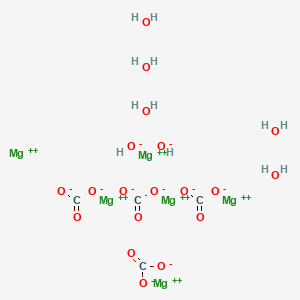
- hexamagnesium;tetracarbonate;dihydroxide;pentahydrate
- Molecular formula
- C4H12Mg6O19+2
- Molecular weight
- 509.96 g/mol
- Exact mass
- 507.9075283 Da
- Topological polar surface area
- 260.0 Ų
- Hydrogen-bond donors
- 7
- Hydrogen-bond acceptors
- 19
- Covalent units
- 17
- Defined stereocentres
- 0
Also known as
YQO029V1L4UNII-YQO029V1L4CCRIS 7884INS NO.504(II)INS-504(II)E-504(II)HYDRATED BASIC MAGNESIUM CARBONATEMAGNESIUM CARBONATE HYDROXIDE [MI]
16 more reported names
MAGNESIUM CARBONATE HYDROXIDE [WHO-DD]MAGNESIUM SUBCARBONATE (LIGHT OR HEAVY)HYDRATED BASIC MAGNESIUM CARBONATE [MART.]CARBONIC ACID, MAGNESIUM SALT (1:1), MIXT. WITH MAGNESIUM HYDROXIDE, HYDRATEHYDRATED BASIC MAGNESIUM CARBONATE (MART.)Marinco CRefChem:155180MAGNESIUM CARBONATE HYDROXIDE [INCI]609-673-0Magnesium hydrogen carbonateMagnesium subcarbonate (light or heavy)Hydrated basic magnesium carbonateMagnesium carbonate hydroxideBasic magnesium carbonateEINECS 235-192-7KinseiMagnesium carbonate basicMagnesium hydroxide carbonateCarbonic acid, magnesium salt (1:1), mixt. with magnesium hydroxide (mg(oh)2), hydrate
Evidence from additional scientific databases
NIH PubChem PUG-View
Exact identifier match73415762
Attributed physical-property, hazard, environmental and use annotations.
- Physical Description: Dry Powder Source: EPA Chemical Data Reporting (CDR)
- Physical Description: Light, white friable mass or bulky white powder Source: EU Food Improvement Agents
- Physical Description: White odorless solid; [Merck Index] White odorless powder; [Alfa Aesar MSDS] Source: Haz-Map, Information on Hazardous Chemicals and Occupational Diseases
- Solubility: Practically insoluble in water. Insoluble in ethanol Source: EU Food Improvement Agents
- Note: This chemical does not meet GHS hazard criteria for 97.7% (86 of 88) of all reports. Source: European Chemicals Agency (ECHA)
- GHS Hazard Statements: Not Classified; Reported as not meeting GHS hazard criteria by 86 of 88 companies (only 2.3% companies provided GHS information). For more detailed information, please visit ECHA C&L website. Source: European Chemicals Agency (ECHA)
- ECHA C&L Notifications Summary: Aggregated GHS information provided per 88 reports by companies from 4 notifications to the ECHA C&L Inventory.; Reported as not meeting GHS hazard criteria per 86 of 88 reports by companies.; There are 2 notifications provided by 2 of 88 reports by companies with hazard statement code(s).; Information may vary between notifications depending on impurities, additives, and other factors. The percentage value in parenthesis indicates the notified classification ratio from companies that provide hazard codes. Only hazard codes with percentage values above 10% are shown. For more detailed information, please visit ECHA C&L website. Source: European Chemicals Agency (ECHA)
- GHS Hazard Statements: Not Classified; Reported as not meeting GHS hazard criteria by 1 of 1 companies. For more detailed information, please visit ECHA C&L website. Source: European Chemicals Agency (ECHA)
- Industry Uses: Catalyst Source: EPA Chemical Data Reporting (CDR)
- Sources/Uses: Magnesite and lansfordite are examples of magnesium carbonate minerals; Used for fireproofing, heat insulating, filtrating, and to make effervescent magnesium citrate, mineral waters, pigments, and paper; Also used in tooth powders, face powders, polishing compounds, rubber fillers, antacids, and cathartics; [Merck Index] Used as a flavoring agent, anticaking agent, drying agent, formulation aid, humectant, lubricant or release agent, nutritive supplement, pH control agent, and processing aid for foods; [FDA] Source: Haz-Map, Information on Hazardous Chemicals and Occupational Diseases
- Industrial Processes with risk of exposure: Pulp and Paper Processing [Category: Industry] Source: Haz-Map, Information on Hazardous Chemicals and Occupational Diseases
Mapped by: Existing checksum-valid CAS to unique PubChem CID match. Retrieved: 2026-08-31. Open source record
Scientific classifications and hazard annotations provide context and do not replace the market-specific regulatory decision shown above.
Additional source coverage and match status
| Source | Result | Checked |
|---|---|---|
| NIH PubChem PUG-View | Exact match | 2026-08-31 |
A recorded no-match is useful evidence that the source was checked; it is not a claim that the substance does not exist elsewhere.
Retrieved from NIH PubChem on 2026-08-31 by checksum-valid CAS matching. Chemical properties do not replace the regulatory decision on this page.