
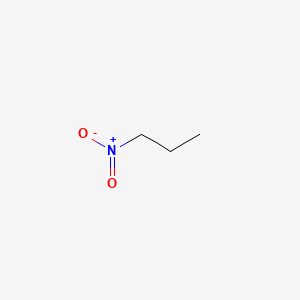
1-Nitropropane
1-nitropropane is a nitroalkane that is propane substituted at C-1 by a nitro group. It derives from a hydride of a propane. — ChEBI
- IUPAC name
- 1-nitropropane
- Molecular formula
- C3H7NO2
- Molecular weight
- 89.09 g/mol
- Exact mass
- 89.047678466 Da
- XLogP3
- 0.9
- Topological polar surface area
- 45.8 Ų
- Hydrogen-bond donors
- 0
- Hydrogen-bond acceptors
- 2
- Covalent units
- 1
- Defined stereocentres
- 0
Also known as
16 more reported names
External database identifiers
- ChEBI:CHEBI:76261
- ChEMBL:CHEMBL1449933
- EPA DTXSID:DTXSID1020980
- PubMed:22435791
- PubMed:22421324
- PubMed:22360187
- PubMed:22319232
- PubMed:22168236
- PubMed:21581056
- PubMed:20011461
- PubMed:19191397
- PubMed:18447345
- PubMed:17070881
- PubMed:16650394
- PubMed:16623529
Evidence from additional scientific databases
NIH PubChem PUG-View
Attributed physical-property, hazard, environmental and use annotations.
- Autoignition Temperature: 789 °F (USCG, 1999) Source: CAMEO Chemicals
- Autoignition Temperature: 789 °F, 421 °C Source: Hazardous Substances Data Bank (HSDB)
- Autoignition Temperature: 421 °C Source: ILO-WHO International Chemical Safety Cards (ICSCs)
- Boiling Point: 270 °F at 760 mmHg (NTP, 1992) Source: CAMEO Chemicals
- Boiling Point: 131.2 °C Source: Hazardous Substances Data Bank (HSDB)
- Boiling Point: 132 °C Source: ILO-WHO International Chemical Safety Cards (ICSCs)
- Boiling Point: 269 °F Source: Occupational Safety and Health Administration (OSHA)
- Boiling Point: 131.1 °C @760 [mm Hg] Source: PAC Chemical Database, U.S. Department of Energy
- Boiling Point: 269 °F Source: The National Institute for Occupational Safety and Health (NIOSH)
- Color/Form: Liquid Source: Hazardous Substances Data Bank (HSDB)
- Color/Form: Colorless liquid Source: Hazardous Substances Data Bank (HSDB)
- Density: 0.9934 at 77 °F (USCG, 1999) - Less dense than water; will float Source: CAMEO Chemicals
- Density: 0.9961 g/cu cm at 25 °C Source: Hazardous Substances Data Bank (HSDB)
- Density: Relative density (water = 1): 0.99 Source: ILO-WHO International Chemical Safety Cards (ICSCs)
- Density: 1 Source: Occupational Safety and Health Administration (OSHA)
- Density: 0.9961 @25 °C Source: PAC Chemical Database, U.S. Department of Energy
- Density: 1.00 Source: The National Institute for Occupational Safety and Health (NIOSH)
- Dissociation Constants: pKa = 8.98 Source: Hazardous Substances Data Bank (HSDB)
- Flash Point: 93 °F (NTP, 1992) Source: CAMEO Chemicals
- Flash Point: 36 °C Source: Haz-Map, Information on Hazardous Chemicals and Occupational Diseases
- Flash Point: 36 °C, 96 °F (closed cup) Source: Hazardous Substances Data Bank (HSDB)
- Flash Point: 93 °F (34 °C) - open cup Source: Hazardous Substances Data Bank (HSDB)
- Flash Point: 120 °F open cup (commercial grade) Source: Hazardous Substances Data Bank (HSDB)
- Flash Point: 36 °C Source: ILO-WHO International Chemical Safety Cards (ICSCs)
- Flash Point: 96 °F Source: Occupational Safety and Health Administration (OSHA)
- Flash Point: 96 °F Source: The National Institute for Occupational Safety and Health (NIOSH)
- LogP: log Kow = 0.87 Source: Hazardous Substances Data Bank (HSDB)
- Melting Point: -162 °F (NTP, 1992) Source: CAMEO Chemicals
- Melting Point: -104.3 °C Source: Hazardous Substances Data Bank (HSDB)
- Melting Point: -108 °C Source: ILO-WHO International Chemical Safety Cards (ICSCs)
- Melting Point: -162 °F Source: Occupational Safety and Health Administration (OSHA)
- Melting Point: -108 °C Source: PAC Chemical Database, U.S. Department of Energy
- Melting Point: -162 °F Source: The National Institute for Occupational Safety and Health (NIOSH)
- Odor: Somewhat disagreeable odor Source: Hazardous Substances Data Bank (HSDB)
- Odor: Mild, fruity odor Source: Hazardous Substances Data Bank (HSDB)
- Physical Description: 1-nitropropane appears as a colorless oily flammable liquid. Density about the same as water. Vapors much heavier than air. Vapors may irritate skin, eyes and mucous membranes. Toxic oxides of nitrogen are released during combustion. Used as a propellant and as a solvent. Source: CAMEO Chemicals
- Physical Description: Liquid Source: EPA Chemical Data Reporting (CDR)
- Physical Description: Colorless liquid with a somewhat disagreeable odor; [NIOSH] Source: Haz-Map, Information on Hazardous Chemicals and Occupational Diseases
- Physical Description: COLOURLESS LIQUID WITH CHARACTERISTIC ODOUR. Source: ILO-WHO International Chemical Safety Cards (ICSCs)
- Physical Description: Colorless oily liquid with a somewhat disagreeable odor. Source: Occupational Safety and Health Administration (OSHA)
- Physical Description: Colorless liquid with a somewhat disagreeable odor. Source: The National Institute for Occupational Safety and Health (NIOSH)
- Refractive Index: Index of refraction: 1.4018 at 20 °C/D Source: Hazardous Substances Data Bank (HSDB)
- Solubility: Slightly soluble (NTP, 1992) Source: CAMEO Chemicals
- Solubility: In water, 1.50X10+4 mg/L at 25 °C Source: Hazardous Substances Data Bank (HSDB)
- Solubility: Slightly soluble in water (1.4 mL/100 mL) Source: Hazardous Substances Data Bank (HSDB)
- Solubility: Slightly soluble in water Source: Hazardous Substances Data Bank (HSDB)
- Solubility: Miscible with ethanol, ethyl ether; soluble in chloroform Source: Hazardous Substances Data Bank (HSDB)
- Solubility: Solubility in water, g/100ml: 1.4 Source: ILO-WHO International Chemical Safety Cards (ICSCs)
- Solubility: 1% Source: The National Institute for Occupational Safety and Health (NIOSH)
- Vapor Pressure: 8 mmHg (NIOSH, 2024) Source: CAMEO Chemicals
- Vapor Pressure: 10.1 [mmHg] Source: Haz-Map, Information on Hazardous Chemicals and Occupational Diseases
- Vapor Pressure: 1.01X10+1 mm Hg at 25 °C /Extrapolated/ Source: Hazardous Substances Data Bank (HSDB)
- Vapor Pressure: Vapor pressure, kPa at 20 °C: 1.0 Source: ILO-WHO International Chemical Safety Cards (ICSCs)
- Vapor Pressure: 8 mmHg Source: Occupational Safety and Health Administration (OSHA)
- Vapor Pressure: 7.5 [mm Hg] @20 °C Source: PAC Chemical Database, U.S. Department of Energy
- Vapor Pressure: 8 mmHg Source: The National Institute for Occupational Safety and Health (NIOSH)
- Viscosity: 0.790 cP at 25 °C Source: Hazardous Substances Data Bank (HSDB)
- pH: pH = 6.0 for a 0.01 M aqueous solution at 25 °C Source: Hazardous Substances Data Bank (HSDB)
- Exposure Routes: The substance can be absorbed into the body by inhalation and by ingestion. Source: ILO-WHO International Chemical Safety Cards (ICSCs)
- Exposure Routes: inhalation, ingestion, skin and/or eye contact Source: The National Institute for Occupational Safety and Health (NIOSH)
- First Aid: EYES: First check the victim for contact lenses and remove if present. Flush victim's eyes with water or normal saline solution for 20 to 30 minutes while simultaneously calling a hospital or poison control center. Do not put any ointments, oils, or medication in the victim's eyes without specific instructions from a physician. IMMEDIATELY transport the victim after flushing eyes to a hospital even if no symptoms (such as redness or irritation) develop.; SKIN: IMMEDIATELY flood affected skin with water while removing and isolating all contaminated clothing. Gently wash all affected skin areas thoroughly with soap and water. If symptoms such as redness or irritation develop, IMMEDIATELY call a physician and be prepared to transport the victim to a hospital for treatment.; INHALATION: IMMEDIATELY leave the contaminated area; take deep breaths of fresh air. If symptoms (such as wheezing, coughing, shortness of breath, or burning in the mouth, throat, or chest) develop, call a physician and be prepared to transport the victim to a hospital. Provide proper respiratory protection to rescuers entering an unknown atmosphere. Whenever possible, Self-Contained Breathing Apparatus (SCBA) shou Source: CAMEO Chemicals
- First Aid: (General first aid procedures); Eye: Irrigate immediately - If this chemical contacts the eyes, immediately wash (irrigate) the eyes with large amounts of water, occasionally lifting the lower and upper lids. Get medical attention immediately.; Skin: Soap wash promptly - If this chemical contacts the skin, promptly wash the contaminated skin with soap and water. If this chemical penetrates the clothing, promptly remove the clothing and wash the skin with soap and water. Get medical attention promptly.; Breathing: Respiratory support; Swallow: Medical attention immediately - If this chemical has been swallowed, get medical attention immediately. Source: The National Institute for Occupational Safety and Health (NIOSH)
- Signal: Warning Source: Regulation (EC) No 1272/2008 of the European Parliament and of the Council
- GHS Hazard Statements: H226: Flammable liquid and vapor [Warning Flammable liquids]; H302: Harmful if swallowed [Warning Acute toxicity, oral]; H312: Harmful in contact with skin [Warning Acute toxicity, dermal]; H332: Harmful if inhaled [Warning Acute toxicity, inhalation] Source: Regulation (EC) No 1272/2008 of the European Parliament and of the Council
- Precautionary Statement Codes: P210, P233, P240, P241, P242, P243, P261, P264, P270, P271, P280, P301+P317, P302+P352, P303+P361+P353, P304+P340, P317, P321, P330, P362+P364, P370+P378, P403+P235, and P501 (click each P-code to see the statement) Source: Regulation (EC) No 1272/2008 of the European Parliament and of the Council
- Signal: Danger Source: European Chemicals Agency (ECHA)
- GHS Hazard Statements: H226 (100%): Flammable liquid and vapor [Warning Flammable liquids]; H302+H312 (11.7%): Harmful if swallowed or in contact with skin [Warning Acute toxicity, oral; acute toxicity, dermal]; H302 (100%): Harmful if swallowed [Warning Acute toxicity, oral]; H312 (75.8%): Harmful in contact with skin [Warning Acute toxicity, dermal]; H331 (39.3%): Toxic if inhaled [Danger Acute toxicity, inhalation]; H332 (60.7%): Harmful if inhaled [Warning Acute toxicity, inhalation] Source: European Chemicals Agency (ECHA)
- Precautionary Statement Codes: P210, P233, P240, P241, P242, P243, P261, P264, P270, P271, P280, P301+P317, P302+P352, P303+P361+P353, P304+P340, P316, P317, P321, P330, P362+P364, P370+P378, P403+P233, P403+P235, P405, and P501 (click each P-code to see the statement) Source: European Chemicals Agency (ECHA)
- ECHA C&L Notifications Summary: Aggregated GHS information provided per 326 reports by companies from 7 notifications to the ECHA C&L Inventory. Each notification may be associated with multiple companies.; Information may vary between notifications depending on impurities, additives, and other factors. The percentage value in parenthesis indicates the notified classification ratio from companies that provide hazard codes. Only hazard codes with percentage values above 10% are shown. For more detailed information, please visit ECHA C&L website. Source: European Chemicals Agency (ECHA)
- Signal: Danger Source: NITE-CMC
- GHS Hazard Statements: H226: Flammable liquid and vapor [Warning Flammable liquids]; H302: Harmful if swallowed [Warning Acute toxicity, oral]; H319: Causes serious eye irritation [Warning Serious eye damage/eye irritation]; H331: Toxic if inhaled [Danger Acute toxicity, inhalation]; H335: May cause respiratory irritation [Warning Specific target organ toxicity, single exposure; Respiratory tract irritation]; H336: May cause drowsiness or dizziness [Warning Specific target organ toxicity, single exposure; Narcotic effects]; H370: Causes damage to organs [Danger Specific target organ toxicity, single exposure] Source: NITE-CMC
- Precautionary Statement Codes: P210, P233, P240, P241, P242, P243, P260, P261, P264, P264+P265, P270, P271, P280, P301+P317, P303+P361+P353, P304+P340, P305+P351+P338, P308+P316, P316, P319, P321, P330, P337+P317, P370+P378, P403+P233, P403+P235, P405, and P501 (click each P-code to see the statement) Source: NITE-CMC
- Signal: Warning Source: NITE-CMC
- GHS Hazard Statements: H226: Flammable liquid and vapor [Warning Flammable liquids]; H336: May cause drowsiness or dizziness [Warning Specific target organ toxicity, single exposure; Narcotic effects]; H351: Suspected of causing cancer [Warning Carcinogenicity] Source: NITE-CMC
- NFPA Health Rating: 2 - Materials that, under emergency conditions, can cause temporary incapacitation or residual injury. Source: Hazardous Substances Data Bank (HSDB)
- NFPA Fire Rating: 3 - Liquids and solids that can be ignited under almost all ambient temperature conditions. Materials produce hazardous atmospheres with air under almost all ambient temperatures or, though unaffected by ambient temperatures, are readily ignited under almost all conditions. Source: Hazardous Substances Data Bank (HSDB)
- NFPA Instability Rating: 2 - Materials that readily undergo violent chemical changes at elevated temperatures and pressures. Source: Hazardous Substances Data Bank (HSDB)
- NFPA Specific Notice: W - No water: Materials that react violently or explosively with water. Source: Hazardous Substances Data Bank (HSDB)
- Target Organs: Eyes, central nervous system, liver, kidneys Source: The National Institute for Occupational Safety and Health (NIOSH)
- Toxicity Summary: IDENTIFICATION AND USE: 1-Nitropropane (1-NP) is a colorless liquid. 1-NP is used as a rocket propellant, gasoline additive, and in chemical syntheses. HUMAN STUDIES: Anorexia, nausea, vomiting, and intermittent diarrhea and headaches occurred in men exposed at 20 to 45 ppm of 1-NP during a dipping processes. Additionally, human exposure to 1-NP concentrations exceeding 100 ppm reportedly causes eye irritation in humans. ANIMAL STUDIES: Exposures at 5,000 ppm of 1-NP for 3 hr killed rabbits and guinea pigs. However, concentration of 10,000 ppm for 1 hr was not lethal. Signs of 1-NP exposure included conjunctival irritation, lacrimation, slow respiration with some rales, incoordination, ataxia, and weakness. Rats treated with 1-NP at 1 mmol/kg bw three times per week for 16 weeks had only slightly reduced body weight, and after 26 weeks (termination of treatment), they regained their body weight. One benign liver tumor was observed in these rats. Hepatotoxic symptoms were also observed. There have been numerous studies on the mutagenic activity of 1-NP in Salmonella typhimurium (Ames test). 1-NP was not mutagenic in multiple strains of S. typhimurium with or without the addition of Source: Hazardous Substances Data Bank (HSDB)
- Environmental Bioconcentration: A BCF value of 1.3 was measured for fish (Golden ide) in a static 3-day test with 1-nitropropane present at 50 ppb(1). According to a classification scheme(2), this BCF value suggests that bioconcentration in aquatic organisms is low(SRC). Bioconcentration of 1-nitropropane in algae (Chlorella fusca) was measured using (14)C-labelled 1-nitropropane at 50 ppb. The algae were irradiated for 24 hours; 92.9% of the radioactivity was present in solution, 1.7% of the radioactivity was associated with the algae(1). A bioconcentration factor of 180 for algae was calculated from this experiment(1). Source: Hazardous Substances Data Bank (HSDB)
- Environmental Fate: TERRESTRIAL FATE: Based on a classification scheme(1), an estimated Koc value of 36(SRC), determined from a structure estimation method(2), indicates that 1-nitropropane is expected to have very high mobility(SRC). The pKa of 1-nitropropane is 8.98(3), indicating that this compound will exist partially in the anion form in the environment and anions generally do not adsorb more strongly to soils containing organic carbon and clay than their neutral counterparts(4). Volatilization of 1-nitropropane from moist soil surfaces is expected to be an important fate process(SRC) given a Henry's Law constant of 8.7X10⁻⁵ atm-cu m/mole(3). 1-Nitropropane is expected to volatilize from dry soil surfaces(SRC) based upon a vapor pressure of 10.1 mm Hg at 25 °C(5). Using the Closed Bottle test, 45% degradation in 4 weeks using an activated sludge inoculum(6) suggests that biodegradation may be an important environmental fate process in soil(SRC). Source: Hazardous Substances Data Bank (HSDB)
- Environmental Fate: AQUATIC FATE: Based on a classification scheme(1), an estimated Koc value of 36(SRC), determined from a structure estimation method(2), indicates that 1-nitropropane is not expected to adsorb to suspended solids and sediment(SRC). Volatilization of the neutral species from water surfaces is expected(3) based upon a Henry's Law constant of 8.70X10⁻⁵ atm-cu m/mole(4). Using this Henry's Law constant and an estimation method(3), volatilization half-lives for a model river and model lake are 12 hrs and 7 days, respectively(SRC). A pKa of 8.98(5) indicates 1-nitropropane will exist partially in the anion form at pH values of 5 to 9 and, therefore, volatilization from water surfaces is not expected to be an important fate process for the ionized species(SRC). According to a classification scheme(6), a BCF of 1.3(7) indicates that bioconcentration in aquatic organisms is low(SRC). Using the Closed Bottle test, 45% degradation in 4 weeks using an activated sludge inoculum(7) suggests that biodegradation may be an important environmental fate process in water(SRC). Source: Hazardous Substances Data Bank (HSDB)
- Environmental Fate: ATMOSPHERIC FATE: According to a model of gas/particle partitioning of semivolatile organic compounds in the atmosphere(1), 1-nitropropane, which has a vapor pressure of 10.1 mm Hg at 25 °C(2), is expected to exist solely as a vapor in the ambient atmosphere. Vapor-phase 1-nitropropane is degraded in the atmosphere by reaction with photochemically-produced hydroxyl radicals(SRC); the half-life for this reaction in air is estimated to be 37 days(SRC), calculated from its rate constant of 4.40X10⁻¹³ cu cm/molecule-sec at 25 °C(3). 1-Nitropropane does not contain chromophores that absorb at wavelengths >290 nm(4) and, therefore, is not expected to be susceptible to direct photolysis by sunlight(SRC). Source: Hazardous Substances Data Bank (HSDB)
- Consumer Uses: Wetting agent (non-aqueous); Solvent Source: EPA Chemical Data Reporting (CDR)
- Industry Uses: Solvent; Wetting agent (non-aqueous) Source: EPA Chemical Data Reporting (CDR)
- Sources/Uses: Used in organic chemical synthesis and as a rocket propellant, gasoline additive, and solvent; [ACGIH] Used as a solvent for waxes, resins, lacquers, synthetic rubber, fats, oils, dyes, inks, and other organic materials; [HSDB] Source: Haz-Map, Information on Hazardous Chemicals and Occupational Diseases
- Industrial Processes with risk of exposure: Semiconductor Manufacturing [Category: Industry]; Painting (Solvents) [Category: Paint]; Plastic Composites Manufacturing [Category: Industry] Source: Haz-Map, Information on Hazardous Chemicals and Occupational Diseases
- Uses: Solvent for cellulose acetate, vinyl resins, lacquers, synthetic rubbers, fats, oils, dyes, other organic materials; as intermediate, propellant. Source: Hazardous Substances Data Bank (HSDB)
- Uses: Solvent, chemical synthesis, rocket propellant, gasoline additive. Source: Hazardous Substances Data Bank (HSDB)
- Uses: ... Synthesis of ethambutol, an antituberculosis drug. Relatively small quantities of 1-nitropropane are used in the preparation of biocides. Source: Hazardous Substances Data Bank (HSDB)
- Uses: ... use as thinner and solvent for cellulose compounds, lacquers, and dopes; in vinyl resins for industrial coatings and printing inks; in synthetic finish removers; and for oil and spirit-sol dyes of molded plastics; use as extraction solvent for purification, separation, recrystallization, and recovery for natural and synthetic resins, tars, coating materials, fats and oils; use as reaction medium in polymer technology, as a catalyst, initiator, and solvent; use in organic chemical synthesis ... . Source: Hazardous Substances Data Bank (HSDB)
- Uses: 1-NP /1-nitropropane/ is used as a rocket propellant, gasoline additive, and in chemical syntheses. Source: Hazardous Substances Data Bank (HSDB)
Mapped by: Existing checksum-valid CAS to unique PubChem CID match. Retrieved: 2026-08-31. Open source record
Scientific classifications and hazard annotations provide context and do not replace the market-specific regulatory decision shown above.
Additional source coverage and match status
| Source | Result | Checked |
|---|---|---|
| NIH PubChem PUG-View | Exact match | 2026-08-31 |
A recorded no-match is useful evidence that the source was checked; it is not a claim that the substance does not exist elsewhere.
Retrieved from NIH PubChem on 2026-08-31 by checksum-valid CAS matching. Chemical properties do not replace the regulatory decision on this page.