
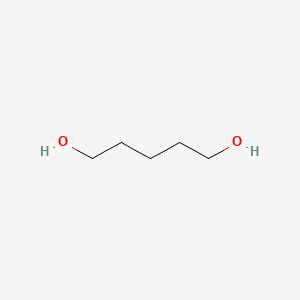
- IUPAC name
- pentane-1,5-diol
- Molecular formula
- C5H12O2
- Molecular weight
- 104.15 g/mol
- Exact mass
- 104.083729621 Da
- XLogP3
- -0.1
- Topological polar surface area
- 40.5 Ų
- Hydrogen-bond donors
- 2
- Hydrogen-bond acceptors
- 2
- Covalent units
- 1
- Defined stereocentres
- 0
Also known as
1,5-DihydroxypentanePentamethylene glycol1,5-Pentamethylene glycol1,5-Pentylene glycolalpha,omega-Pentanediol07UXZ0SCSTNSC-5927RefChem:73549
16 more reported names
203-854-41,5 PentanediolNSC 59271,5-Pentandiol.alpha.,.omega.-PentanediolEINECS 203-854-4UNII-07UXZ0SCSTBRN 1560130AI3-033181.5-pentanediol9JEpentan-1,5-diol1,5-pentane diol.omega.-PentanediolPentane diol-1,5EC 203-854-4
External database identifiers
- ChEBI:CHEBI:185431
- ChEMBL:CHEMBL448289
- EPA DTXSID:DTXSID2041256
- PubMed:22733605
- PubMed:22691416
- PubMed:22669359
- PubMed:22645248
- PubMed:22173989
- PubMed:22110867
- PubMed:22066681
- PubMed:21347475
- PubMed:21157012
- PubMed:21121346
- PubMed:21058660
- PubMed:20839374
Evidence from additional scientific databases
NIH PubChem PUG-View
Exact identifier match8105
Attributed physical-property, hazard, environmental and use annotations.
- Autoignition Temperature: 635 °F Source: Hazardous Substances Data Bank (HSDB)
- Boiling Point: 240 °C Source: Hazardous Substances Data Bank (HSDB)
- Boiling Point: 239 °C @760 [mm Hg] Source: PAC Chemical Database, U.S. Department of Energy
- Color/Form: Viscous, oily liquid Source: Hazardous Substances Data Bank (HSDB)
- Color/Form: Colorless Source: Hazardous Substances Data Bank (HSDB)
- Density: 0.9941 g/cm cu at 20 °C; 0.9858 g/cm cu at 25 °C Source: Hazardous Substances Data Bank (HSDB)
- Density: 0.994 @ 20°C Source: PAC Chemical Database, U.S. Department of Energy
- Flash Point: 129 °C (265 °F) (open cup) Source: Hazardous Substances Data Bank (HSDB)
- Flash Point: 136 °C (277 °F) - closed cup Source: Hazardous Substances Data Bank (HSDB)
- Melting Point: -18 °C Source: Hazardous Substances Data Bank (HSDB)
- Physical Description: CBI; Liquid Source: EPA Chemical Data Reporting (CDR)
- Physical Description: Viscous liquid; [Merck Index] Colorless viscous liquid; Hygroscopic; [Alfa Aesar MSDS] Source: Haz-Map, Information on Hazardous Chemicals and Occupational Diseases
- Refractive Index: Index of refraction: 1.4499 at 20 °C Source: Hazardous Substances Data Bank (HSDB)
- Solubility: Miscible with water Source: Hazardous Substances Data Bank (HSDB)
- Solubility: Soluble in water Source: Hazardous Substances Data Bank (HSDB)
- Solubility: Miscible with methanol, ethanol, acetone, ethyl acetate. Soluble in ether (25 °C) 11% w/w. Limited solubility in benzene, trichloroethylene, methylene chloride, petroleum ether, heptane. Source: Hazardous Substances Data Bank (HSDB)
- Solubility: Soluble in alcohols, acetone, and relatively insoluble in aliphatic and aromatic hydrocarbons Source: Hazardous Substances Data Bank (HSDB)
- Vapor Pressure: 0.0039 [mmHg] Source: Haz-Map, Information on Hazardous Chemicals and Occupational Diseases
- Vapor Pressure: 3.90X10⁻³ mm Hg at 25 °C Source: Hazardous Substances Data Bank (HSDB)
- Viscosity: 128 mPa.s at 20 °C Source: Hazardous Substances Data Bank (HSDB)
- Note: This chemical does not meet GHS hazard criteria for 84.9% (275 of 324) of all reports. Source: European Chemicals Agency (ECHA)
- Signal: Warning Source: European Chemicals Agency (ECHA)
- GHS Hazard Statements: H302 (15.1%): Harmful if swallowed [Warning Acute toxicity, oral] Source: European Chemicals Agency (ECHA)
- Precautionary Statement Codes: P264, P270, P301+P317, P330, and P501 (click each P-code to see the statement) Source: European Chemicals Agency (ECHA)
- ECHA C&L Notifications Summary: Aggregated GHS information provided per 324 reports by companies from 5 notifications to the ECHA C&L Inventory.; Reported as not meeting GHS hazard criteria per 275 of 324 reports by companies.; There are 3 notifications provided by 49 of 324 reports by companies with hazard statement code(s).; Information may vary between notifications depending on impurities, additives, and other factors. The percentage value in parenthesis indicates the notified classification ratio from companies that provide hazard codes. Only hazard codes with percentage values above 10% are shown. For more detailed information, please visit ECHA C&L website. Source: European Chemicals Agency (ECHA)
- NFPA Health Rating: 1 - Materials that, under emergency conditions, can cause significant irritation. Source: Hazardous Substances Data Bank (HSDB)
- NFPA Fire Rating: 1 - Materials that must be preheated before ignition can occur. Materials require considerable preheating, under all ambient temperature conditions, before ignition and combustion can occur. Source: Hazardous Substances Data Bank (HSDB)
- NFPA Instability Rating: 0 - Materials that in themselves are normally stable, even under fire conditions. Source: Hazardous Substances Data Bank (HSDB)
- Cosmetic Ingredient Review Finding(s): Safe in the present practices of use and concentration. Ingredient, concentration, and use information are available in documents discoverable at https://cir-reports.cir-safety.org Source: Cosmetic Ingredient Review (CIR)
- Toxicity Summary: IDENTIFICATION AND USE: 1,5-Pentanediol has antimicrobial and antifungal properties in pharmaceutical applications. Additionally, 1,5-pentanediol has reported uses in products for hair loss, cold sores, nail problems, dry and scaly feet, and eczema; it can be used as a moisturizing substance and solvent. In addition, it is used as a plasticizer in cellulose products and adhesives, and in brake fluid compositions. It forms esters and polyesters which can be used as plasticizers, emulsifying agents and resin intermediates. HUMAN STUDIES: 1,5-Pentanediol (5%) was non-irritating to skin in an occlusive patch test. 1,5-Pentanediol (5% and 25% in different tests) was non-sensitizing to skin. A patient was diagnosed with allergic contact dermatitis from resveratrol-containing cream which also contained 1,5-pentanediol. The reaction was attributed to sensitization to 1,5-pentanediol and potential co-sensitization to resveratrol. ANIMAL STUDIES: No-to-mild irritation was observed for undiluted 1,5-pentanediol in rabbit eyes. 1,5-Pentanediol (undiluted) was non-irritating to rabbit skin in both a 24-hour non-occlusive skin test and a 20-hour occlusive patch test on intact and scarified skin. Source: Hazardous Substances Data Bank (HSDB)
- Environmental Bioconcentration: An estimated BCF of 3.2 was calculated in fish for 1,5-Pentanediol(SRC), using an estimated log Kow of 0.27(1) and a regression-derived equation(1). According to a classification scheme(2), this BCF suggests the potential for bioconcentration in aquatic organisms is low(SRC). Source: Hazardous Substances Data Bank (HSDB)
- Environmental Fate: TERRESTRIAL FATE: Based on a classification scheme(1), an estimated Koc value of 1(SRC), determined from a structure estimation method(2), indicates that 1,5-pentanediol is expected to have very high mobility in soil(SRC). Volatilization of 1,5-pentanediol from moist soil surfaces is not expected to be an important fate process(SRC) given an estimated Henry's Law constant of 3.1X10⁻⁷ atm-cu m/mole(SRC), using a fragment constant estimation method(3). 1,5-Pentanediol is not expected to volatilize from dry soil surfaces(SRC) based upon a vapor pressure of 3.9X10⁻³ mm Hg at 25 °C(4). An 83-89% of theoretical BOD using activated sludge in the OECD Manometric Respiromerty test(5) suggests that biodegradation is an important environmental fate process in soil(SRC). Source: Hazardous Substances Data Bank (HSDB)
- Environmental Fate: AQUATIC FATE: Based on a classification scheme(1), an estimated Koc value of 1(SRC), determined from a structure estimation method(2), indicates that 1,5-pentanediol is not expected to adsorb to suspended solids and sediment(SRC). Volatilization from water surfaces is not expected(3) based upon an estimated Henry's Law constant of 3.1X10⁻⁷ atm-cu m/mole(SRC), developed using a fragment constant estimation method(4). According to a classification scheme(5), an estimated BCF of 3.2(SRC), from an estimated log Kow of 0.27(2) and a regression-derived equation(2), suggests the potential for bioconcentration in aquatic organisms is low(SRC). An 83-89% of theoretical BOD using activated sludge in the OECD Manometric Respiromerty test(6) suggests that biodegradation is an important environmental fate process in water(SRC). Source: Hazardous Substances Data Bank (HSDB)
- Environmental Fate: ATMOSPHERIC FATE: According to a model of gas/particle partitioning of semivolatile organic compounds in the atmosphere(1), 1,5-pentanediol, which has a vapor pressure of 3.9X10⁻³ mm Hg at 25 °C(2), is expected to exist solely as a vapor in the ambient atmosphere. Vapor-phase 1,5-pentanediol is degraded in the atmosphere by reaction with photochemically-produced hydroxyl radicals(SRC); the half-life for this reaction in air is estimated to be 31 hours(SRC), calculated from its rate constant of 1.3X10⁻¹¹ cu cm/molecule-sec at 25 °C(SRC) (that was derived using a structure estimation method(3). 1,5-Pentanediol does not contain chromophores that absorb at wavelengths >290 nm(4) and, therefore, is not expected to be susceptible to direct photolysis by sunlight(SRC). Source: Hazardous Substances Data Bank (HSDB)
- Consumer Uses: Diluent Source: EPA Chemical Data Reporting (CDR)
- Industry Uses: Solvent; Intermediate Source: EPA Chemical Data Reporting (CDR)
- Cosmetic Ingredient Review Link: CIR ingredient: 1,5-Pentanediol Source: Cosmetic Ingredient Review (CIR)
- Sources/Uses: Used as plasticizer and brake fluid additive; Also used to make polyesters for emulsifying agents and resin intermediates; [Merck Index] Source: Haz-Map, Information on Hazardous Chemicals and Occupational Diseases
- Uses: For 1,5-pentanediol (USEPA/OPP Pesticide Code: 690202) there are 0 labels match. /SRP: Not registered for current use in the U.S., but approved pesticide uses may change periodically and so federal, state and local authorities must be consulted for currently approved uses./ Source: Hazardous Substances Data Bank (HSDB)
- Uses: 1,5-Pentanediol is used as a building block in the production of polyesters, thermoplastic polyurethanes, and plasticizers. The linear structure with an uneven number of carbon atoms gives rise to a relatively low viscosity and glass transition temperature (Tg) and good flexibility. 1,5-Pentanediol is also used as an intermediate for dyes and of pharmaceuticals and pesticides. It can be used, for example, for the production of various heterocyclic compounds, such as 1-methylpiperidine. Source: Hazardous Substances Data Bank (HSDB)
- Uses: As a plasticizer in cellulose products and adhesives, in brake fluid compositions. Forms esters and polyesters which can be used as plasticizers, emulsifying agents and resin intermediates. Source: Hazardous Substances Data Bank (HSDB)
- Uses: MEDICATION Source: Hazardous Substances Data Bank (HSDB)
- Uses: 1,5-Pentanediol has been reported to have antimicrobial and antifungal properties in pharmaceutical applications. Additionally, 1,5-Pentanediol has reported uses in products for hair loss, cold sores, nail problems, dry and scaly feet, and eczema; it can be used as a moisturizing substance and solvent. Source: Hazardous Substances Data Bank (HSDB)
Mapped by: Existing checksum-valid CAS to unique PubChem CID match. Retrieved: 2026-08-31. Open source record
Scientific classifications and hazard annotations provide context and do not replace the market-specific regulatory decision shown above.
Additional source coverage and match status
| Source | Result | Checked |
|---|---|---|
| NIH PubChem PUG-View | Exact match | 2026-08-31 |
A recorded no-match is useful evidence that the source was checked; it is not a claim that the substance does not exist elsewhere.
Retrieved from NIH PubChem on 2026-08-31 by checksum-valid CAS matching. Chemical properties do not replace the regulatory decision on this page.