
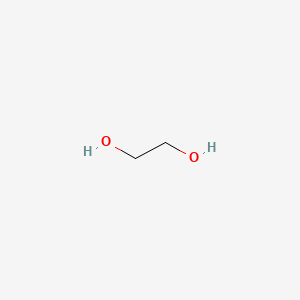
Ethylene Glycol
Ethylene glycol is a synthetic liquid substance that absorbs water. It is odorless, but has a sweet taste. Ethylene glycol is used to make antifreeze and de-icing solutions for cars, airplanes, and boats. It is also used in hydraulic brake fluids and inks used in stamp pads, ballpoint pens, and print shops. — Agency for Toxic Substances and Disease Registry (ATSDR)
- IUPAC name
- ethane-1,2-diol
- Molecular formula
- C2H6O2
- Molecular weight
- 62.07 g/mol
- Exact mass
- 62.036779430 Da
- XLogP3
- -1.4
- Topological polar surface area
- 40.5 Ų
- Hydrogen-bond donors
- 2
- Hydrogen-bond acceptors
- 2
- Covalent units
- 1
- Defined stereocentres
- 0
Also known as
16 more reported names
External database identifiers
- ChEBI:CHEBI:30742
- ChEBI:CHEBI:46793
- ChEMBL:CHEMBL457299
- EPA DTXSID:DTXSID8020597
- PubMed:37414240
- PubMed:37244400
- PubMed:34468068
- PubMed:33681995
- PubMed:33542403
- PubMed:31711903
- PubMed:31639794
- PubMed:30763314
- PubMed:28807745
- PubMed:28433809
- PubMed:27241030
- PubMed:27021274
Evidence from additional scientific databases
EMBL-EBI ChEBI
ethylene glycol
A 1,2-glycol compound produced via reaction of ethylene oxide with water.
- Formula
- C2H6O2
- Average mass
- 62.068 g/mol
- Monoisotopic mass
- 62.03678 Da
- Formal charge
- 0
- ethanediol — is a (CHEBI:23976)
- glycol — is a (CHEBI:13643)
- mouse metabolite — has role (CHEBI:75771)
- metabolite — has role (CHEBI:25212)
- toxin — has role (CHEBI:27026)
- solvent — has role (CHEBI:46787)
- mouse metabolite — has role (CHEBI:75771)
- metabolite — has role (CHEBI:25212)
- toxin — has role (CHEBI:27026)
- solvent — has role (CHEBI:46787)
- ethanediol — is a (CHEBI:23976)
- glycol — is a (CHEBI:13643)
- 10349109 Source: PubMed
- 15716482 Source: PubMed
- 16901854 Source: PubMed
- 17186009 Source: PubMed
- 17336832 Source: PubMed
- 17439666 Source: PubMed
- 17979222 Source: PubMed
- 18612987 Source: PubMed
- 23764541 Source: PubMed
- 23827374 Source: PubMed
- 24045699 Source: PubMed
- 24643482 Source: PubMed
- 25108762 Source: PubMed
- 9463526 Source: PubMed
Additional curated names
Cross-references from this source
- CAS: 107-21-1 — ChemIDplus
- CAS: 107-21-1 — KEGG COMPOUND
- CAS: 107-21-1 — ChemIDplus
- CAS: 107-21-1 — NIST Chemistry WebBook
- MANUAL_X_REF: 1310 — PPDB
- MANUAL_X_REF: C00007409 — KNApSAcK
- MANUAL_X_REF: C01380 — KEGG COMPOUND
- MANUAL_X_REF: c0542 — UM-BBD
- MANUAL_X_REF: C15588 — KEGG COMPOUND
- MANUAL_X_REF: EDO — PDBeChem
- MANUAL_X_REF: Ethylene_Glycol — Wikipedia
- MANUAL_X_REF: GLYCOL — MetaCyc
- REGISTRY_NUMBER: 505945 — Reaxys
- REGISTRY_NUMBER: 943 — Gmelin
Mapped by: Exact CAS cross-reference in the ChEBI compound record. Source updated: 2024-04-18. Retrieved: 2026-08-31. Open source record
NIH PubChem PUG-View
Attributed physical-property, hazard, environmental and use annotations.
- Autoignition Temperature: 775 °F (USCG, 1999) Source: CAMEO Chemicals
- Autoignition Temperature: 748 °F (398 °C) Source: Hazardous Substances Data Bank (HSDB)
- Autoignition Temperature: 398 °C Source: ILO-WHO International Chemical Safety Cards (ICSCs)
- Boiling Point: 387.7 °F at 760 mmHg (NTP, 1992) Source: CAMEO Chemicals
- Boiling Point: 197.3 °C Source: Hazardous Substances Data Bank (HSDB)
- Boiling Point: 197.00 to 198.00 °C. @ 760.00 mm Hg Source: Human Metabolome Database (HMDB)
- Boiling Point: 197 °C Source: ILO-WHO International Chemical Safety Cards (ICSCs)
- Boiling Point: 388 °F Source: Occupational Safety and Health Administration (OSHA)
- Boiling Point: 197.3 °C @760 [mm Hg] Source: PAC Chemical Database, U.S. Department of Energy
- Boiling Point: 388 °F Source: The National Institute for Occupational Safety and Health (NIOSH)
- Color/Form: Clear, colorless, syrupy, liquid [Note: A solid below 9 degrees F]. Source: Hazardous Substances Data Bank (HSDB)
- Density: 1.115 at 68 °F (USCG, 1999) - Denser than water; will sink Source: CAMEO Chemicals
- Density: 1.1135 g/cu cm AT 20 °C Source: Hazardous Substances Data Bank (HSDB)
- Density: Bulk density: 9.31 lb/gal (15/15C) Source: Hazardous Substances Data Bank (HSDB)
- Density: Relative density (water = 1): 1.1 Source: ILO-WHO International Chemical Safety Cards (ICSCs)
- Density: 1.11 Source: Occupational Safety and Health Administration (OSHA)
- Density: 1.1135 @ 20°C Source: PAC Chemical Database, U.S. Department of Energy
- Density: 1.11 Source: The National Institute for Occupational Safety and Health (NIOSH)
- Dissociation Constants: pKa = 15.1 Source: Hazardous Substances Data Bank (HSDB)
- Flash Point: 232 °F (NTP, 1992) Source: CAMEO Chemicals
- Flash Point: 232 °F Source: Haz-Map, Information on Hazardous Chemicals and Occupational Diseases
- Flash Point: 232 °F (111 °C) (closed cup) Source: Hazardous Substances Data Bank (HSDB)
- Flash Point: 111.11 °C c.c., 115 °C o.c. Source: ILO-WHO International Chemical Safety Cards (ICSCs)
- Flash Point: 232 °F Source: Occupational Safety and Health Administration (OSHA)
- Flash Point: 232 °F Source: The National Institute for Occupational Safety and Health (NIOSH)
- LogP: log Kow = -1.36 Source: Hazardous Substances Data Bank (HSDB)
- LogP: -1.36 Source: ILO-WHO International Chemical Safety Cards (ICSCs)
- Melting Point: 9 °F (NTP, 1992) Source: CAMEO Chemicals
- Melting Point: PEG 400: 4-8 °C; PEG 3000: 50-56 °C; PEG 3350: 53-57 °C; PEG 4000: 53-59 °C; PEG 6000:55-61 °C; PEG 8000: 55-62 °C Source: EU Food Improvement Agents
- Melting Point: -12.69 °C Source: Hazardous Substances Data Bank (HSDB)
- Melting Point: 4 - 10 °C Source: Human Metabolome Database (HMDB)
- Melting Point: -13 °C Source: ILO-WHO International Chemical Safety Cards (ICSCs)
- Melting Point: 9 °F Source: Occupational Safety and Health Administration (OSHA)
- Melting Point: -12.69 °C Source: PAC Chemical Database, U.S. Department of Energy
- Melting Point: 9 °F Source: The National Institute for Occupational Safety and Health (NIOSH)
- Odor: Odorless Source: Hazardous Substances Data Bank (HSDB)
- Physical Description: Ethylene glycol is a clear, colorless syrupy liquid. The primary hazard is the threat to the environment. Immediate steps should be taken to limit its spread to the environment. Since it is a liquid it can easily penetrate the soil and contaminate groundwater and nearby streams. Source: CAMEO Chemicals
- Physical Description: CBI; Other Solid; Liquid Source: EPA Chemical Data Reporting (CDR)
- Physical Description: PEG 400 is a clear, viscous, colourless or almost colourless hygroscopic liquid; PEG 3000, PEG 3350, PEG 4000, PEG 6000 and PEG 8000 are white or almost white solids with a waxy or paraffin-like appearance Source: EU Food Improvement Agents
- Physical Description: Clear, colorless, syrupy, odorless liquid. [antifreeze] [Note: A solid below 9 degrees F.]; [NIOSH] Source: Haz-Map, Information on Hazardous Chemicals and Occupational Diseases
- Physical Description: Liquid Source: Human Metabolome Database (HMDB)
- Physical Description: ODOURLESS COLOURLESS VISCOUS HYGROSCOPIC LIQUID. Source: ILO-WHO International Chemical Safety Cards (ICSCs)
- Physical Description: Clear, colorless, syrupy, odorless liquid. Source: Occupational Safety and Health Administration (OSHA)
- Physical Description: Clear, colorless, syrupy, odorless liquid. [antifreeze] [Note: A solid below 9 °F.] Source: The National Institute for Occupational Safety and Health (NIOSH)
- Physical Description: Clear, colorless, syrupy (viscous) liquid at room temperature. Often colored fluorescent yellow-green when used in automotive antifreeze. Source: The National Institute for Occupational Safety and Health (NIOSH)
- Refractive Index: Index of refraction: 1.4318 at 20 °C Source: Hazardous Substances Data Bank (HSDB)
- Solubility: greater than or equal to 100 mg/mL at 63.5 °F (NTP, 1992) Source: CAMEO Chemicals
- Solubility: PEG 400 is miscible with water, very soluble in acetone, in alcohol and in methylene chloride, practically insoluble in fatty oils and in mineral oils; PEG 3000 and PEG 3350: very soluble in water and in methylene chloride, very slightly soluble in alcohol, practically insoluble in fatty oils and in mineral oils; PEG 4000, PEG 6000 and PEG 8000: very soluble in water and in methylene chloride, practically insoluble in alcohol and in fatty oils and in mineral oils. Source: EU Food Improvement Agents
- Solubility: Miscible with lower aliphatic alcohols, glycerol, acetic acid, acetone and similar ketones, aldehydes, pyridine, similar coal tar bases; slightly soluble in ether (1:200); practically insoluble in benzene, its homologs, chlorinated hydrocarbons, petroleum ether, oils Source: Hazardous Substances Data Bank (HSDB)
- Solubility: Miscible with water Source: Hazardous Substances Data Bank (HSDB)
- Solubility: Solubility in water: miscible Source: ILO-WHO International Chemical Safety Cards (ICSCs)
- Solubility: Miscible Source: The National Institute for Occupational Safety and Health (NIOSH)
- Vapor Pressure: 0.06 mmHg at 68 °F ; 1 mmHg at 127.4 °F (NTP, 1992) Source: CAMEO Chemicals
- Vapor Pressure: 0.05 [mmHg] Source: Haz-Map, Information on Hazardous Chemicals and Occupational Diseases
- Vapor Pressure: 0.092 mm Hg at 25 °C /Extrapolated/ Source: Hazardous Substances Data Bank (HSDB)
- Vapor Pressure: Vapor pressure, Pa at 20 °C: 6.5 Source: ILO-WHO International Chemical Safety Cards (ICSCs)
- Vapor Pressure: 0.06 mmHg Source: Occupational Safety and Health Administration (OSHA)
- Vapor Pressure: 0.06 mmHg Source: The National Institute for Occupational Safety and Health (NIOSH)
- Viscosity: /p>PEG 400: 105 to 130 mPa.s at 20 °C; PEG 3000: 75 to 100 mPa.s at 20 °C; PEG 3350: 83 to 120 mPa.s at 20 °C; PEG 4000: 110 to 170 mPa.s at 20 °C; PEG 6000: 200 to 270 mPa.s at 20 °C; PEG 8000: 260 to 510 mPa.s at 20 °C; For polyethylene glycols having a average molecular weight greater than 400, the viscosity is determined on a 50 per cent m/m solution of the candidate substance in water Source: EU Food Improvement Agents
- Viscosity: 16.1 mPa-sec at 25 °C; 6.554 mPa-sec at 50 °C; 3.340 mPa-sec at 75 °C; 1.975 mPa-sec at 100 °C Source: Hazardous Substances Data Bank (HSDB)
- Viscosity: 21 mPa*s at 20 °C Source: ILO-WHO International Chemical Safety Cards (ICSCs)
- Substance: Ethylene Glycol Source: NTP Technical Reports
- NTP Technical Report: TR-413: Toxicology and Carcinogenesis Studies of Ethylene Glycol (CASRN 107-21-1) in B6C3F1 Mice (Feed Studies) (1993 ) Source: NTP Technical Reports
- Peer Review Date: 07/09/91 Source: NTP Technical Reports
- Conclusion for Male Rat: Chemical Not Tested in Species/Sex Source: NTP Technical Reports
- Conclusion for Female Rat: Chemical Not Tested in Species/Sex Source: NTP Technical Reports
- Conclusion for Male Mice: No Evidence Source: NTP Technical Reports
- Conclusion for Female Mice: No Evidence Source: NTP Technical Reports
- Summary: Under the conditions of these 2-year feed studies, there was no evidence of carcinogenic activity of ethylene glycol in male B6C3F1 mice receiving 6, 250, 12,500, or 25,000 ppm, or in female B6C3F1 mice receiving 12,500, 25,000, or 50,000 ppm. Administration of ethylene glycol resulted in hepatocellular hyaline degeneration in male mice fed diets containing 12,500 or 25,000 ppm and in female mice fed diets containing 50,000 ppm. An increased incidence of medial hyperplasia of small pulmonary arteries and arterioles occurred in female mice fed diets containing 12,500, 25,000, or 50,000 ppm ethylene glycol. Source: NTP Technical Reports
- Carcinogen Classification: No indication of carcinogenicity to humans (not listed by IARC). Source: Toxin and Toxin Target Database (T3DB)
- Exposure Routes: The substance can be absorbed into the body by inhalation and through the skin. Source: ILO-WHO International Chemical Safety Cards (ICSCs)
- Exposure Routes: inhalation, ingestion, skin and/or eye contact Source: The National Institute for Occupational Safety and Health (NIOSH)
- Exposure Routes: Systemic ethylene glycol toxicity can occur through ingestion. Breathing ethylene glycol vapors may irritate eyes and lungs but is unlikely to cause systemic toxicity. Ethylene glycol does not absorb well through the skin so systemic toxicity is unlikely. Eye exposure may lead to local adverse health effects but is unlikely to result in systemic toxicity. Source: The National Institute for Occupational Safety and Health (NIOSH)
- Exposure Routes: Oral (T29) ; dermal (T29) Source: Toxin and Toxin Target Database (T3DB)
- First Aid: EYES: First check the victim for contact lenses and remove if present. Flush victim's eyes with water or normal saline solution for 20 to 30 minutes while simultaneously calling a hospital or poison control center. Do not put any ointments, oils, or medication in the victim's eyes without specific instructions from a physician. IMMEDIATELY transport the victim after flushing eyes to a hospital even if no symptoms (such as redness or irritation) develop.; SKIN: IMMEDIATELY flood affected skin with water while removing and isolating all contaminated clothing. Gently wash all affected skin areas thoroughly with soap and water. If symptoms such as redness or irritation develop, IMMEDIATELY call a physician and be prepared to transport the victim to a hospital for treatment.; INHALATION: IMMEDIATELY leave the contaminated area; take deep breaths of fresh air. If symptoms (such as wheezing, coughing, shortness of breath, or burning in the mouth, throat, or chest) develop, call a physician and be prepared to transport the victim to a hospital. Provide proper respiratory protection to rescuers entering an unknown atmosphere. Whenever possible, Self-Contained Breathing Apparatus (SCBA) shou Source: CAMEO Chemicals
- First Aid: (General first aid procedures); Eye: Irrigate immediately - If this chemical contacts the eyes, immediately wash (irrigate) the eyes with large amounts of water, occasionally lifting the lower and upper lids. Get medical attention immediately.; Skin: Water wash immediately - If this chemical contacts the skin, immediately wash the contaminated skin with water. If this chemical penetrates the clothing, immediately remove the clothing and wash the skin with water. If symptoms occur after washing, get medical attention immediately.; Breathing: Respiratory support; Swallow: Medical attention immediately - If this chemical has been swallowed, get medical attention immediately. Source: The National Institute for Occupational Safety and Health (NIOSH)
- Signal: Warning Source: Regulation (EC) No 1272/2008 of the European Parliament and of the Council
- GHS Hazard Statements: H302: Harmful if swallowed [Warning Acute toxicity, oral] Source: Regulation (EC) No 1272/2008 of the European Parliament and of the Council
- Precautionary Statement Codes: P264, P270, P301+P317, P330, and P501 (click each P-code to see the statement) Source: Regulation (EC) No 1272/2008 of the European Parliament and of the Council
- Note: This chemical does not meet GHS hazard criteria for < 0.1% (3 of 8196) of reports. Source: European Chemicals Agency (ECHA)
- Signal: Warning Source: European Chemicals Agency (ECHA)
- GHS Hazard Statements: H302 (> 99.9%): Harmful if swallowed [Warning Acute toxicity, oral]; H373 (24.8%): May causes damage to organs through prolonged or repeated exposure [Warning Specific target organ toxicity, repeated exposure] Source: European Chemicals Agency (ECHA)
- Precautionary Statement Codes: P260, P264, P270, P301+P317, P319, P330, and P501 (click each P-code to see the statement) Source: European Chemicals Agency (ECHA)
- ECHA C&L Notifications Summary: Aggregated GHS information provided per 8196 reports by companies from 68 notifications to the ECHA C&L Inventory. Each notification may be associated with multiple companies.; Reported as not meeting GHS hazard criteria per 3 of 8196 reports by companies.; There are 67 notifications provided by 8193 of 8196 reports by companies with hazard statement code(s).; Information may vary between notifications depending on impurities, additives, and other factors. The percentage value in parenthesis indicates the notified classification ratio from companies that provide hazard codes. Only hazard codes with percentage values above 10% are shown. For more detailed information, please visit ECHA C&L website. Source: European Chemicals Agency (ECHA)
- GHS Hazard Statements: Not Classified; Reported as not meeting GHS hazard criteria by 1 of 1 companies. For more detailed information, please visit ECHA C&L website. Source: European Chemicals Agency (ECHA)
- Signal: Danger Source: NITE-CMC
- GHS Hazard Statements: H315: Causes skin irritation [Warning Skin corrosion/irritation]; H320: Causes eye irritation [Warning Serious eye damage/eye irritation]; H332: Harmful if inhaled [Warning Acute toxicity, inhalation]; H335: May cause respiratory irritation [Warning Specific target organ toxicity, single exposure; Respiratory tract irritation]; H336: May cause drowsiness or dizziness [Warning Specific target organ toxicity, single exposure; Narcotic effects]; H370: Causes damage to organs [Danger Specific target organ toxicity, single exposure] Source: NITE-CMC
- Precautionary Statement Codes: P260, P261, P264, P264+P265, P270, P271, P280, P302+P352, P304+P340, P305+P351+P338, P308+P316, P317, P319, P321, P332+P317, P337+P317, P362+P364, P403+P233, P405, and P501 (click each P-code to see the statement) Source: NITE-CMC
- Health Effects: Health effects of ethylene glycol poisoning include tachycardia, hypertension, hyperventilation, and metabolic acidosis. Stage 3 of ethylene glycol poisoning is the result of kidney injury, leading to acute kidney failure. Oxalic acid reacts with calcium and forms calcium oxalate crystals in the kidney (L1023). Source: Toxin and Toxin Target Database (T3DB)
- NFPA Health Rating: 2 - Materials that, under emergency conditions, can cause temporary incapacitation or residual injury. Source: Hazardous Substances Data Bank (HSDB)
- NFPA Fire Rating: 1 - Materials that must be preheated before ignition can occur. Materials require considerable preheating, under all ambient temperature conditions, before ignition and combustion can occur. Source: Hazardous Substances Data Bank (HSDB)
- NFPA Instability Rating: 0 - Materials that in themselves are normally stable, even under fire conditions. Source: Hazardous Substances Data Bank (HSDB)
- Target Organs: Cardiovascular (Heart and Blood Vessels), Developmental (effects during periods when organs are developing) , Renal (Urinary System or Kidneys), Respiratory (From the Nose to the Lungs) Source: Agency for Toxic Substances and Disease Registry (ATSDR)
- Target Organs: Urinary Source: EPA Integrated Risk Information System (IRIS)
- Target Organs: Eyes, skin, respiratory system, central nervous system Source: The National Institute for Occupational Safety and Health (NIOSH)
- Toxicity Summary: IDENTIFICATION: Ethylene glycol is a colorless, odorless, sweet tasting, relatively non-volatile liquid and is completely soluble in water. This chemical has numerous uses, in manufacturing of polyethylene terephthalate, in natural gas processing, and as an antifreeze agent. HUMAN EXPOSURE: In humans ethylene glycol has induced only minimal dermal irritation, Nasal and or throat irritation were reported in a small number of subjects inhaling ethylene glycol, while higher concentrations caused eye irritation. Available data from acute poisoning cases indicate that the kidney is the critical organ for the toxicity of ethylene glycol. Available data are inadequate to assess the potential adverse neurological or immunological effects associated with long term exposure to ethylene glycol, although neurobehavioral and neurological disorders have been reported in cases of acute ethylene glycol poisonings in humans. In the limited number of investigations examined, neurological effects have not been observed at doses below those that have induced renal toxicity. ANIMAL STUDIES: Ethylene glycol has low acute toxicity in experimental animals following oral, inhalation and dermal exposure. Et Source: Hazardous Substances Data Bank (HSDB)
- Toxicity Summary: Ethylene glycol is metabolized by alcohol dehydrogenase to glycoaldehyde, which is then metabolized to glycolic, glyoxylic, and oxalic acids. These acids, along with excess lactic acid are responsible for the anion gap metabolic acidosis. Oxalic acid readily precipitates with calcium to form insoluble calcium oxalate crystals. Tissue injury is caused by widespread deposition of oxalate crystals and the toxic effects of glycolic and glyoxylic acids. Ethylene glycol produces central nervous system depression. The glycol probably causes the initial CNS depression; oxalate and the other intermediates seem to be responsible for nephrotoxicity. Glycoaldehyde and glyoxylate may be the principal metabolites responsible for EG nephrotoxicity and do so by causing ATP depletion and phospholipid and enzyme destruction. Glycine and acidosis, by-products of EG metabolism, can attenuate glyoxylate-mediated injury. This suggests that naturally occurring but incomplete protective pathways may be operative during the evolution of EG cytotoxicity. (A612, A613, A310) Source: Toxin and Toxin Target Database (T3DB)
- Environmental Bioconcentration: A BCF of 10 was reported for fish, Golden ide (Leuciscus idus melanotus), after 3 days of exposure(1). According to a classification scheme(2), this BCF suggests the potential for bioconcentration in aquatic organisms is low(SRC). A BCF of 190 after 1 day exposure was reported for algae (Chlorella fusca)(1). Crawfish were exposed to ethylene glycol at three concentrations (50 ug/mL, 200 ug/mL, and 1000 ug/mL) for 61 days and then transferred to clean water for 67 days; BCF values of 0.21 to 0.61 were recorded(3). Crawfish were able to completely eliminate the accumulated ethylene glycol within 5 days for animals exposed to 50 ug/mL and 6 days for those exposed to 200 and 1000 ug/mL ethylene glycol(3). Source: Hazardous Substances Data Bank (HSDB)
- Environmental Fate: TERRESTRIAL FATE: Based on a classification scheme(1), an estimated Koc value of 0.2(SRC), determined from a structure estimation method(2), indicates that ethylene glycol is expected to have very high mobility in soil(SRC). Percent adsorption to 4 soils (two clay and two sandy clay soils) ranged from 0-0.5%(7). Volatilization of ethylene glycol from moist soil surfaces is not expected to be an important fate process(SRC) given a Henry's Law constant of 6.00X10⁻⁸ atm-cu m/mole(3). Ethylene glycol is not expected to volatilize from dry soil surfaces(SRC) based upon a vapor pressure of 0.0878 mm Hg at 25 °C(4). Ethylene glycol (100 ppm) added to Texas soil (sandy silt loam) was biodegraded 100% in 2 days; Mississippi soil (sandy loam) containing 100 ppm ethylene glycol showed 90, 95, and 97% biodegradation in 3, 4, and 12 days, respectively(5). Ethylene glycol at 100 ppm and 1000 ppm required 6 and 8 days, respectively, for complete biodegradation using a Mississippi soil inoculum(5). Biodegradation of aircraft deicing fluid components, containing ethylene glycol, was studied at 8 °C using a sandy loam soil collected from the side of an airport runway; corrected biodegradation rates Source: Hazardous Substances Data Bank (HSDB)
- Environmental Fate: AQUATIC FATE: Based on a classification scheme(1), an estimated Koc value of 0.2(SRC), determined from a structure estimation method(2), indicates that ethylene glycol is not expected to adsorb to suspended solids and sediment(SRC). Volatilization from water surfaces is not expected(3) based upon a Henry's Law constant of 6.00X10⁻⁸ atm-cu m/mole(4) According to a classification scheme(5), a BCF of 10 reported in fish (Golden ide (Leuciscus idus melanotus)) after 3 days exposure to ethylene glycol(6), suggests the potential for bioconcentration in aquatic organisms is low(SRC). In a river die-away test, degradation was complete within 3 days at 20 °C and 5-14 days at 8 °C(7), indicating that biodegradation in water is expected to be an important environmental fate process(SRC). Source: Hazardous Substances Data Bank (HSDB)
- Environmental Fate: ATMOSPHERIC FATE: According to a model of gas/particle partitioning of semivolatile organic compounds in the atmosphere(1), ethylene glycol, which has a vapor pressure of 0.0878 mm Hg at 25 °C,(2), is expected to exist solely as a vapor in the ambient atmosphere. Vapor-phase ethylene glycol is degraded in the atmosphere by reaction with photochemically-produced hydroxyl radicals(SRC); the half-life for this reaction in air is estimated to be 50 hours(SRC), calculated from its rate constant of 7.7X10⁻¹² cu cm/molecule-sec at 25 °C(3). Ethylene glycol is not expected to be susceptible to direct photolysis by sunlight, since it does not contain functional groups that are expected to absorb light with wavelengths >290 nm(SRC). Source: Hazardous Substances Data Bank (HSDB)
- Consumer Uses: Processing aids, specific to petroleum production; Intermediate; Adhesion/cohesion promoter; Coalescing agent; Plasticizer; Hydraulic fluids; Catalyst; Corrosion inhibitor; Not Known or Reasonably Ascertainable; Diluent; Soil amendments (fertilizers); Monomers; Heat transferring agent; Insulators; Anti-adhesive/cohesive; Anti-freeze agent; Solvent; Freeze-thaw additive; Lubricating agent; Other Source: EPA Chemical Data Reporting (CDR)
- Industry Uses: Processing aids not otherwise specified; Monomers; Surfactant (surface active agent); Plating agent; Heat transferring agent; Fuel; pH regulating agent; Solvent; Anti-adhesive/cohesive; Anti-freeze agent; Binder; Other; Freeze-thaw additive; Lubricating agent; Processing aids, specific to petroleum production; Intermediate; Laboratory chemicals; Hydraulic fluids; Plasticizer; Refrigerants; Corrosion inhibitor; Filler; Diluent; Not Known or Reasonably Ascertainable; Catalyst; Emulsifier; Soil amendments (fertilizers) Source: EPA Chemical Data Reporting (CDR)
- Cosmetic Ingredient Review Link: CIR ingredient: Ethylene Glycol Source: Cosmetic Ingredient Review (CIR)
- Uses: Ethylene glycol is used as antifreeze in cooling and heating systems, in hydraulic brake fluids, as an industrial humectant, as an ingredient of electrolytic condensers, as a solvent in the paint and plastics industries, in the formulations of printers' inks, stamp pad inks, and inks for ballpoint pens, as a softening agent for cellophane, and in the synthesis of safety explosives, plasticizers, synthetic fibers (Terylene, Dacron), and synthetic waxes. Source: EPA Hazardous Air Pollutants
- Sources/Uses: Used in antifreeze and deicing solutions for cars, boats, and aircraft; also used as a solvent for paints, plastics, photographic developing solutions, coolants, hydraulic fluids, and inks; [ATSDR ToxFAQs] Highest risk for exposure in deicing aircraft and runways; [Reference #2] Occupational exposure mainly through skin and eyes, but also inhalation if heated or aerosolized; 50% solution used to de-ice bridges; Has been used in adhesives, polishes, cosmetics, and pharmaceuticals; [ACGIH] Source: Haz-Map, Information on Hazardous Chemicals and Occupational Diseases
- Industrial Processes with risk of exposure: Painting (Solvents) [Category: Paint]; Working with Glues and Adhesives [Category: Other]; Photographic Processing [Category: Other] Source: Haz-Map, Information on Hazardous Chemicals and Occupational Diseases
- Uses: Both oil base and water base fracturing fluids are being used in the fracturing industry. Water base, which includes alcohol-water mixtures and low strength acids, make up the majority of treating fluids. The common chemicals added to these fluids are polymers for viscosity development, crosslinkers for viscosity enhancement, pH control chemicals, gel breakers for polymer degradation following the treatment, surfactants, clay stabilizers, alcohol, bactericides, fluid loss additives and friction reducer. /Hydraulic fracturing/ Source: Hazardous Substances Data Bank (HSDB)
- Uses: Hydraulic fracturing uses a specially blended liquid which is pumped into a well under extreme pressure causing cracks in rock formations underground. These cracks in the rock then allow oil and natural gas to flow, increasing resource production. ... Chemical Name: Ethylene glycol; Chemical Purpose: Product stabilizer and / or winterizing agent; Product Function: Non-Emulsifier. Source: Hazardous Substances Data Bank (HSDB)
- Uses: For ethylene glycol (USEPA/OPP Pesticide Code: 042203) there are 0 labels match. /SRP: Not registered for current use in the U.S., but approved pesticide uses may change periodically and so federal, state and local authorities must be consulted for currently approved uses./ Source: Hazardous Substances Data Bank (HSDB)
- Uses: The active ingredient is no longer contained in any registered pesticide products ... "cancelled." Source: Hazardous Substances Data Bank (HSDB)
- Uses: For more Uses (Complete) data for ETHYLENE GLYCOL (8 total), please visit the HSDB record page. Source: Hazardous Substances Data Bank (HSDB)
- Uses: Ethylene glycol is a useful industrial compound found in many consumer products. Examples include antifreeze, hydraulic brake fluids, some stamp pad inks, ballpoint pens, solvents, paints, plastics, films, and cosmetics. It can also be a pharmaceutical vehicle. Ethylene glycol has a sweet taste and is often ingested by accident or on purpose. Ethylene glycol breaks down into toxic compounds in the body. Ethylene glycol and its toxic byproducts first affect the central nervous system (CNS), then the heart, and finally the kidneys. Ingesting enough can cause death. Ethylene glycol is odorless. Source: The National Institute for Occupational Safety and Health (NIOSH)
- Uses: The major use of ethylene glycol is as a coolant or antifreeze in, for example, automobiles and personal computers. Ethylene glycol has become increasingly important in the plastics industry for the manufacture of polyester fibers and resins, including polyethylene terephthalate, which is used to make plastic bottles for soft drinks. (L1023) Source: Toxin and Toxin Target Database (T3DB)
Mapped by: Existing checksum-valid CAS to unique PubChem CID match. Retrieved: 2026-08-31. Open source record
Scientific classifications and hazard annotations provide context and do not replace the market-specific regulatory decision shown above.
Additional source coverage and match status
| Source | Result | Checked |
|---|---|---|
| EMBL-EBI ChEBI | Exact match | 2026-08-31 |
| NIH PubChem PUG-View | Exact match | 2026-08-31 |
A recorded no-match is useful evidence that the source was checked; it is not a claim that the substance does not exist elsewhere.
Retrieved from NIH PubChem on 2026-08-31 by checksum-valid CAS matching. Chemical properties do not replace the regulatory decision on this page.