
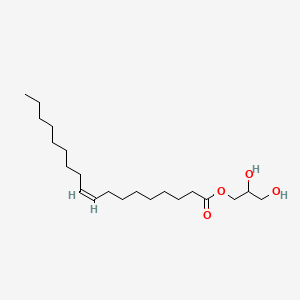
Glyceryl Monooleate
glyceryl 1-oleate has been reported in Nelumbo nucifera and Saposhnikovia divaricata with data available. — LOTUS - the natural products occurrence database
- IUPAC name
- 2,3-dihydroxypropyl (Z)-octadec-9-enoate
- Molecular formula
- C21H40O4
- Molecular weight
- 356.5 g/mol
- Exact mass
- 356.29265975 Da
- XLogP3
- 6.5
- Topological polar surface area
- 66.8 Ų
- Hydrogen-bond donors
- 2
- Hydrogen-bond acceptors
- 4
- Covalent units
- 1
- Defined stereocentres
- 0
Also known as
16 more reported names
External database identifiers
- ChEBI:CHEBI:75342
- ChEMBL:CHEMBL428593
- EPA DTXSID:DTXSID3042003
- PubMed:33352258
- PubMed:22651926
- PubMed:21778222
- PubMed:21170321
- PubMed:15550674
- PubMed:11283027
- PubMed:6517562
- PubMed:6269644
Evidence from additional scientific databases
NIH PubChem PUG-View
Attributed physical-property, hazard, environmental and use annotations.
- Boiling Point: 238-240 °C AT 3 MM HG Source: Hazardous Substances Data Bank (HSDB)
- Boiling Point: 250 °C (8 mmHg) Source: Joint FAO/WHO Expert Committee on Food Additives (JECFA)
- Color/Form: PLATES FROM ETHANOL Source: Hazardous Substances Data Bank (HSDB)
- Color/Form: YELLOW OIL OR SOFT SOLID Source: Hazardous Substances Data Bank (HSDB)
- Density: 0.9420 @ 20 °C/4 °C Source: Hazardous Substances Data Bank (HSDB)
- Density: 0.925-0.935 Source: Joint FAO/WHO Expert Committee on Food Additives (JECFA)
- Melting Point: 25 °C (UNSTABLE) Source: Hazardous Substances Data Bank (HSDB)
- Melting Point: MELTING POINT: 32 °C (UNSTABLE) /PRIMARY BETA FORM/; 35.5 °C (STABLE) /BETA FORM/ Source: Hazardous Substances Data Bank (HSDB)
- Odor: SWEET Source: Hazardous Substances Data Bank (HSDB)
- Physical Description: Liquid; Dry Powder; CBI Source: EPA Chemical Data Reporting (CDR)
- Physical Description: Clear amber or pale yellow liquid; [Hawley] Yellow liquid or soft solid with a sweet odor; mp = 25 deg C (unstable); [HSDB] Solid; mp = 35.5 deg C; Opaque liquid; mp = 20 deg C; [MSDSonline] Source: Haz-Map, Information on Hazardous Chemicals and Occupational Diseases
- Physical Description: pale yellow viscous oily liquid with a faint fatty odour Source: Joint FAO/WHO Expert Committee on Food Additives (JECFA)
- Refractive Index: INDEX OF REFRACTION: 1.4626 @ 40 °C/D Source: Hazardous Substances Data Bank (HSDB)
- Refractive Index: 1.462-1.468 Source: Joint FAO/WHO Expert Committee on Food Additives (JECFA)
- Solubility: INSOL IN WATER; SOL IN ETHANOL, ETHER, CHLOROFORM Source: Hazardous Substances Data Bank (HSDB)
- Solubility: insoluble in water; soluble in hot organic solvents Source: Joint FAO/WHO Expert Committee on Food Additives (JECFA)
- Solubility: soluble in hot alcohol (in ethanol) Source: Joint FAO/WHO Expert Committee on Food Additives (JECFA)
- Note: This chemical does not meet GHS hazard criteria for 96.9% (492 of 508) of all reports. Source: European Chemicals Agency (ECHA)
- GHS Hazard Statements: Not Classified; Reported as not meeting GHS hazard criteria by 492 of 508 companies (only 3.1% companies provided GHS information). For more detailed information, please visit ECHA C&L website. Source: European Chemicals Agency (ECHA)
- ECHA C&L Notifications Summary: Aggregated GHS information provided per 508 reports by companies from 5 notifications to the ECHA C&L Inventory.; Reported as not meeting GHS hazard criteria per 492 of 508 reports by companies.; There are 3 notifications provided by 16 of 508 reports by companies with hazard statement code(s).; Information may vary between notifications depending on impurities, additives, and other factors. The percentage value in parenthesis indicates the notified classification ratio from companies that provide hazard codes. Only hazard codes with percentage values above 10% are shown. For more detailed information, please visit ECHA C&L website. Source: European Chemicals Agency (ECHA)
- Note: This chemical does not meet GHS hazard criteria for 100% (260 of 260) of all reports. Source: European Chemicals Agency (ECHA)
- GHS Hazard Statements: Not Classified; Reported as not meeting GHS hazard criteria by 260 of 260 companies. For more detailed information, please visit ECHA C&L website. Source: European Chemicals Agency (ECHA)
- ECHA C&L Notifications Summary: Aggregated GHS information provided per 260 reports by companies from 1 notifications to the ECHA C&L Inventory.; Reported as not meeting GHS hazard criteria per 260 of 260 reports by companies.; There are 0 notifications provided by 0 of 260 reports by companies with hazard statement code(s).; Information may vary between notifications depending on impurities, additives, and other factors. The percentage value in parenthesis indicates the notified classification ratio from companies that provide hazard codes. Only hazard codes with percentage values above 10% are shown. For more detailed information, please visit ECHA C&L website. Source: European Chemicals Agency (ECHA)
- Consumer Uses: Surface modifier; Emulsifier; Surfactant (surface active agent); Lubricating agent; Anti-adhesive/cohesive Source: EPA Chemical Data Reporting (CDR)
- Industry Uses: Lubricating agent; Processing aids not otherwise specified; Surfactant (surface active agent); Not Known or Reasonably Ascertainable; Emulsifier; Surface modifier Source: EPA Chemical Data Reporting (CDR)
- Sources/Uses: Used in foods, pharmaceuticals, cosmetics, rust-preventive oils, vinyl light stabilizers, odorless base paints, textile finishing, and flavoring; Used as emulsifier for liquid and paste waxes, polishes, and cleaners; [Hawley] Source: Haz-Map, Information on Hazardous Chemicals and Occupational Diseases
- Industrial Processes with risk of exposure: Painting (Pigments, Binders, and Biocides) [Category: Paint]; Textiles (Printing, Dyeing, or Finishing) [Category: Industry] Source: Haz-Map, Information on Hazardous Chemicals and Occupational Diseases
- Uses: SURFACE-ACTIVE AGENT IN FOODS, PHARMACEUTICALS AND COSMETICS, ODORLESS BASE PAINTS, IN RUST-PREVENTIVE OILS, TEXTILE FINISHING, AND VINYL LIGHT STABILIZERS; FLAVORING INGREDIENT Source: Hazardous Substances Data Bank (HSDB)
Mapped by: Existing checksum-valid CAS to unique PubChem CID match. Retrieved: 2026-08-31. Open source record
Scientific classifications and hazard annotations provide context and do not replace the market-specific regulatory decision shown above.
Additional source coverage and match status
| Source | Result | Checked |
|---|---|---|
| NIH PubChem PUG-View | Exact match | 2026-08-31 |
A recorded no-match is useful evidence that the source was checked; it is not a claim that the substance does not exist elsewhere.
Retrieved from NIH PubChem on 2026-08-31 by checksum-valid CAS matching. Chemical properties do not replace the regulatory decision on this page.