
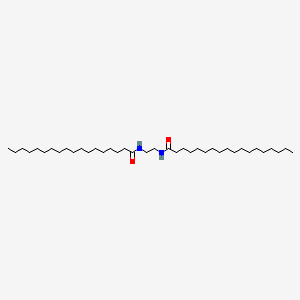
CAS 110-30-5PubChem CID 8044
Ethylenebis(stearamide)
- IUPAC name
- N-[2-(octadecanoylamino)ethyl]octadecanamide
- Molecular formula
- C38H76N2O2
- Molecular weight
- 593.0 g/mol
- Exact mass
- 592.59067967 Da
- XLogP3
- 15.7
- Topological polar surface area
- 58.2 Ų
- Hydrogen-bond donors
- 2
- Hydrogen-bond acceptors
- 2
- Covalent units
- 1
- Defined stereocentres
- 0
Also known as
N,N'-Ethylenebis(stearamide)AdvawaxEthylene distearamideLubrol EAEthylenebis(stearylamide)EthylenedistearamideMicrotomic 280Advawachs 280
16 more reported names
Chemetron 100Carlisle 280Octadecanamide, N,N'-1,2-ethanediylbis-Ethylenebisstearoamide1,2-Bis(octadecanamido)ethaneN,N'-ETHYLENE DISTEARYLAMIDEKemamide W 40N,N'-DistearoylethylenediamineN,N'-EthylenedistearamideEthylenediamine steardiamideEthylenediamine bisstearamideStearic acid, ethylenediamine diamideN,N'-Ethylene bisstearamideOctadecanamide, N,N'-ethylenebis-N,N'-1,2-Ethanediylbisoctadecanamide603RP8TB9A
External database identifiers
- EPA DTXSID:DTXSID4026840
- PubMed:19815096
- PubMed:17765251
Evidence from additional scientific databases
NIH PubChem PUG-View
Exact identifier match8044
Attributed physical-property, hazard, environmental and use annotations.
- Density: Relative density (water = 1): 0.97 Source: ILO-WHO International Chemical Safety Cards (ICSCs)
- Flash Point: 280 °C o.c. Source: ILO-WHO International Chemical Safety Cards (ICSCs)
- Melting Point: HARD; HIGH MELTING POINT Source: Hazardous Substances Data Bank (HSDB)
- Melting Point: 135-146 °C Source: ILO-WHO International Chemical Safety Cards (ICSCs)
- Physical Description: Large Crystals; CBI; Dry Powder; Other Solid; Wet Solid; Liquid; Large Crystals; Liquid; Other Solid; Dry Powder; Large Crystals; Other Solid; Dry Powder; Other Solid; Dry Powder; Large Crystals Source: EPA Chemical Data Reporting (CDR)
- Physical Description: White waxy solid; [ICSC] Commercial product: White to light brown solid; [SIDS UNEP] White to light yellow powder; [Clariant MSDS] Source: Haz-Map, Information on Hazardous Chemicals and Occupational Diseases
- Physical Description: WAXY WHITE SOLID IN VARIOUS FORMS. Source: ILO-WHO International Chemical Safety Cards (ICSCs)
- Solubility: Solubility in water: none Source: ILO-WHO International Chemical Safety Cards (ICSCs)
- Exposure Routes: The substance can be absorbed into the body by inhalation of dust. Source: ILO-WHO International Chemical Safety Cards (ICSCs)
- Note: This chemical does not meet GHS hazard criteria for 76.3% (1409 of 1846) of all reports. Source: European Chemicals Agency (ECHA)
- Signal: Warning Source: European Chemicals Agency (ECHA)
- GHS Hazard Statements: H315 (10.2%): Causes skin irritation [Warning Skin corrosion/irritation]; H319 (11.4%): Causes serious eye irritation [Warning Serious eye damage/eye irritation]; H335 (10.2%): May cause respiratory irritation [Warning Specific target organ toxicity, single exposure; Respiratory tract irritation] Source: European Chemicals Agency (ECHA)
- Precautionary Statement Codes: P261, P264, P264+P265, P271, P280, P302+P352, P304+P340, P305+P351+P338, P319, P321, P332+P317, P337+P317, P362+P364, P403+P233, P405, and P501 (click each P-code to see the statement) Source: European Chemicals Agency (ECHA)
- ECHA C&L Notifications Summary: Aggregated GHS information provided per 1846 reports by companies from 18 notifications to the ECHA C&L Inventory. Each notification may be associated with multiple companies.; Reported as not meeting GHS hazard criteria per 1409 of 1846 reports by companies.; There are 15 notifications provided by 437 of 1846 reports by companies with hazard statement code(s).; Information may vary between notifications depending on impurities, additives, and other factors. The percentage value in parenthesis indicates the notified classification ratio from companies that provide hazard codes. Only hazard codes with percentage values above 10% are shown. For more detailed information, please visit ECHA C&L website. Source: European Chemicals Agency (ECHA)
- Consumer Uses: Processing aids not otherwise specified; Binder; Other; Lubricating agent; Dispersing agent; Surface modifier; Defoamer; Processing aids, specific to petroleum production; Not Known or Reasonably Ascertainable; Plasticizer; Fixing agent (mordant) Source: EPA Chemical Data Reporting (CDR)
- Industry Uses: Plasticizer; Anti-slip agent; Fixing agent (mordant); Stabilizing agent; Viscosity modifiers; Not Known or Reasonably Ascertainable; Waterproofing agent; Filler; Intermediate; Processing aids, specific to petroleum production; Defoamer; Surface modifier; Solvent; Dispersing agent; Anti-adhesive/cohesive; Insulators; Other; Binder; Lubricating agent; Processing aids not otherwise specified Source: EPA Chemical Data Reporting (CDR)
- Sources/Uses: Used as a plastic lubricant, extender or substitute for carnauba wax, mold release agent for rubber compounding, defoamer, and heat stabilizer for plastics; [HSDB] Used as a powder lubricant for metal and plastics and in varnishes and mar-resistant paints; [Hawley] Comprises 40% of the commercial product, with the balance being 40% N-(2-Octadecanoylaminoethyl)hexadecanamide (CAS # 5136-44-7), 13% N-(2-Hexadecanoylaminoethyl)hexadecanamide (CAS # 5518-18-3), and the remainder is other fatty acid amides and residual fatty acids; [SIDS UNEP] Source: Haz-Map, Information on Hazardous Chemicals and Occupational Diseases
- Industrial Processes with risk of exposure: Painting (Pigments, Binders, and Biocides) [Category: Paint]; Plastic Composites Manufacturing [Category: Industry] Source: Haz-Map, Information on Hazardous Chemicals and Occupational Diseases
- Uses: SYNTHETIC WAX; FOR USE IN LACQUERS, VARNISHES, AS A PLASTIC LUBRICANT AND ANTIBLOCKING AGENT; AS EXTENDER OR SUBSTITUE FOR CARNAUBA WAX Source: Hazardous Substances Data Bank (HSDB)
- Uses: IN BATH OIL BARS Source: Hazardous Substances Data Bank (HSDB)
- Uses: INTERNAL LUBRICANT FOR ABS & PVC PLASTICS Source: Hazardous Substances Data Bank (HSDB)
- Uses: DETACKIFIER & MOLD RELEASE AGENT FOR RUBBER COMPOUNDING Source: Hazardous Substances Data Bank (HSDB)
- Uses: For more Uses (Complete) data for N,N'-ETHYLENE DISTEARYLAMIDE (6 total), please visit the HSDB record page. Source: Hazardous Substances Data Bank (HSDB)
- Uses: Plastics -> Typical concentration range in plastic materials -> 0.3 - 0.5% Source: NORMAN Suspect List Exchange
Mapped by: Existing checksum-valid CAS to unique PubChem CID match. Retrieved: 2026-08-31. Open source record
Scientific classifications and hazard annotations provide context and do not replace the market-specific regulatory decision shown above.
Additional source coverage and match status
| Source | Result | Checked |
|---|---|---|
| NIH PubChem PUG-View | Exact match | 2026-08-31 |
A recorded no-match is useful evidence that the source was checked; it is not a claim that the substance does not exist elsewhere.
Retrieved from NIH PubChem on 2026-08-31 by checksum-valid CAS matching. Chemical properties do not replace the regulatory decision on this page.