
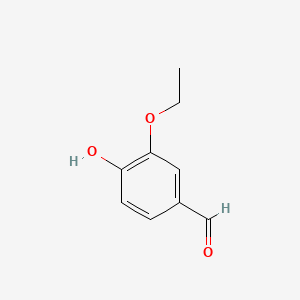
Ethylvanillin
Ethyl vanillin is a member of the class of benzaldehydes that is vanillin in which the methoxy group is replaced by an ethoxy group. It has a role as an antioxidant and a flavouring agent. It is a member of benzaldehydes, a member of phenols and an aromatic ether. It is functionally related to a vanillin. — ChEBI
- IUPAC name
- 3-ethoxy-4-hydroxybenzaldehyde
- Molecular formula
- C9H10O3
- Molecular weight
- 166.17 g/mol
- Exact mass
- 166.062994177 Da
- XLogP3
- 1.6
- Topological polar surface area
- 46.5 Ų
- Hydrogen-bond donors
- 1
- Hydrogen-bond acceptors
- 3
- Covalent units
- 1
- Defined stereocentres
- 0
Also known as
16 more reported names
External database identifiers
- ChEBI:CHEBI:48408
- ChEMBL:CHEMBL508676
- EPA DTXSID:DTXSID5021968
- PubMed:32496054
- PubMed:22900597
- PubMed:22701361
- PubMed:22450566
- PubMed:22412708
- PubMed:22346927
- PubMed:22315575
- PubMed:22292481
- PubMed:22221489
- PubMed:22186046
- PubMed:22146718
- PubMed:21920564
Evidence from additional scientific databases
NIH PubChem PUG-View
Attributed physical-property, hazard, environmental and use annotations.
- Boiling Point: 285 °C Source: Hazardous Substances Data Bank (HSDB)
- Boiling Point: 285.00 to 294.00 °C. @ 760.00 mm Hg Source: Human Metabolome Database (HMDB)
- Boiling Point: 285 °C Source: Joint FAO/WHO Expert Committee on Food Additives (JECFA)
- Color/Form: Fine, crystalline needles Source: Hazardous Substances Data Bank (HSDB)
- Color/Form: White or slightly yellowish crystals Source: Hazardous Substances Data Bank (HSDB)
- Color/Form: Colorless flakes Source: Hazardous Substances Data Bank (HSDB)
- Flash Point: 145 °C (293 °F) - closed cup Source: Hazardous Substances Data Bank (HSDB)
- LogP: log Kow = 1.58 Source: Hazardous Substances Data Bank (HSDB)
- LogP: 1.58 Source: Human Metabolome Database (HMDB)
- Melting Point: 171 to 172 °F (NTP, 1992) Source: CAMEO Chemicals
- Melting Point: 76.7 °C Source: Hazardous Substances Data Bank (HSDB)
- Melting Point: 76 - 78 °C Source: Human Metabolome Database (HMDB)
- Odor: Finer and more intense vanilla Source: Hazardous Substances Data Bank (HSDB)
- Odor: Resembles that of vanillin but approximately 3 times as strong. Source: Hazardous Substances Data Bank (HSDB)
- Physical Description: Ethyl vanillin appears as colorless crystals. More intense vanilla odor and taste than vanillin. (NTP, 1992) Source: CAMEO Chemicals
- Physical Description: Large Crystals; CBI; Other Solid; Dry Powder; Liquid; Liquid Source: EPA Chemical Data Reporting (CDR)
- Physical Description: Colorless, white, or slightly yellow solid with an intense vanilla odor; [HSDB] White crystalline powder; [MSDSonline] Source: Haz-Map, Information on Hazardous Chemicals and Occupational Diseases
- Physical Description: Solid Source: Human Metabolome Database (HMDB)
- Physical Description: colourless or slightly yellow crystal flakes with an intense vanilla odour Source: Joint FAO/WHO Expert Committee on Food Additives (JECFA)
- Solubility: Slightly soluble (NTP, 1992) Source: CAMEO Chemicals
- Solubility: In water, 2,822 mg/L at 25 °C Source: Hazardous Substances Data Bank (HSDB)
- Solubility: Slightly soluble in water (1 g in 100 mL at 50 °C) Source: Hazardous Substances Data Bank (HSDB)
- Solubility: Soluble in ethanol, ether, benzene, chloroform Source: Hazardous Substances Data Bank (HSDB)
- Solubility: Freely soluble in ... solutions of alkali hydroxides; soluble in glycerol, propylene glycol Source: Hazardous Substances Data Bank (HSDB)
- Solubility: Solubility in 95% alcohol about 1 g/2 mL Source: Hazardous Substances Data Bank (HSDB)
- Solubility: 2.82 mg/mL at 25 °C Source: Human Metabolome Database (HMDB)
- Solubility: insoluble in water; soluble in organic solvents, oils Source: Joint FAO/WHO Expert Committee on Food Additives (JECFA)
- Solubility: very soluble (1g in 2ml) (in ethanol) Source: Joint FAO/WHO Expert Committee on Food Additives (JECFA)
- Vapor Pressure: 0.0000104 [mmHg] Source: Haz-Map, Information on Hazardous Chemicals and Occupational Diseases
- Vapor Pressure: 1.04X10⁻⁵ mm Hg at 25 °C Source: Hazardous Substances Data Bank (HSDB)
- pH: Solutions are acid to litmus Source: Hazardous Substances Data Bank (HSDB)
- First Aid: EYES: First check the victim for contact lenses and remove if present. Flush victim's eyes with water or normal saline solution for 20 to 30 minutes while simultaneously calling a hospital or poison control center. Do not put any ointments, oils, or medication in the victim's eyes without specific instructions from a physician. IMMEDIATELY transport the victim after flushing eyes to a hospital even if no symptoms (such as redness or irritation) develop.; SKIN: IMMEDIATELY flood affected skin with water while removing and isolating all contaminated clothing. Gently wash all affected skin areas thoroughly with soap and water. If symptoms such as redness or irritation develop, IMMEDIATELY call a physician and be prepared to transport the victim to a hospital for treatment.; INHALATION: IMMEDIATELY leave the contaminated area; take deep breaths of fresh air. If symptoms (such as wheezing, coughing, shortness of breath, or burning in the mouth, throat, or chest) develop, call a physician and be prepared to transport the victim to a hospital. Provide proper respiratory protection to rescuers entering an unknown atmosphere. Whenever possible, Self-Contained Breathing Apparatus (SCBA) shou Source: CAMEO Chemicals
- Note: This chemical does not meet GHS hazard criteria for 78.7% (1611 of 2046) of all reports. Source: European Chemicals Agency (ECHA)
- Signal: Warning Source: European Chemicals Agency (ECHA)
- GHS Hazard Statements: H319 (20.7%): Causes serious eye irritation [Warning Serious eye damage/eye irritation] Source: European Chemicals Agency (ECHA)
- Precautionary Statement Codes: P264+P265, P280, P305+P351+P338, and P337+P317 (click each P-code to see the statement) Source: European Chemicals Agency (ECHA)
- ECHA C&L Notifications Summary: Aggregated GHS information provided per 2046 reports by companies from 15 notifications to the ECHA C&L Inventory.; Reported as not meeting GHS hazard criteria per 1611 of 2046 reports by companies.; There are 13 notifications provided by 435 of 2046 reports by companies with hazard statement code(s).; Information may vary between notifications depending on impurities, additives, and other factors. The percentage value in parenthesis indicates the notified classification ratio from companies that provide hazard codes. Only hazard codes with percentage values above 10% are shown. For more detailed information, please visit ECHA C&L website. Source: European Chemicals Agency (ECHA)
- Signal: Warning Source: Hazardous Substances Data Bank (HSDB)
- GHS Hazard Statements: H302: Harmful if swallowed [Warning Acute toxicity, oral]; H315: Causes skin irritation [Warning Skin corrosion/irritation]; H319: Causes serious eye irritation [Warning Serious eye damage/eye irritation]; H335: May cause respiratory irritation [Warning Specific target organ toxicity, single exposure; Respiratory tract irritation]; H402: Harmful to aquatic life [Hazardous to the aquatic environment, acute hazard]; H412: Harmful to aquatic life with long lasting effects [Hazardous to the aquatic environment, long-term hazard] Source: Hazardous Substances Data Bank (HSDB)
- Precautionary Statement Codes: P261, P264, P264+P265, P270, P271, P273, P280, P301+P317, P302+P352, P304+P340, P305+P351+P338, P319, P321, P330, P332+P317, P337+P317, P362+P364, P403+P233, P405, and P501 (click each P-code to see the statement) Source: Hazardous Substances Data Bank (HSDB)
- Toxicity Summary: IDENTIFICATION AND USE: Ethyl vanillin forms fine crystalline needles and is used in fragrances for its vanilla odor. It is also used as a replacement of or to strengthen the flavor of vanilla in a variety of foods. Ethyl vanillin is a widely used food additive and spice in foods, beverages, cosmetics and drugs. HUMAN EXPOSURE AND TOXICITY: Research in humans showed that ethyl vanillin had no significant effect on the activity of five human CYP450 enzymes with concentration ranged from 8 to 128 uM. A 2% concentration of ethyl vanillin caused mild irritation on the skin of humans after 48 hours of direct contact. ANIMAL STUDIES: In animal studies, ethyl vanillin was found to be mostly non-toxic except when given at high doses for longer than 6 weeks. Rabbits were given ethyl vanillin orally in 10% aqueous glycerin 49 mg/kg bw/day for 43 days. At this dose level anemia, diarrhea and lack of weight gain were observed. Rats (20/sex/group) were fed ethyl vanillin of > 99.9% purity (nature of diet e.g., semi-synthetic/chow diet, not specified) at dose levels of 0, 500, 1000 or 2000 mg/kg bw/day for 13 weeks. Clinical biochemistry showed statistically significant higher values in the high Source: Hazardous Substances Data Bank (HSDB)
- Environmental Bioconcentration: An estimated BCF of 5 was calculated in fish for ethyl vanillin(SRC), using a log Kow of 1.58(1) and a regression-derived equation(1). According to a classification scheme(2), this BCF suggests the potential for bioconcentration in aquatic organisms is low(SRC). Source: Hazardous Substances Data Bank (HSDB)
- Environmental Fate: TERRESTRIAL FATE: Based on a classification scheme(1), an estimated Koc value of 60(SRC), determined from a log Kow of 1.58(2) and a regression-derived equation(3), indicates that ethyl vanillin is expected to have high mobility in soil(SRC). Volatilization of ethyl vanillin from moist soil surfaces is not expected to be an important fate process(SRC) given an estimated Henry's Law constant of 8.1X10⁻¹⁰ atm-cu m/mole(4) derived from its vapor pressure, 1.04X10⁻⁵ mm Hg(5), and water solubility, 2,820 mg/L(6). Ethyl vanillin is not expected to volatilize from dry soil surfaces(SRC) based upon its vapor pressure(5). Utilizing the Japanese MITI test, 88% of the Theoretical BOD was reached in 2 weeks(7) indicating that biodegradation may be an important environmental fate process in soil(SRC). Source: Hazardous Substances Data Bank (HSDB)
- Environmental Fate: AQUATIC FATE: Based on a classification scheme(1), an estimated Koc value of 60(SRC), determined from a log Kow of 1.58(2) and a regression-derived equation(3), indicates that ethyl vanillin is not expected to adsorb to suspended solids and sediment(SRC). Volatilization from water surfaces is not expected(4) based upon an estimated Henry's Law constant of 8.1X10⁻¹⁰ atm-cu m/mole(5), derived from its vapor pressure, 1.04X10⁻⁵ mm Hg(6), and water solubility, 2,820 mg/L(7). According to a classification scheme(8), an estimated BCF of 5(SRC), from its log Kow(2) and a regression-derived equation(3), suggests the potential for bioconcentration in aquatic organisms is low(SRC). Ethyl vanillin contains chromophores that absorb at wavelengths >290 nm(9) and, therefore, may be susceptible to direct photolysis by sunlight(SRC). Utilizing the Japanese MITI test, 88% of the Theoretical BOD was reached in 2 weeks(10) indicating that biodegradation may be an important environmental fate process in water(SRC). Source: Hazardous Substances Data Bank (HSDB)
- Environmental Fate: ATMOSPHERIC FATE: According to a model of gas/particle partitioning of semivolatile organic compounds in the atmosphere(1), ethyl vanillin, which has a vapor pressure of 1.04X10⁻⁵ mm Hg at 25 °C(2), will exist in both the vapor and particulate phases in the ambient atmosphere. Vapor-phase ethyl vanillin is degraded in the atmosphere by reaction with photochemically-produced hydroxyl radicals(SRC); the half-life for this reaction in air is estimated to be 1 day(SRC), calculated from its rate constant of 3.3X10⁻¹¹ cu cm/molecule-sec at 25 °C(SRC). Particulate-phase ethyl vanillin may be removed from the air by wet and dry deposition(SRC). Ethyl vanillin contains chromophores that absorb at wavelengths >290 nm(3) and, therefore, may be susceptible to direct photolysis by sunlight(SRC). Source: Hazardous Substances Data Bank (HSDB)
- Consumer Uses: Fragrance Source: EPA Chemical Data Reporting (CDR)
- Industry Uses: Fragrance; Flavoring and nutrient Source: EPA Chemical Data Reporting (CDR)
- Sources/Uses: Used in perfumes, flavors, and organic synthesis; [HSDB] Source: Haz-Map, Information on Hazardous Chemicals and Occupational Diseases
- Uses: In flavoring and perfumery Source: Hazardous Substances Data Bank (HSDB)
- Uses: Used as a chemical intermediate Source: Hazardous Substances Data Bank (HSDB)
- Uses: Flavors, to replace or fortify vanillin. Source: Hazardous Substances Data Bank (HSDB)
- Uses: Reported uses (ppm):; Table: Reported uses (ppm): (Flavor and Extract Manufacturers' Association, 1994) [Table#2519] Source: Hazardous Substances Data Bank (HSDB)
- Uses: Ethyl vanillin is used extensively in the chocolate industry. It gives a sweet, balsamic note to flowery and fruity perfume compositions. Source: Hazardous Substances Data Bank (HSDB)
Mapped by: Existing checksum-valid CAS to unique PubChem CID match. Retrieved: 2026-08-31. Open source record
Scientific classifications and hazard annotations provide context and do not replace the market-specific regulatory decision shown above.
Additional source coverage and match status
| Source | Result | Checked |
|---|---|---|
| NIH PubChem PUG-View | Exact match | 2026-08-31 |
A recorded no-match is useful evidence that the source was checked; it is not a claim that the substance does not exist elsewhere.
Retrieved from NIH PubChem on 2026-08-31 by checksum-valid CAS matching. Chemical properties do not replace the regulatory decision on this page.