
CAS 97-65-4PubChem CID 811
Itaconic acid
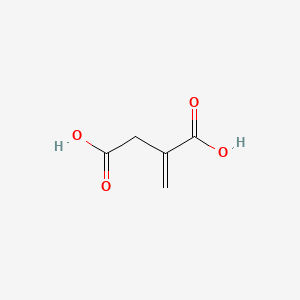
Itaconic acid is a dicarboxylic acid that is methacrylic acid in which one of the methyl hydrogens is substituted by a carboxylic acid group. It has a role as a fungal metabolite and a human metabolite. It is a dicarboxylic fatty acid, a dicarboxylic acid and an olefinic compound. It is functionally related to a succinic acid. It is a conjugate acid of an itaconate(2-). — ChEBI
- IUPAC name
- 2-methylidenebutanedioic acid
- Molecular formula
- C5H6O4
- Molecular weight
- 130.10 g/mol
- Exact mass
- 130.02660867 Da
- XLogP3
- -0.1
- Topological polar surface area
- 74.6 Ų
- Hydrogen-bond donors
- 2
- Hydrogen-bond acceptors
- 4
- Covalent units
- 1
- Defined stereocentres
- 0
Also known as
2-Methylenesuccinic acidMETHYLENESUCCINIC ACIDMethylenebutanedioic acidPropylenedicarboxylic aciditaconateButanedioic acid, methylene-2-Propene-1,2-dicarboxylic acidSuccinic acid, methylene-
16 more reported names
2-methylenebutanedioic acidNSC-3357CHEBI:30838methylidenebutanedioateRefChem:792464hydron;2-methylidenebutanedioate202-599-6Itaconicacidbutanedioic acid, 2-methylene-2-methylenebutanedioateAI3-16901NSC3357CAS-97-65-4HSDB 5308NSC 3357EINECS 202-599-6
External database identifiers
- ChEBI:CHEBI:30838
- ChEMBL:CHEMBL359159
- EPA DTXSID:DTXSID2026608
- PubMed:36862550
- PubMed:26358042
- PubMed:24781056
- PubMed:23000746
- PubMed:22925689
- PubMed:22885157
- PubMed:22814491
- PubMed:22759642
- PubMed:22704478
- PubMed:22658709
- PubMed:22569416
- PubMed:22493167
Retrieved from NIH PubChem on 2026-08-31 by checksum-valid CAS matching. Chemical properties do not replace the regulatory decision on this page.