
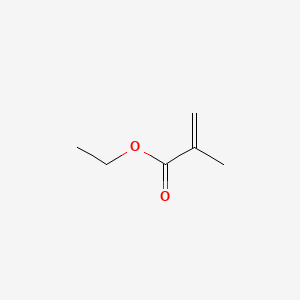
CAS 97-63-2PubChem CID 7343
Ethyl Methacrylate
Ethyl methacrylate appears as a colorless moderately toxic liquid with an acrid odor. Flash point of 70 °F. Boiling point 278 °F. Vapors irritate the eyes and respiratory system. Less dense than water. Not soluble in water. Used to make polymers and other chemicals. — CAMEO Chemicals
- IUPAC name
- ethyl 2-methylprop-2-enoate
- Molecular formula
- C6H10O2
- Molecular weight
- 114.14 g/mol
- Exact mass
- 114.068079557 Da
- XLogP3
- 1.9
- Topological polar surface area
- 26.3 Ų
- Hydrogen-bond donors
- 0
- Hydrogen-bond acceptors
- 2
- Covalent units
- 1
- Defined stereocentres
- 0
Also known as
2-Propenoic acid, 2-methyl-, ethyl esterEthyl 2-methylacrylateEthyl 2-methyl-2-propenoateRhoplex AC-33Ethyl 2-methacrylateMETHACRYLIC ACID, ETHYL ESTERRCRA waste number U1182-Methylacrylic acid, ethyl ester
16 more reported names
Ethyl alpha-methylacrylateNSC 24152CCRIS 4817Ethylester kyseliny methakryloveEthyl 2-methylpropenoateHSDB 1332Rhoplex AC-33 (rohm and haas)EINECS 202-597-5UN2277BRN 047120180F70CLT4OEthylester kyseliny methakrylove [Czech]AI3-25421LIGHT ESTER ENSC-241522-Methyl-2-propenoic acid, ethyl ester
External database identifiers
Retrieved from NIH PubChem on 2026-09-02 by checksum-valid CAS matching. Chemical properties do not replace the regulatory decision on this page.