
CAS 96-26-4PubChem CID 670
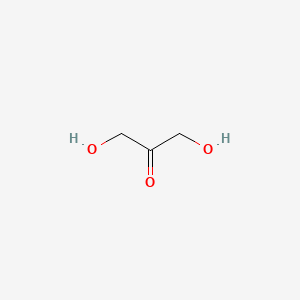
Dihydroxyacetone
Dihydroxyacetone is a ketotriose consisting of acetone bearing hydroxy substituents at positions 1 and 3. The simplest member of the class of ketoses and the parent of the class of glycerones. It has a role as a metabolite, an antifungal agent, a mouse metabolite, a Saccharomyces cerevisiae metabolite, an Escherichia coli metabolite and a human metabolite. It is a primary alpha-hydroxy ketone and a ketotriose. — ChEBI
- IUPAC name
- 1,3-dihydroxypropan-2-one
- Molecular formula
- C3H6O3
- Molecular weight
- 90.08 g/mol
- Exact mass
- 90.031694049 Da
- XLogP3
- -1.4
- Topological polar surface area
- 57.5 Ų
- Hydrogen-bond donors
- 2
- Hydrogen-bond acceptors
- 3
- Covalent units
- 1
- Defined stereocentres
- 0
Also known as
1,3-dihydroxyacetoneglyceroneChromelin1,3-Dihydroxy-2-propanoneOxantinTriuloseViticolorDihyxal
16 more reported names
OxatoneSolealOtan2-Propanone, 1,3-dihydroxy-1,3-Dihydroxypropanone1,3-Dihydroxydimethyl ketoneNSC-24343Dihydroxyacetone (USP)Dihydroxyacetone [USP]FEMA NO. 4033O10DDW6JOOCHEBI:160161,3 Dihydroxy 2 PropanoneGZE Tanning CreamDihydroxyacetone 10%RefChem:5755
External database identifiers
- ChEBI:CHEBI:16016
- ChEMBL:CHEMBL1229937
- EPA DTXSID:DTXSID0025072
- PubMed:38867704
- PubMed:38582340
- PubMed:34448514
- PubMed:32506039
- PubMed:31974165
- PubMed:30959092
- PubMed:29193605
- PubMed:23220003
- PubMed:23088097
- PubMed:23067124
- PubMed:23060553
- PubMed:23017393
Retrieved from NIH PubChem on 2026-08-31 by checksum-valid CAS matching. Chemical properties do not replace the regulatory decision on this page.