
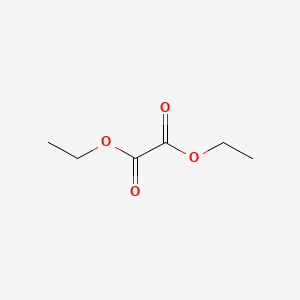
CAS 95-92-1PubChem CID 7268
Diethyl Oxalate
Ethyl oxalate appears as a colorless liquid. Slightly denser than water and insoluble in water. Hence sinks in water. May irritate skin and mucous membranes; may be mildly toxic by ingestion; may emit irritating fumes in a fire. Vapors are much heavier than air. Used as a solvent for plastics and in the manufacture of perfumes and pharmaceuticals. — CAMEO Chemicals
- IUPAC name
- diethyl oxalate
- Molecular formula
- C6H10O4
- Molecular weight
- 146.14 g/mol
- Exact mass
- 146.05790880 Da
- XLogP3
- 0.6
- Topological polar surface area
- 52.6 Ų
- Hydrogen-bond donors
- 0
- Hydrogen-bond acceptors
- 4
- Covalent units
- 1
- Defined stereocentres
- 0
Also known as
Ethyl oxalateOxalic etherEthyl oxalate (VAN)NSC 8851Diethylester kyseliny staveloveHSDB 2131EINECS 202-464-1UNII-860M3ZWF6J
16 more reported names
Diethyl ester of oxalic acidUN2525Diethylester kyseliny stavelove [Czech]BRN 0606350860M3ZWF6JETHYL OXOLATENSC-8851C2H5OCOCOOC2H5Ethanedioic acid, 1,2-diethyl esterDIETHYL OXALATE [MI]DIETHYL OXALATE [HSDB]EC 202-464-14-02-00-01848 (Beilstein Handbook Reference)ETHANEDIOC ACID, DIETHYL ESTERUN 2525RefChem:133432
External database identifiers
Retrieved from NIH PubChem on 2026-09-02 by checksum-valid CAS matching. Chemical properties do not replace the regulatory decision on this page.