
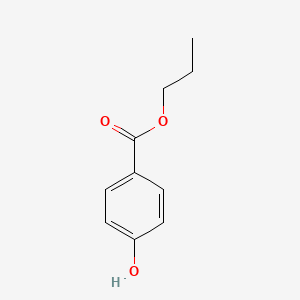
CAS 94-13-3PubChem CID 7175
Propylparaben
Propylparaben is the benzoate ester that is the propyl ester of 4-hydroxybenzoic acid. Preservative typically found in many water-based cosmetics, such as creams, lotions, shampoos and bath products. Also used as a food additive. It has a role as an antimicrobial agent and an antifungal agent. It is a member of phenols, a benzoate ester and a paraben. It is functionally related to a propan-1-ol and a 4-hydroxybenzoic acid. — ChEBI
- IUPAC name
- propyl 4-hydroxybenzoate
- Molecular formula
- C10H12O3
- Molecular weight
- 180.20 g/mol
- Exact mass
- 180.078644241 Da
- XLogP3
- 3.0
- Topological polar surface area
- 46.5 Ų
- Hydrogen-bond donors
- 1
- Hydrogen-bond acceptors
- 3
- Covalent units
- 1
- Defined stereocentres
- 0
Also known as
Propyl parabenNipasolPropyl p-hydroxybenzoateNipazolPropagin4-Hydroxybenzoic acid propyl esterPropyl parahydroxybenzoateTegosept P
16 more reported names
Nipagin PPropyl ButexBetacide PNipasol PChemocide pkPropyl ParaseptAseptoform PPropyl ChemoseptSolbrol PPropylparaseptn-Propyl 4-hydroxybenzoatePaseptolChemacide pkPreserval PBetacine PN-Propyl p-hydroxybenzoate
External database identifiers
- ChEBI:CHEBI:32063
- ChEMBL:CHEMBL194014
- EPA DTXSID:DTXSID4022527
- PubMed:23056216
- PubMed:23037998
- PubMed:23028405
- PubMed:22814205
- PubMed:22790701
- PubMed:22640822
- PubMed:22606064
- PubMed:22606022
- PubMed:22594253
- PubMed:22523455
- PubMed:22518310
- PubMed:22470890
Retrieved from NIH PubChem on 2026-08-31 by checksum-valid CAS matching. Chemical properties do not replace the regulatory decision on this page.