
CAS 93-07-2PubChem CID 7121
Veratric Acid
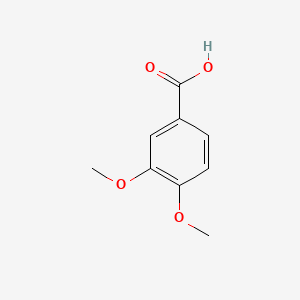
3,4-dimethoxybenzoic acid is a member of the class of benzoic acids that is benzoic acid substituted by methoxy groups at positions 2 and 3. It has a role as an allergen and a plant metabolite. It derives from a hydride of a benzoic acid. — ChEBI
- IUPAC name
- 3,4-dimethoxybenzoic acid
- Molecular formula
- C9H10O4
- Molecular weight
- 182.17 g/mol
- Exact mass
- 182.05790880 Da
- XLogP3
- 1.6
- Topological polar surface area
- 55.8 Ų
- Hydrogen-bond donors
- 1
- Hydrogen-bond acceptors
- 4
- Covalent units
- 1
- Defined stereocentres
- 0
Also known as
Benzoic acid, 3,4-dimethoxy-Dimethylprotocatechuic acid3,4-Dimethylprotocatechuic acidNSC-77211YY04E7RR4CHEBI:296881RefChem:901791202-215-7
16 more reported names
Veratrylic acid3,4-Dimethoxy-benzoic acidVeratrumenoic acidNSC 77213,4dimethoxy benzoic acid3,4-Dimethoxy benzoic acidKBioGR_0021643,4-Dimethoxybenzoic acid (Veratric acid)3,4-bis(methyloxy)benzoic acidNSC7721CCG-39276SDCCGMLS-0066972.P0013,?4-?Dimethoxybenzoic Acid (Veratric Acid)BRD-K14520048-001-04-23,4-DimethoxybenzoicacidEINECS 202-215-7
External database identifiers
- ChEBI:CHEBI:296881
- ChEMBL:CHEMBL118903
- EPA DTXSID:DTXSID6059077
- PubMed:22426778
- PubMed:22361750
- PubMed:22333299
- PubMed:22199845
- PubMed:22104369
- PubMed:21966248
- PubMed:21937012
- PubMed:21579933
- PubMed:21546882
- PubMed:21423357
- PubMed:21359349
- PubMed:21272305
Retrieved from NIH PubChem on 2026-08-31 by checksum-valid CAS matching. Chemical properties do not replace the regulatory decision on this page.