
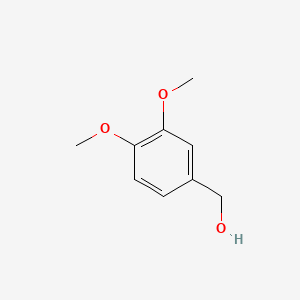
CAS 93-03-8PubChem CID 7118
Veratryl alcohol
(3,4-dimethoxyphenyl)methanol is a member of the class of benzyl alcohols that is benzyl alcohol in which the hydrogens at positions 3 and 4 of the phenyl group are substituted by methoxy groups. It has a role as a fungal metabolite. It is a primary alcohol, a member of benzyl alcohols and a dimethoxybenzene. — ChEBI
- IUPAC name
- (3,4-dimethoxyphenyl)methanol
- Molecular formula
- C9H12O3
- Molecular weight
- 168.19 g/mol
- Exact mass
- 168.078644241 Da
- XLogP3
- 0.6
- Topological polar surface area
- 38.7 Ų
- Hydrogen-bond donors
- 1
- Hydrogen-bond acceptors
- 3
- Covalent units
- 1
- Defined stereocentres
- 0
Also known as
3,4-Dimethoxybenzyl alcoholBenzenemethanol, 3,4-dimethoxy-3,4-Dimethoxyphenylmethyl alcohol3,4-dimethoxybenzenemethanoldimethoxybenzyl alcoholMB4T4A711HNSC-6317CHEBI:62150
16 more reported names
RefChem:911763,4-dimethoxy benzenemethanol202-212-0veratrole alcoholNSC 63173,4-dimethoxy-benzyl alcoholVeratryl alcoho(3,4-dimethoxyphenyl)methan-1-olVerapamil EP Impurity EUNII-MB4T4A711H3,4-dimethoxybenzyl methanolVOHEINECS 202-212-0VERATRALCOHOLAI3-241813,4dimethoxybenzyl alcohol
External database identifiers
- ChEBI:CHEBI:62150
- EPA DTXSID:DTXSID1059076
- PubMed:22191017
- PubMed:20229365
- PubMed:19640646
- PubMed:19440524
- PubMed:18588345
- PubMed:14604381
- PubMed:12094739
- PubMed:11163350
Retrieved from NIH PubChem on 2026-08-31 by checksum-valid CAS matching. Chemical properties do not replace the regulatory decision on this page.