
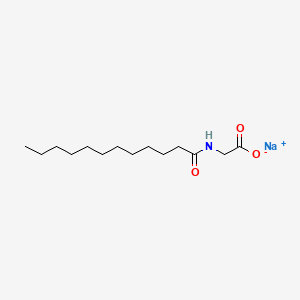
CAS 90387-74-9PubChem CID 23694635
Sodium lauroyl glycinate
The panel concluded that the 115 amino acid alkyl amides listed below are safe in the present practices of use and concentration in cosmetics, when formulated to be non-irritating...Sodium Cocoyl Glycinate... — Cosmetic Ingredient Review (CIR)
- IUPAC name
- sodium 2-(dodecanoylamino)acetate
- Molecular formula
- C14H26NNaO3
- Molecular weight
- 279.35 g/mol
- Exact mass
- 279.18103797 Da
- Topological polar surface area
- 69.2 Ų
- Hydrogen-bond donors
- 1
- Hydrogen-bond acceptors
- 3
- Covalent units
- 2
- Defined stereocentres
- 0
Also known as
Sodium N-lauroylglycineSodium dodecanoylglycinateN-Lauroylglycine sodium saltGlycine, N-lauroyl-, sodium saltUNII-L54QIO80PNL54QIO80PNGlycine, N-lauroyl-, monosodium saltGlycine, N-(1-oxododecyl)-, sodium salt (1:1)
10 more reported names
RefChem:183962SODIUM LAUROYL GLYCINATE [INCI]Sodium cocoyl glycinatesodium;2-(dodecanoylamino)acetateEINECS 291-350-5sodium n-lauroylglycinateSodium dodecanamidoacetateUNII-XLU9KH03XMXLU9KH03XM2-(dodecanoylamino)acetic acid, sodium salt
External database identifiers
- EPA DTXSID:DTXSID90172088
Retrieved from NIH PubChem on 2026-08-31 by checksum-valid CAS matching. Chemical properties do not replace the regulatory decision on this page.