
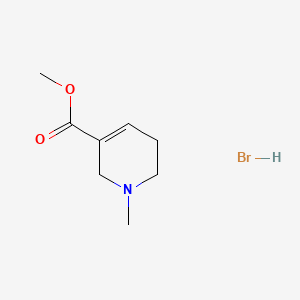
Arecoline Hydrobromide
Arecoline is found in nuts. Arecoline is isolated from betel nuts Arecoline is an alkaloid natural product found in the areca nut, the fruit of the areca palm (Areca catechu). It is an oily liquid that is soluble in water, alcohols, and ether. Owing to its muscarinic and nicotinic agonist properties, arecoline has shown improvement in the learning ability of healthy volunteers. Since one of the hallmarks of Alzheimer's disease is a cognitive decline, arecoline was suggested as a treatment to slow down this process and arecoline administered via i.v. route did indeed show modest verbal and spatial memory improvement in Alzheimer's patients, though due to arecoline's possible carcinogenic properties, it is not the first drug of choice for this degenerative disease. Arecoline has been shown to exhibit apoptotic, excitant and steroidogenic functions (A7876, A7878, A7879). Arecoline belongs to the family of Alkaloids and Derivatives. These are naturally occurring chemical compounds that contain mostly basic nitrogen atoms. This group also includes some related compounds with neutral and even weakly acidic properties. Also some synthetic compounds of similar structure are attributed to alkaloids. In addition to carbon, hydrogen and nitrogen, alkaloids may also contain oxygen, sulfur and more rarely other elements such as chlorine, bromine, and phosphorus. — Toxin and Toxin Target Database (T3DB)
- IUPAC name
- methyl 1-methyl-3,6-dihydro-2H-pyridine-5-carboxylate;hydrobromide
- Molecular formula
- C8H14BrNO2
- Molecular weight
- 236.11 g/mol
- Exact mass
- 235.02079 Da
- Topological polar surface area
- 29.5 Ų
- Hydrogen-bond donors
- 1
- Hydrogen-bond acceptors
- 3
- Covalent units
- 2
- Defined stereocentres
- 0
Also known as
16 more reported names
External database identifiers
- ChEBI:CHEBI:233150
- ChEMBL:CHEMBL449209
- EPA DTXSID:DTXSID9075379
- PubMed:30910432
- PubMed:17997002
Retrieved from NIH PubChem on 2026-08-31 by checksum-valid CAS matching. Chemical properties do not replace the regulatory decision on this page.