
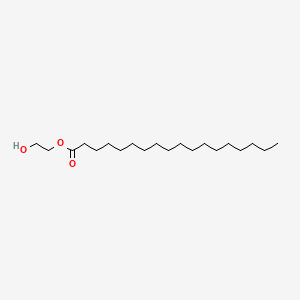
CAS 86418-55-5PubChem CID 24762
Glycol monostearate
Polyoxyl 40 stearate is an octadecanoate ester composed of repeating 8-40 ethyleneoxy units. It is an ingredient used in cosmetics and beauty products primarily as a surfactant and emulsifier. It has a role as a nonionic surfactant, an emulsifier and a food emulsifier. It is a hydroxypolyether and an octadecanoate ester. — ChEBI
- IUPAC name
- 2-hydroxyethyl octadecanoate
- Molecular formula
- C20H40O3
- Molecular weight
- 328.5 g/mol
- Exact mass
- 328.29774513 Da
- XLogP3
- 7.8
- Topological polar surface area
- 46.5 Ų
- Hydrogen-bond donors
- 1
- Hydrogen-bond acceptors
- 3
- Covalent units
- 1
- Defined stereocentres
- 0
Also known as
Ethylene glycol monostearateGlycol stearate111-60-4MonthybaseMonthyleParastarinIvoritSedetol
16 more reported names
Prodhybase ethylProdhybas NClindrol SEGEmerest 2350Ethylene glycol stearateLipo EGMSEmpilan 2848OCTADECANOIC ACID, 2-HYDROXYETHYL ESTERUSAF KE-11STEARIC ACID, 2-HYDROXYETHYL ESTERStearic acid, monoester with ethylene glycolS 1510324G66D0ECHEBI:167626RefChem:1086082203-886-9
External database identifiers
- ChEBI:CHEBI:167626
- ChEBI:CHEBI:32027
- ChEMBL:CHEMBL2355383
- EPA DTXSID:DTXSID5026881
- PubMed:18717575
- PubMed:1680169
Retrieved from NIH PubChem on 2026-08-31 by checksum-valid CAS matching. Chemical properties do not replace the regulatory decision on this page.