
CAS 85-79-0PubChem CID 3025
Dibucaine
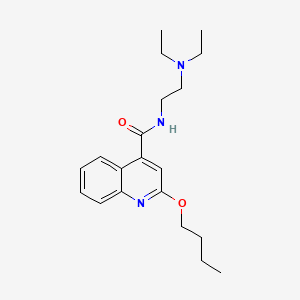
Cinchocaine is a monocarboxylic acid amide that is the 2-(diethylamino)ethyl amide of 2-butoxyquinoline-4-carboxylic acid. One of the most potent and toxic of the long-acting local anesthetics, its parenteral use was restricted to spinal anesthesia. It is now generally only used (usually as the hydrochloride) in creams and ointments and in suppositories for temporary relief of pain and itching associated with skin and anorectal conditions. It has a role as a topical anaesthetic. It is a monocarboxylic acid amide, an aromatic ether and a tertiary amino compound. — ChEBI
- IUPAC name
- 2-butoxy-N-[2-(diethylamino)ethyl]quinoline-4-carboxamide
- Molecular formula
- C20H29N3O2
- Molecular weight
- 343.5 g/mol
- Exact mass
- 343.22597718 Da
- XLogP3
- 4.4
- Topological polar surface area
- 54.5 Ų
- Hydrogen-bond donors
- 1
- Hydrogen-bond acceptors
- 4
- Covalent units
- 1
- Defined stereocentres
- 0
Also known as
CinchocaineNupercainalDermacaineDibucaine BaseDibucainCinchocainumCincocainaCincocainio
16 more reported names
Dibucaine [USP]2-Butoxyquinoline-4-carboxylic acid diethylaminoethylamide2-butoxy-N-(2-(diethylamino)ethyl)quinoline-4-carboxamideDibucaine (USP)2-Butoxy-N-(2-(diethylamino)ethyl)cinchoninamide2-Butoxy-N-(beta-diethylaminoethyl)cinchoninamide2-N-Butoxy-N-(2-diethylaminoethyl)cinchoninamideN-(2-(Diethylamino)ethyl)-2-butoxycinchoninamidealpha-Butyloxycinchoninic acid diethylethylenediamidealpha-Butyloxycinchonic acid-gamma-diethylethylenediamine2-Butoxy-N-[2-(diethylamino)ethyl]-4-quinolinecarboxamideDibucaine 1%L6JW2TJG99NSC-1590554-Quinolinecarboxamide, 2-butoxy-N-[2-(diethylamino)ethyl]-2-Butoxy-N-[2-(diethylamino)ethyl]cinchoninamide
External database identifiers
- ChEBI:CHEBI:247956
- ChEMBL:CHEMBL1086
- EPA DTXSID:DTXSID3045271
- PubMed:32795450
- PubMed:28551711
- PubMed:27109752
- PubMed:25947082
- PubMed:25455453
- PubMed:22842001
- PubMed:22753757
- PubMed:22653014
- PubMed:22558504
- PubMed:22529904
- PubMed:22504686
- PubMed:22471523
Retrieved from NIH PubChem on 2026-09-02 by checksum-valid CAS matching. Chemical properties do not replace the regulatory decision on this page.