
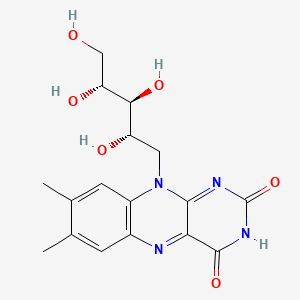
Riboflavin
Riboflavin is D-Ribitol in which the hydroxy group at position 5 is substituted by a 7,8-dimethyl-2,4-dioxo-3,4-dihydrobenzo[g]pteridin-10(2H)-yl moiety. It is a nutritional factor found in milk, eggs, malted barley, liver, kidney, heart, and leafy vegetables, but the richest natural source is yeast. The free form occurs only in the retina of the eye, in whey, and in urine; its principal forms in tissues and cells are as flavin mononucleotide and flavin-adenine dinucleotide. It has a role as an antioxidant, a cofactor, a photosensitizing agent, an anti-inflammatory agent, a mouse metabolite, a plant metabolite, an Escherichia coli metabolite, a food colouring, a fundamental metabolite and a human urinary metabolite. It is a vitamin B2 and a flavin. It is a conjugate acid of a riboflavin(1-). — ChEBI
- IUPAC name
- 7,8-dimethyl-10-[(2S,3S,4R)-2,3,4,5-tetrahydroxypentyl]benzo[g]pteridine-2,4-dione
- Molecular formula
- C17H20N4O6
- Molecular weight
- 376.4 g/mol
- Exact mass
- 376.13828437 Da
- XLogP3
- -1.5
- Topological polar surface area
- 155.0 Ų
- Hydrogen-bond donors
- 5
- Hydrogen-bond acceptors
- 7
- Covalent units
- 1
- Defined stereocentres
- 3
Also known as
16 more reported names
External database identifiers
- ChEBI:CHEBI:17015
- ChEMBL:CHEMBL1534
- EPA DTXSID:DTXSID8021777
- PubMed:37944868
- PubMed:34062077
- PubMed:33882315
- PubMed:33352258
- PubMed:26360969
- PubMed:23105845
- PubMed:23074417
- PubMed:23063183
- PubMed:23062003
- PubMed:23062001
- PubMed:23056435
- PubMed:23056269
Retrieved from NIH PubChem on 2026-08-31 by checksum-valid CAS matching. Chemical properties do not replace the regulatory decision on this page.