
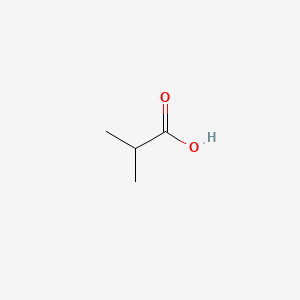
CAS 79-31-2PubChem CID 6590
Isobutyric Acid
Isobutyric acid is a branched fatty acid comprising propanoic acid carrying a methyl branch at C-2. It has a role as a volatile oil component, a plant metabolite and a Daphnia magna metabolite. It is a fatty acid 4:0, a branched-chain saturated fatty acid and a methyl-branched fatty acid. It is a conjugate acid of an isobutyrate. — ChEBI
- IUPAC name
- 2-methylpropanoic acid
- Molecular formula
- C4H8O2
- Molecular weight
- 88.11 g/mol
- Exact mass
- 88.052429494 Da
- XLogP3
- 0.8
- Topological polar surface area
- 37.3 Ų
- Hydrogen-bond donors
- 1
- Hydrogen-bond acceptors
- 2
- Covalent units
- 1
- Defined stereocentres
- 0
Also known as
Isobutanoic acidIsopropylformic acidDimethylacetic acidIso-butyric acidPropanoic acid, 2-methyl-Cenex RP b2alpha-Methylpropanoic acidalpha-Methylpropionic acid
16 more reported names
Acetic acid, dimethyl-Propionic acid, 2-methyl-2-METHYL-PROPIONIC ACIDKyselina isomaselnaIsobuttersaeurei-Butyric acid2-methyl-propanoic acidFEMA No. 2222alpha-isobutyric acid2,2-dimethylacetic acid8LL210O1U0NSC-62780CHEBI:161352-methpropanoic acidRefChem:5915201-195-7
External database identifiers
- ChEBI:CHEBI:16135
- ChEMBL:CHEMBL108778
- EPA DTXSID:DTXSID4021636
- PubMed:22925715
- PubMed:22809545
- PubMed:22736106
- PubMed:22731523
- PubMed:22682363
- PubMed:22666107
- PubMed:22612930
- PubMed:22606039
- PubMed:22589723
- PubMed:22589715
- PubMed:22571732
- PubMed:22479594
Retrieved from NIH PubChem on 2026-08-31 by checksum-valid CAS matching. Chemical properties do not replace the regulatory decision on this page.