
CAS 7764-50-3PubChem CID 24473
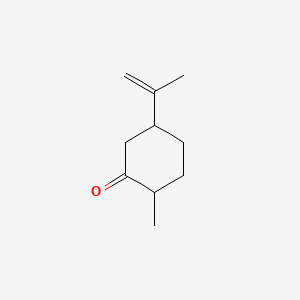
1,6-Dihydrocarvone
Dihydrocarvone is a dihydrocarvone resulting from reduction of the endocyclic cyclohexene double bond. It has a role as a plant metabolite. — ChEBI
- IUPAC name
- 2-methyl-5-prop-1-en-2-ylcyclohexan-1-one
- Molecular formula
- C10H16O
- Molecular weight
- 152.23 g/mol
- Exact mass
- 152.120115130 Da
- XLogP3
- 2.7
- Topological polar surface area
- 17.1 Ų
- Hydrogen-bond donors
- 0
- Hydrogen-bond acceptors
- 1
- Covalent units
- 1
- Defined stereocentres
- 0
Also known as
RefChem:1053509Dihydrocarvone(+)-Dihydrocarvonep-Menth-8-en-2-one2-Methyl-5-(Prop-1-En-2-Yl)Cyclohexan-1-One2-METHYL-5-(1-METHYLETHENYL)CYCLOHEXANONE8-p-Menthen-2-oneCyclohexanone, 2-methyl-5-(1-methylethenyl)-
16 more reported names
p-Menth-8(9)-en-2-oneMenth-8-en-2-one2-Methyl-5-(1-methylvinyl)cyclohexan-1-one5-Isopropenyl-2-methylcyclohexanone2-methyl-5-isopropenylcyclohexanone2-methyl-5-(prop-1-en-2-yl)cyclohexanone5948-04-9EINECS 231-857-0UNII-YQS5CW1O1Ja dihydrocarvonean isodihydrocarvone3-isopropenyl-6-methylcyclohexanoneDihydrocarvone, (+)-YQS5CW1O1J(2S,5R)-2-methyl-5-(1-methylethenyl)-1-cyclohexanoneCyclohexanone, 2-methyl-5-(1-methylethenyl)-, (2R,5R)-rel-
External database identifiers
Retrieved from NIH PubChem on 2026-08-31 by checksum-valid CAS matching. Chemical properties do not replace the regulatory decision on this page.