
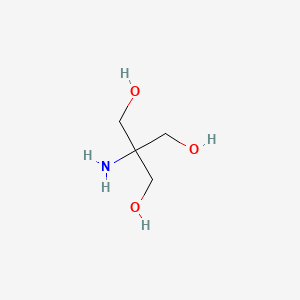
CAS 77-86-1PubChem CID 6503
Tris(hydroxymethyl)aminomethane
Tris is a primary amino compound that is tert-butylamine in which one hydrogen attached to each methyl group is replaced by a hydroxy group. A compound widely used as a biological buffer substance in the pH range 79; pKa = 8.3 at 20 C; pKa = 7.82 at 37 C. It has a role as a buffer. It is a triol and a primary amino compound. It is a conjugate base of a member of Htris. — ChEBI
- IUPAC name
- 2-amino-2-(hydroxymethyl)propane-1,3-diol
- Molecular formula
- C4H11NO3
- Molecular weight
- 121.14 g/mol
- Exact mass
- 121.07389321 Da
- XLogP3
- -2.9
- Topological polar surface area
- 86.7 Ų
- Hydrogen-bond donors
- 4
- Hydrogen-bond acceptors
- 4
- Covalent units
- 1
- Defined stereocentres
- 0
Also known as
TrometamolTROMETHAMINEThamTrisamine2-Amino-2-(hydroxymethyl)-1,3-propanediolTris bufferTromethaneTris-base
16 more reported names
TrisaminolPehanormTalatrolTutofusin trisTris-sterilAddex-tham1,3-Propanediol, 2-amino-2-(hydroxymethyl)-TrispufferTrimethylolaminomethaneTris AminoTris, free baseAminotrimethylolmethaneAminotris(hydroxymethyl)methaneTris(hydroxymethyl)methylamineTHAM-ETris (buffering agent)
External database identifiers
- ChEBI:CHEBI:9754
- ChEMBL:CHEMBL1200391
- EPA DTXSID:DTXSID2023723
- PubMed:23107141
- PubMed:23054718
- PubMed:23037841
- PubMed:23032750
- PubMed:23016141
- PubMed:23016110
- PubMed:23011048
- PubMed:23010469
- PubMed:22990964
- PubMed:22989297
- PubMed:22975122
- PubMed:22945490
Retrieved from NIH PubChem on 2026-08-31 by checksum-valid CAS matching. Chemical properties do not replace the regulatory decision on this page.