
CAS 70-26-8PubChem CID 6262
L-(-)-Ornithine
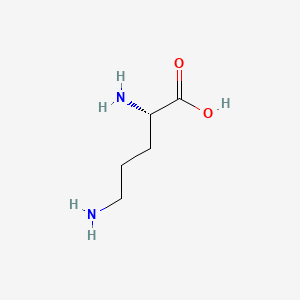
L-ornithine is an optically active form of ornithine having L-configuration. It has a role as a hepatoprotective agent, a mouse metabolite and an algal metabolite. It is an ornithine and a non-proteinogenic L-alpha-amino acid. It is a conjugate base of a L-ornithinium(1+). It is a conjugate acid of a L-ornithinate. It is an enantiomer of a D-ornithine. — ChEBI
- IUPAC name
- (2S)-2,5-diaminopentanoic acid
- Molecular formula
- C5H12N2O2
- Molecular weight
- 132.16 g/mol
- Exact mass
- 132.089877630 Da
- XLogP3
- -4.4
- Topological polar surface area
- 89.3 Ų
- Hydrogen-bond donors
- 3
- Hydrogen-bond acceptors
- 4
- Covalent units
- 1
- Defined stereocentres
- 1
Also known as
L-ornithineornithine(S)-2,5-Diaminopentanoic acid(S)-Ornithine(S)-2,5-diaminovaleric acid(S)-alpha,delta-Diaminovaleric acidOrnitina(+)-S-Ornithine
16 more reported names
Ornithinum(S)-2,5-DiaminopentanoateNSC-758894E524N2IXA3CHEBI:15729CHEBI:18257RefChem:8569232,5 Diaminopentanoic AcidA05BA06(2S)-2,5-diaminopentanoate;hydron200-731-72,5-Diaminopentanoate2,5-Diaminovaleric acidOrnithine [INN]Ornithinum [Latin]Ornitina [Spanish]
External database identifiers
- ChEBI:CHEBI:15729
- ChEMBL:CHEMBL446143
- EPA DTXSID:DTXSID00883219
- PubMed:29968805
- PubMed:23122508
- PubMed:23122502
- PubMed:23116672
- PubMed:23105849
- PubMed:23105814
- PubMed:23082535
- PubMed:23071598
- PubMed:23038227
- PubMed:23031436
- PubMed:23024808
- PubMed:22998630
Retrieved from NIH PubChem on 2026-08-31 by checksum-valid CAS matching. Chemical properties do not replace the regulatory decision on this page.