
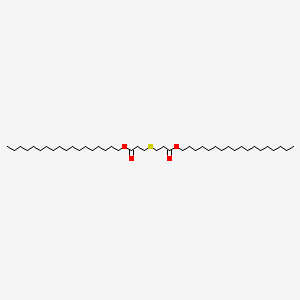
CAS 693-36-7PubChem CID 12738
Distearyl Thiodipropionate
The CIR Expert Panel concludes that Dilauryl Thiodipropionate, Thiodipropionic Acid, Dicetyl Thiodipropionate, Dimyristyl Thiodipropionate, Distearyl Thiodipropionate, and Ditridecyl Thiodipropionate are safe as cosmetic ingredients in the practices of use and concentration given in this safety assessment when formulated to be non-irritating. — Cosmetic Ingredient Review (CIR)
- IUPAC name
- octadecyl 3-(3-octadecoxy-3-oxopropyl)sulfanylpropanoate
- Molecular formula
- C42H82O4S
- Molecular weight
- 683.2 g/mol
- Exact mass
- 682.59338227 Da
- XLogP3
- 18.2
- Topological polar surface area
- 77.9 Ų
- Hydrogen-bond donors
- 0
- Hydrogen-bond acceptors
- 5
- Covalent units
- 1
- Defined stereocentres
- 0
Also known as
Dioctadecyl 3,3'-thiodipropionateDioctadecyl thiodipropionatePlastanox STDPAntioxidant STDPDistearyl 3,3'-thiodipropionateCyanox STDPAdvastab 802DSTDP
16 more reported names
Advastab PS 802Sumilizer TPSIrganox PS 802Arbestab DSTDPLusmit SSSeenox DSYoshinox DSTDPNaugard DSTDPEvanstab 18Hostanox SE 2Hostanox SE 4Varox DSTDPAntage STDP-NThio 1Cyanox-stdpHostanox VP-SE 2
External database identifiers
- EPA DTXSID:DTXSID3027299
- PubMed:20634504
Retrieved from NIH PubChem on 2026-08-31 by checksum-valid CAS matching. Chemical properties do not replace the regulatory decision on this page.