
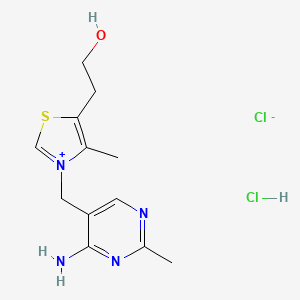
CAS 67-03-8PubChem CID 6202
Thiamine Hydrochloride
Thiamine hydrochloride is a hydrochloride obtained by combining thiamine chloride with one molar equivalent of hydrochloric acid. It has a role as an insect repellent. It is a vitamin B1 and a hydrochloride. It contains a thiamine(2+). — ChEBI
- IUPAC name
- 2-[3-[(4-amino-2-methylpyrimidin-5-yl)methyl]-4-methyl-1,3-thiazol-3-ium-5-yl]ethanol;chloride;hydrochloride
- Molecular formula
- C12H18Cl2N4OS
- Molecular weight
- 337.3 g/mol
- Exact mass
- 336.0578378 Da
- Topological polar surface area
- 104.0 Ų
- Hydrogen-bond donors
- 3
- Hydrogen-bond acceptors
- 6
- Covalent units
- 3
- Defined stereocentres
- 0
Also known as
Thiamine HCLAneurine hydrochlorideVitamin B1 hydrochlorideClotiaminaEskaphenBetalin SThiamine chloride hydrochlorideThiamine dichloride
16 more reported names
BevitineBenervaThiamin chlorideThiaminum hydrochloricumThiamin hydrochlorideBiamineBetabion hydrochlorideFEMA No. 3322Thiamin dichlorideThiaminium chloride hydrochlorideVitamin b(sub 1) hydrochlorideThiamine, monohydrochlorideNSC-36226thymine hydrochlorideThiamini hydrochloridumThiamine chloride, hydrochloride
External database identifiers
- ChEBI:CHEBI:49105
- ChEMBL:CHEMBL1200941
- EPA DTXSID:DTXSID0040622
- PubMed:1215
Retrieved from NIH PubChem on 2026-08-31 by checksum-valid CAS matching. Chemical properties do not replace the regulatory decision on this page.