
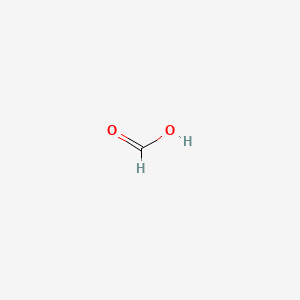
CAS 64-18-6PubChem CID 284
Formic Acid
Formic acid is the simplest carboxylic acid, containing a single carbon. Occurs naturally in various sources including the venom of bee and ant stings, and is a useful organic synthetic reagent. Principally used as a preservative and antibacterial agent in livestock feed. Induces severe metabolic acidosis and ocular injury in human subjects. It has a role as a metabolite, an antibacterial agent, a solvent, a protic solvent and an astringent. It is a conjugate acid of a formate. — ChEBI
- IUPAC name
- formic acid
- Molecular formula
- CH2O2
- Molecular weight
- 46.025 g/mol
- Exact mass
- 46.005479302 Da
- XLogP3
- -0.2
- Topological polar surface area
- 37.3 Ų
- Hydrogen-bond donors
- 1
- Hydrogen-bond acceptors
- 2
- Covalent units
- 1
- Defined stereocentres
- 0
Also known as
Methanoic acidFormylic acidAminic acidBilorinHydrogen carboxylic acidFormisotonFormiraMyrmicyl
16 more reported names
Collo-bueglattCollo-didaxAcide formiqueAdd-FAmeisensaeureC1 acidRCRA waste number U123MierenzuurAcido formicoFormicum acidumKwas metaniowyKyselina mravenciFEMA No. 2487AI3-242370YIW783RG1CHEBI:30751
External database identifiers
- ChEBI:CHEBI:10036
- ChEBI:CHEBI:191874
- ChEBI:CHEBI:232780
- ChEBI:CHEBI:232781
- ChEBI:CHEBI:232866
- ChEBI:CHEBI:232867
- ChEBI:CHEBI:233172
- ChEBI:CHEBI:233467
- ChEBI:CHEBI:233468
- ChEBI:CHEBI:233469
- ChEBI:CHEBI:233757
- ChEBI:CHEBI:234070
- ChEBI:CHEBI:30751
- ChEBI:CHEBI:35748
- ChEBI:CHEBI:36036
- ChEMBL:CHEMBL116736
- EPA DTXSID:DTXSID2024115
- PubMed:23295229
- PubMed:23124456
- PubMed:23124449
- PubMed:23122090
- PubMed:23115171
- PubMed:23105510
- PubMed:23100838
Retrieved from NIH PubChem on 2026-08-31 by checksum-valid CAS matching. Chemical properties do not replace the regulatory decision on this page.